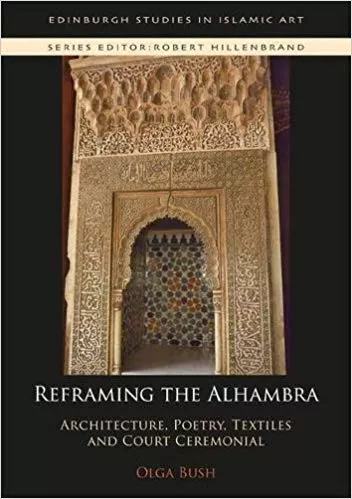
Reframing the Alhambra: Architecture, Poetry, Textiles and Court Ceremonial
Ana Carreño Leyva
Olga Bush
2018, Edinburgh UP, 978-1-47441-650-4, $150 hb.
This volume offers an intriguing interdisciplinary look at the Alhambra, the last Muslim bastion in al-Andalus, built in Granada from the 12th to the 15th century. Although the palace complex has been studied extensively, the author, a visiting scholar of Islamic art and architecture at Vassar College, “reframes” it by addressing not only its famous architecture, but also the poetry carved in its walls, and the textile designs and court ceremonials of the period. She then shows how these media interrelate scientifically, artistically and transcendentally. Most significantly, she explores the application of fractal theory—the replication of a geometric structure where each part is identical to the whole—in the Alhambra, filling out her treatment of a structure that, ultimately, reflects both spirituality and state power.
You may also be interested in...

Anthology Shows Soccer—and Sport—as Our Favorite Muse—Book Review
In Picturing the Beautiful Game, art historian Daniel Haxall shows readers the perspective of the artist’s psyche—one rarely depicted in discussions of sport.
The Two Worlds of Saweda Kamara's Besaydoo: Poems—Our Book Review
Yalie Saweda Kamra's third poetry collection about her experience as a child of African immigrants navigating life in the US and Sierra Leone is both intellectually engaging and emotionally resonant.