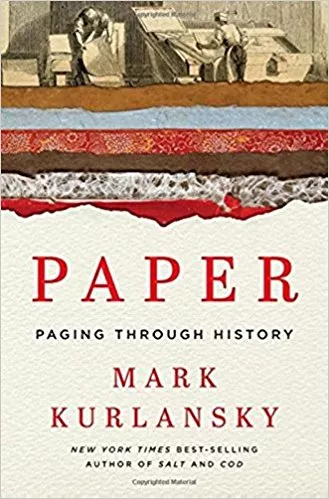
Paper: Paging Through History
Tom Verde
Mark Kurlansky
2016, W. W. Norton, 978-0-39323-961-4, $27.95 hb.
Before the rise of Islam in the seventh century Arabs “had little need for writing material,” writes Kurlansky. Subsequently, “more and more copies of the Holy Book were needed, and each copy had to be made with painstaking accuracy” in beautiful script: “the origin of Arab calligraphy.”
Kurlansky focuses on the importance of paper to scientists, translators and authors of mathematical and medical treatises, and also dwells engagingly on the role paper played in the culinary arts. In addition, he offers colorful details, such as the creation of the first airmail stationary: “special light, thin paper … made for messages sent by carrier pigeon.” This volume offers readers a wealth of information on a material sometimes taken for granted, but which played an enormous role in world history.
Kurlansky focuses on the importance of paper to scientists, translators and authors of mathematical and medical treatises, and also dwells engagingly on the role paper played in the culinary arts. In addition, he offers colorful details, such as the creation of the first airmail stationary: “special light, thin paper … made for messages sent by carrier pigeon.” This volume offers readers a wealth of information on a material sometimes taken for granted, but which played an enormous role in world history.
You may also be interested in...

Memoir Paints World’s Biggest Game as Great Connector—Our Book Review
Tim Bascom transforms a lifetime of playing football across five continents into a meditation on belonging, arguing that the game’s great gift is not the goals but the wordless understanding it creates among people.
A History of Mali’s National Drink Traces Green Tea—Book Review
By tracing ritual instead of commerce, anthropologist Ute Röschenthaler shows that the story of tea in West Africa involves multidirectional routes and local agency.