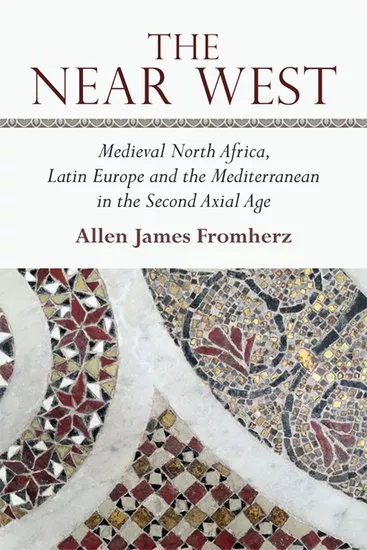
The Near West: Medieval North Africa, Latin Europe and the Mediterranean in the Second Axial Age
Robert W. Lebling
Allen James Fromherz
2016, Edinburgh UP, 978-0-7486-4294-6, $120 hb.
The author argues that North Africa played a key role in the religio-cultural transformation of the Mediterranean region that peaked in the 12th century CE, making the medieval period a pivotal or “axial” era comparable to the mid-first millennium BCE. Fromherz takes a fresh look at a variety of sources, finding—rather than a period of sometimes violent hostility—a fascinating mixing of cultures in art and architecture, music, poetry, medicine and commerce. He builds his case around four cities—Bèjaïa (today’s Bougie, Algeria), Rome, Tunis and Marrakech—and describes North Africa as “a dynamic republic of letters, words and ideas.” In the form of the Berber Almoravid and Almohad dynasties, North Africa was a dominant player in the history of the western Mediterranean, as the strict conservatism of the initial rulers gave way to a more tolerant, cosmopolitan worldview.
You may also be interested in...

Essays on Nile Delta, From Ancient Egypt to Today—Our Book Review
Editor and ancient historian Katherine Blouin asks 18 scholars to address why this crucial region is less visited and studied compared to the rest of Egypt.
Memoir Paints World’s Biggest Game as Great Connector—Our Book Review
Tim Bascom transforms a lifetime of playing football across five continents into a meditation on belonging, arguing that the game’s great gift is not the goals but the wordless understanding it creates among people.