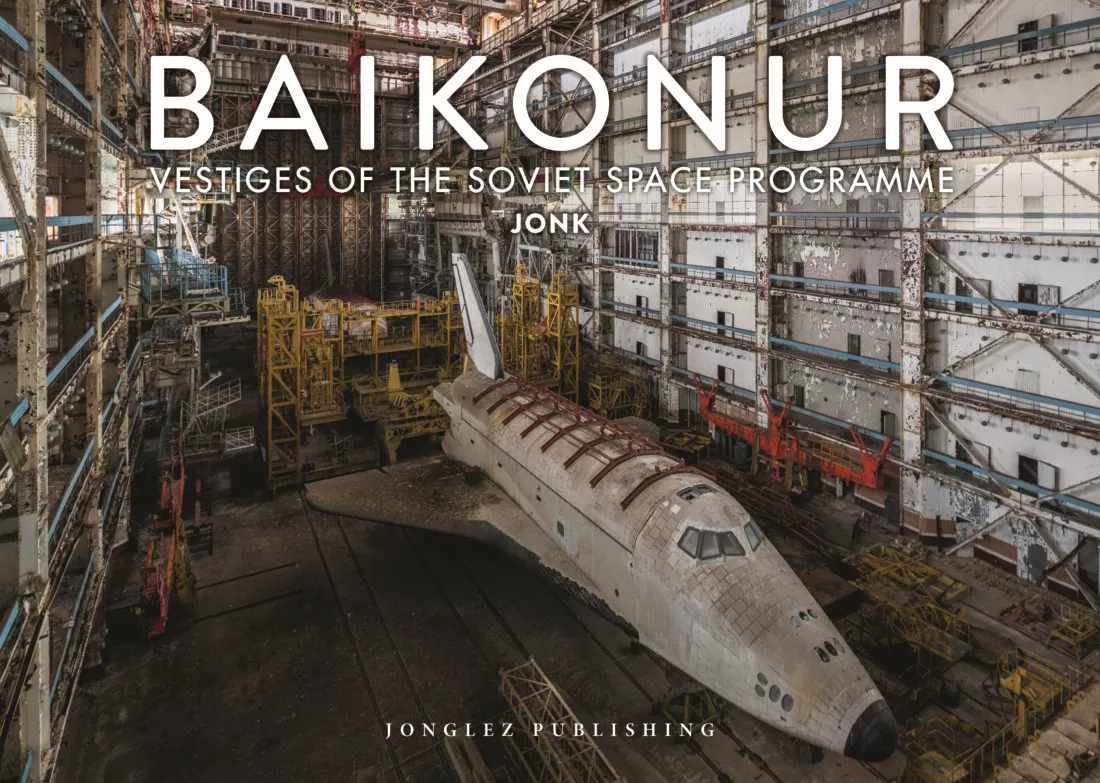
Baikonur: Vestiges of the Soviet Space Programme
Dennis Keen
Jonk
2019, Jonglez Publishing, 978-2-36195-377-5, 39.95 hb.
Secreted away on the silent steppe of southern Kazakhstan, the Baikonur Cosmodrome has played an outsized role in the history of human civilization. This was the earthly departure point for Sputnik, the first artificial satellite; for Yuri Gagarin and Valentina Tereshkova, the first man and woman in space; and for Luna 9, the first spacecraft to land on the moon. The facility, now loaned to the Russian Federation for $115 million a year, is under tight security, yet in 2018 it was infiltrated by photographer Jonathan Jimenez, nom de guerre Jonk, who spent three days shooting derelict Ptichka space shuttles in an abandoned hangar. Jonk’s spectacular images of the space-race relics went viral, and in this volume he supplements his photographic documentation with a suspenseful account of how he and three friends, armed with thermal imaging goggles and 22 kilograms of photo gear, were able to trespass “the world’s most important urban exploration site.”
You may also be interested in...

Author Andrew Collins’ The First Female Pharaoh—Our Book Review
Andrew Collins explores the mythmaking and historical erasure of Egypt’s first female pharaoh.
The Two Worlds of Saweda Kamara's Besaydoo: Poems—Our Book Review
Yalie Saweda Kamra's third poetry collection about her experience as a child of African immigrants navigating life in the US and Sierra Leone is both intellectually engaging and emotionally resonant.