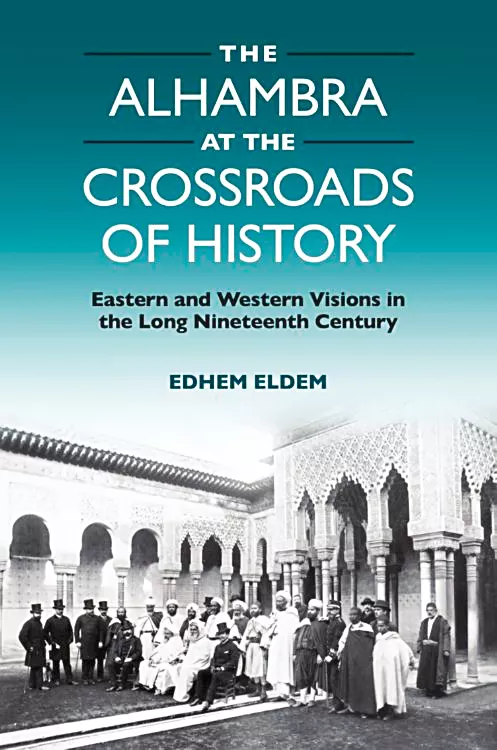
The Alhambra at the Crossroads of History—Our Book Review
Written by Jamie S. Scott
The Alhambra at the Crossroads of History: Eastern and Western Visions in the Long Nineteenth Century.
Edhem Eldem. Edinburgh University Press, 2024.
"The point was not just to document an architectural wonder, but to convey the atmosphere of an edifice in ruins and of the colorful figures who still haunted it."
The Alhambra at the Crossroads of History shows how the 13th-century Andalusi palace complex in Granada, modern Spain, generates often conflicting meanings at the same time—meanings actively constructed and sometimes misread. Edhem Eldem, an Istanbul-based history professor, traces its role in shaping social and cultural identities across imperial Europe, Arab North Africa and Ottoman Türkiye from the 18th to the early 20th centuries. He builds his analysis like a layered confection, drawing on sources ranging from architectural history and travelogue to photographs and diplomatic correspondence. This approach both confirms and unsettles earlier assumptions about the Alhambra’s significance. One resource stands out and disrupts expectations. A multivolume register of visitors started in 1829 but long overlooked by scholars reveals recurring expressions of admiration and dissatisfaction shaped by shared expectations among travelers locally from Europe to the Maghreb of North Africa and farther east to the Levant. Eldem invokes the image of Russian matryoshka dolls to describe these layered reinterpretations. Figures as different as a Moroccan diplomat and a European architect expressed admiration, even as shifting fashions rendered Ottoman observers increasingly indifferent. Then again, Spanish Orientalists reappropriated Andalusian Islamic features copied elsewhere in Europe, while in Istanbul similar structures echoed both the Alhambra and its imitators. In each case, the monument becomes a site where meaning is continually reconfigured through inherited cultural frameworks.