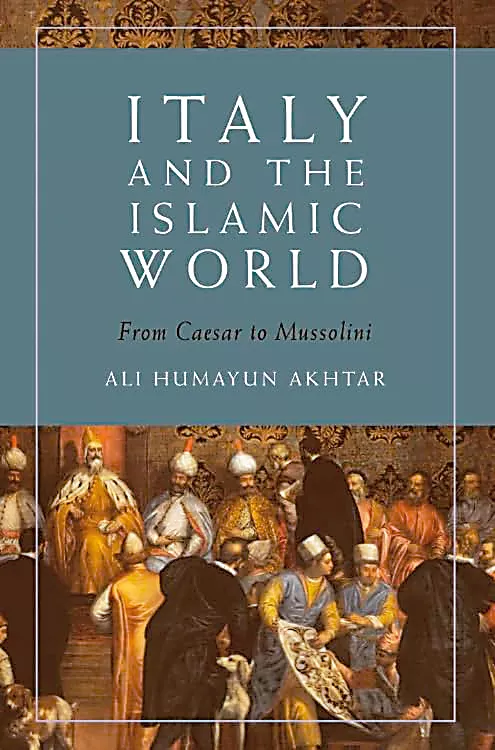
Ali Humayan Akhtar's Italy and the Islamic World—Our Book Review
Christina Riggs
Italy and the Islamic World: From Caesar to Mussolini
Ali Humayun Akhtar. Edinburgh University Press, 2024.
How deeply has Italy’s history been shaped by the Islamic world? That question anchors Ali Humayun Akhtar’s sweeping study, which argues that centuries of exchange across the Mediterranean forged the foundations of modern Europe. Dividing his book by geography and era, Akhtar sails through nearly 2,000 years—from the Roman Empire to World War II—with the ease of the Italian ships that once crossed the “middle sea.” He traces shifting centers of power from Rome to Constantinople (Istanbul) and follows how medieval Sicily and Italy’s coastal regions traded with, or were ruled by, Muslim states. By the 15th century CE, the Italian Renaissance owed much of its brilliance—and the wealth that sustained it—to goods, ideas and expertise arriving from North Africa and southwestern Asia. Glassmaking, gunpowder and rediscovered classical and Arabic texts transformed Italy into a cosmopolitan contact. By situating Italy within its Mediterranean and Islamic contexts, Akhtar powerfully reshapes how we see its past. The second half of the book follows Italian communities in Istanbul; Alexandria, Egypt; and colonial Tripoli, modern-day Libya; and their return to Italy after the 1950s. Their legacy survives through figures like Italian actress Claudia Cardinale, born in Tunis in then French Tunisia, whose fame embodies the intertwined identities Akhtar restores to view. Italy and the Islamic World ultimately reminds readers that Europe’s story was never self-contained—it has always crossed the sea. —Christina Riggs