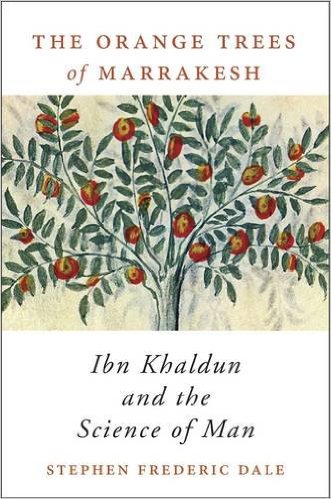
The Orange Trees of Marrakesh: Ibn Khaldun and the Science of Man
Tom Verde
Stephen Frederic Dale
2015, Harvard UP, 978-0-674-96765-6, $29.95 hb.
When the task of chronicling of history turned a major corner in the mid-14th century, Tunis-born Ibn Khaldun was there directing traffic. Taking his cue from the investigative nature of ancient Greek philosophers (Aristotle in particular), Ibn Khaldun reimagined history “as a science, a philosophical discipline . . . able to explain the underlying structures and circumstances that determined trajectories of historical change,” observes scholar Stephen Frederic Dale. As Ibn Khaldun himself put it in his masterpiece, the Muqaddimah, the introduction to his history of the world, he endeavored to examine the “nature of human society and human existence.” This line of thought can be traced to the early modern times, to thinkers like 18th-century Scotland’s Adam Smith, whose Wealth of Nations “represents what Ibn Khaldun would term philosophical history,” or France’s early 20th-century Annales School that “embraced the notion of social causality, nearly identical” to Ibn Khaldun’s own viewpoint. Indeed, few historians and social scientists who followed this great medieval thinker failed to be impacted by his work, as this readable study re-emphasizes.
You may also be interested in...

Anthology Shows Soccer—and Sport—as Our Favorite Muse—Book Review
In Picturing the Beautiful Game, art historian Daniel Haxall shows readers the perspective of the artist’s psyche—one rarely depicted in discussions of sport.
Archaeology and Geology of Ancient Egyptian Stones—Book Review
In categorizing the stones the ancient Egyptians used, author James A. Harrell unites geology, archeology and cultural history in one monumental reference.