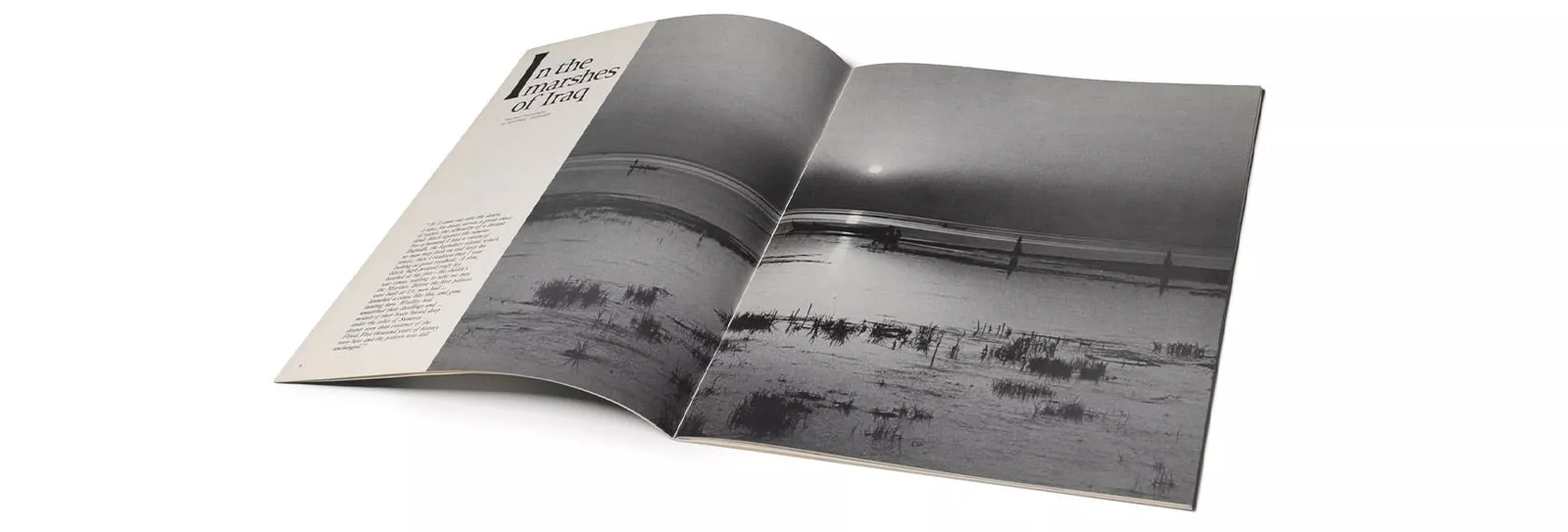
Spotlight on Photography: Discover the Marshes of Iraq in a Visual Story by Wilfred Thesiger
“In the Marshes of Iraq” — November/December 1966
November/December 1966
As we celebrate the 75th anniversary of AramcoWorld this year, we are looking back at some of the memorable and visual story spreads in the magazine. In the past, AramcoWorld has written about the cultural impact of a simple reed hut like those in the marshes of Iraq and built recently in Houston, Texas. That journey really began in 1964, with the publishing of Wilfred Thesiger’s book The Marsh Arabs. His travelogue connected the world to a culture and people few had known or experienced. AramcoWorld amplified that connection in the November/December 1966 issue with the story "In the Marshes of Iraq."
“… then I realized that I was looking at great reedbeds. A slim black, high-prowed craft lay beached at my feet—the sheikh’s war canoe, waiting to take me into the Marshes. Before the first palaces were built at Ur, men had … launched a canoe like this and gone hunting here. … Five thousand years of history were here and the pattern was still unchanged.”
— Wilfred Thesiger, The Marsh Arabs
You may also be interested in...

How to Discover Egypt From the Inside Out
Arts
Rather than just telling travelers where to go, the guidebook Egypt: Inside Out by Trevor Naylor offers an inside-out perspective that evokes the experience of being there, inviting readers to embrace an almost meditative travel discipline of slowing down to take in the details and complexities of Egypt, moment by moment.
Ithra Explores Hijrah in Islam and Prophet Muhammad
History
Arts
Avoiding main roads due to threats to his life, in 622 CE the Prophet Muhammad and his followers escaped north from Makkah to Madinah by riding through the rugged western Arabian Peninsula along path whose precise contours have been traced only recently. Known as the Hijrah, or migration, their eight-day journey became the beginning of the Islamic calendar, and this spring, the exhibition "Hijrah: In the Footsteps of the Prophet," at Ithra in Dhahran, Saudi Arabia, explored the journey itself and its memories-as-story to expand understandings of what the Hijrah has meant both for Muslims and the rest of a the world. "This is a story that addresses universal human themes," says co-curator Idries Trevathan.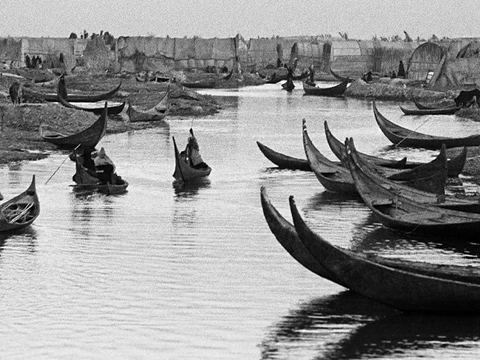
The Lost World Of Southern Iraq's Marsh Arabs
History
Arts
In late 1967, photographer Tor Eigoland traveled for more than: a month, mostly by canoe, among the countless villages of southern Iraq's vast marshes. Now, 45 years later, writer Anthony Sattin calls his photographs a "rare and ethnographic record of a lost world. They bring us back to a time and place where people lived in harmony with their environment and respected the balance the natural world needs to thrive.'