From Leather to Labs: The Science of Football Design
The ball's continually refined materials and construction affect its behavior, quietly reshaping how the game is played.
The football looks simple. It isn’t. Before it was tracked, engineered and analyzed, the ball used to play the game was something far less refined.
Long before embedded microchips and meticulous engineering transformed the game, simple leather construction and hand-stitching defined balls such as that displayed with vintage boots at Beamish Open Air Museum in Durham, England.
In medieval England, where the sport is rooted, a ball was little more than stitched leather packed with moss or cork, or an inflated pig’s bladder wrapped in hide—rarely round and never uniform.
When the modern game began to take form in the 19th century, its laws made no mention of the ball’s size or weight; teams simply agreed among themselves.
Gradually, the ball took on a more standardized circumference of 68-70 centimeters and weight of 410-450 grams, measurements that have remained remarkably stable ever since.
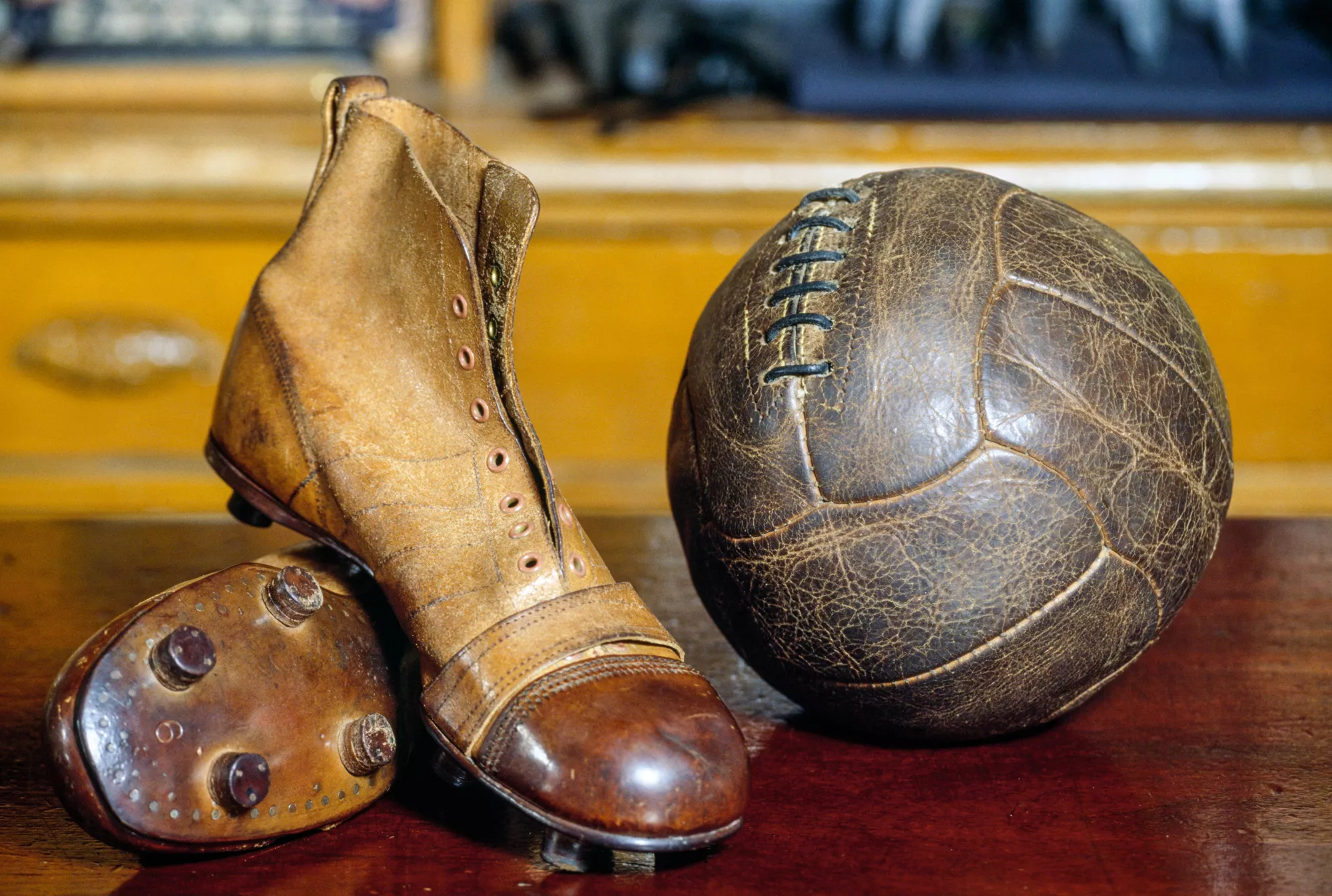
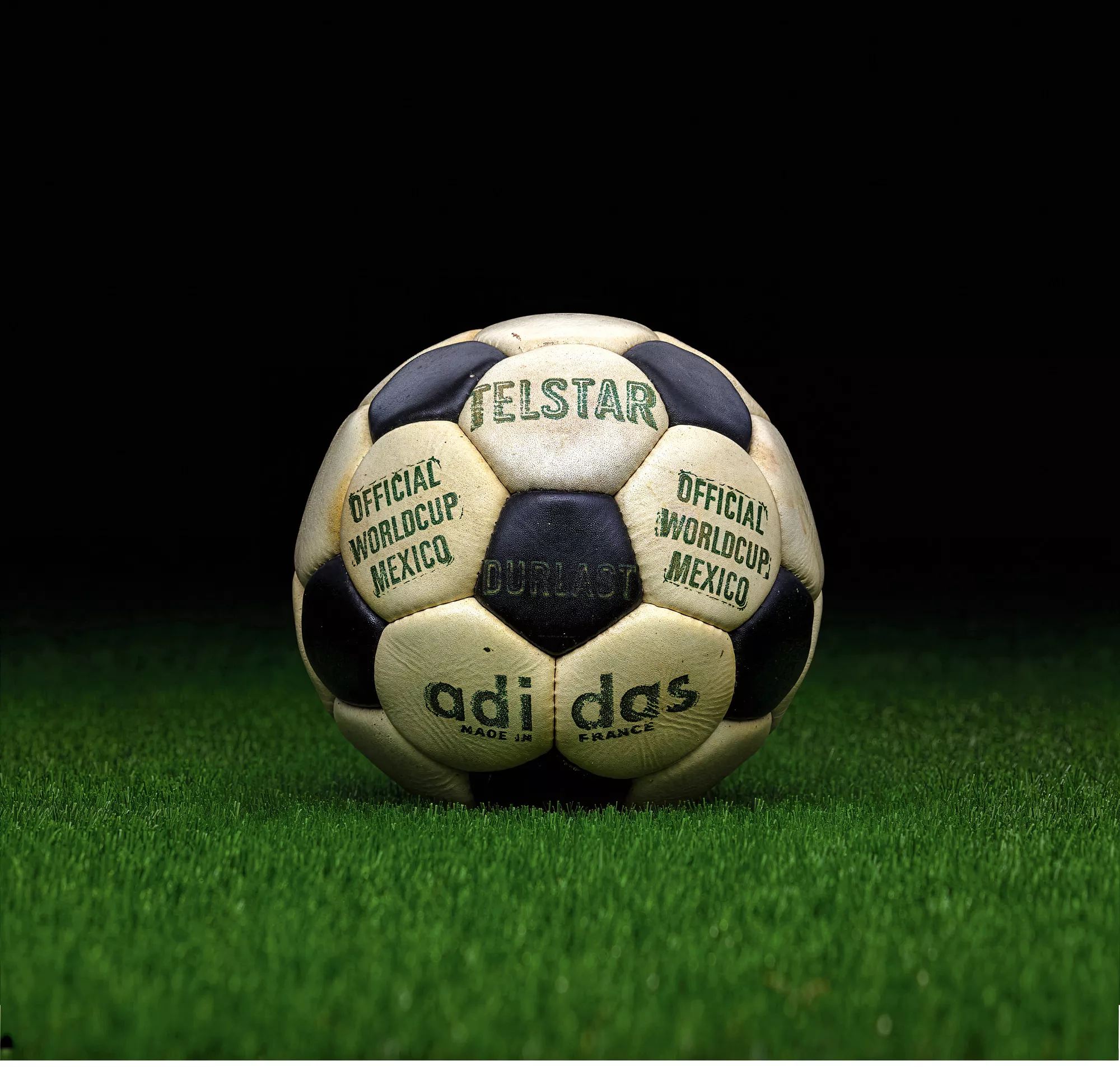
Long before embedded microchips and meticulous engineering transformed the game, simple leather construction and hand-stitching defined balls such as that displayed with vintage boots at Beamish Open Air Museum in Durham, England. Top Adidas produced the first black-and-white ball, called Telstar, for the FIFA World Cup in 1970. Its name—a marriage of “television” and “star”—alluded to how the ball’s contrasting pattern would amplify its visibility on TV.
DEA/S. VANNINI/GETTY Images Top Peter Pesti/Getty Images
Yet while these measurements have remained largely unchanged, the ball itself has continued to evolve. Its materials, construction and behavior have been quietly reshaping how the game is played.
Today’s football is one of the most carefully engineered objects in sport. Its surface, its seams—even the invisible air moving around it—are tested so that refinements can be made. And yet, at its core, the process remains an attempt to solve a problem that still exists.
“We know what a sphere is mathematically,” says sports physicist John Eric Goff. “But physically, making every point exactly the same distance from the center—we’ve never been able to do that.”
In the Factory
Long before it reaches a pitch, the ball begins its life like the pieces of a puzzle.
In Sialkot, a city in northeastern Pakistan that produces 70 percent of the world’s footballs, according to Bloomberg, panels are cut, arranged and joined with a precision that is learned over years. The process is repetitive and exacting, shaped as much by muscle memory as by instruction.
“We stitch the ball inside out so the seams are strong and don’t show,” Sughran Bibi, a senior worker in Sialkot, explains, describing a technique that has changed little since the early 1900s, even as materials have.
Workers pull waxed thread tightly by hand through layers of synthetic material, panel by panel, until the shape begins to emerge. Experience matters, so in some workshops, the final panels are left to the most skilled workers.
“The last part needs more strength,” says Ayesha, another stitcher, who gave just her first name.
Even as manufacturing has modernized, these techniques remain embedded in the work. For many families, the craft is passed down through observation and repetition, without formal training.
From the late 19th century until the 1960s, workers in Pakistan constructed footballs from thick panels of local leather, stitched around a rubber bladder. In wet conditions, they absorbed water, becoming heavier and harder to control.
That began to change with the mass production of modern balls by companies like Nike, Puma, Mitre and Adidas, the latter of which has been creating World Cup tournament balls since 1970. As materials improved and synthetic coatings replaced leather, another, less visible change began to reshape the ball. With manufacturers searching for greater consistency and durability, the way the panels were joined became a new focus.
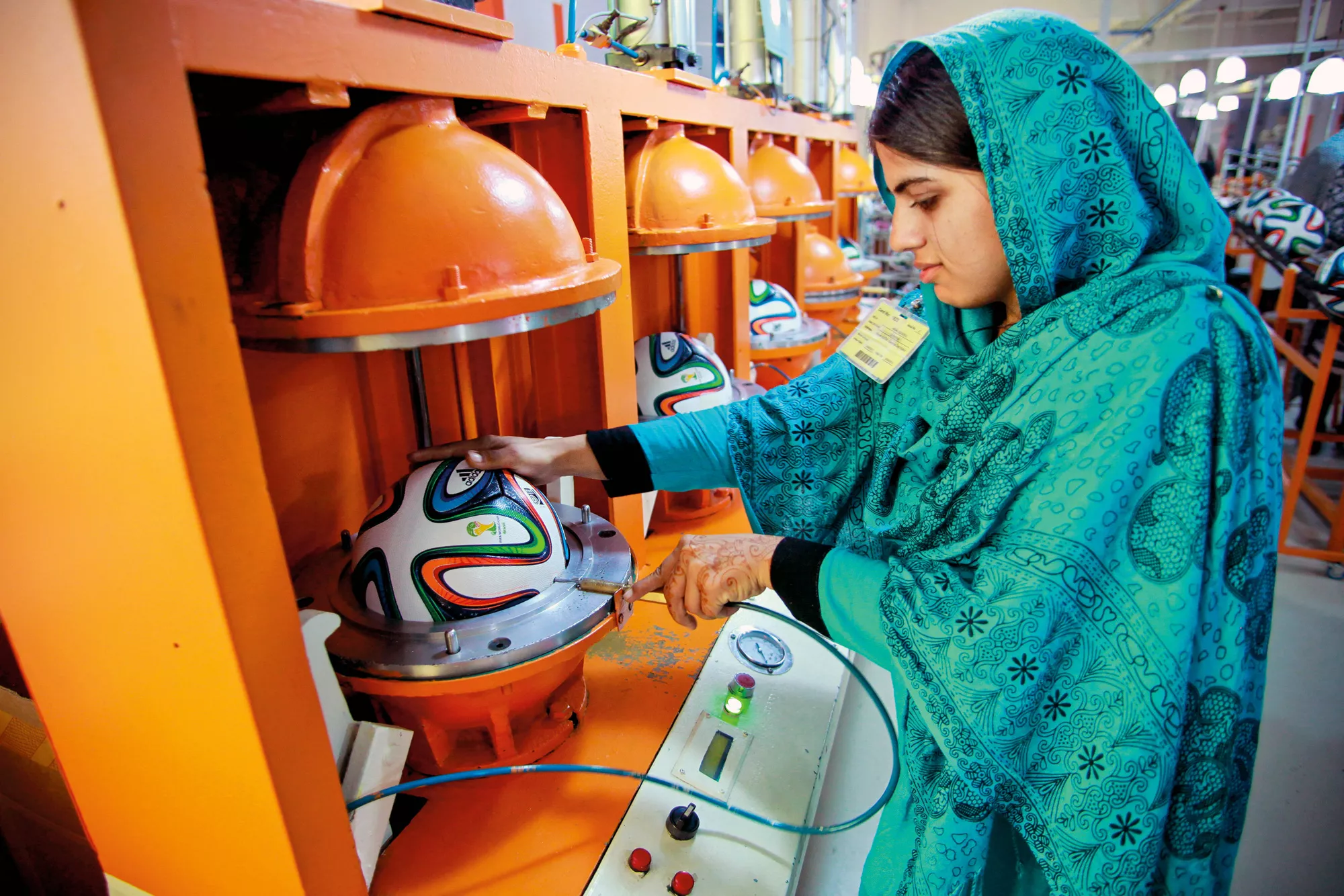
A worker inserts a hose into the valve of an Adidas AG “Brazuca” soccer ball in a thermo- bonding molding machine at the Forward Sports factory in Sialkot, Pakistan.
Asad Zaidi/Bloomberg via Getty Images
Over time, machines introduced consistency, but human expertise remained essential.
That shift led to the development of thermo-bonding, in which heat rather than thread fuses panels, creating a smoother surface and a more uniform structure.
“Thermo-bonding helps keep it dry and consistent,” Goff explains. “Even a little bit of moisture changes how the ball flies and feels.”
That transition was not seamless.
“The biggest challenge was moving away from hand stitching,” says Khawaja Masood Akhtar, CEO of Sialkot-based Forward Sports, one of the world’s leading football manufacturers. It produces 15 million footballs each year, including those for World Cup tournaments. “There were far too many balls being rejected at first. That was our worst time.”
Now he takes pride in the factory’s automation processes being “second to none.”
“We’re using laser-cutting technology. We are using robots. ... Printing has moved to automated machines too. It requires someone to initially feed the design and then step back and let it do its magic,” Akhtar explains.
New materials behaved differently, requiring new processes and skills. Workers who had spent years perfecting one method had to adapt. Over time, machines introduced consistency, but human expertise remained essential.
Shifting Designs
For much of the 20th century, the football settled into a familiar design of 32 stitched panels arranged in pentagons and hexagons. That pattern became iconic with the introduction of the Telstar ball in 1970, named after a communications satellite. Its black-and-white panels were designed for visibility on television sets of that era.
The real story, though, lies not in how the ball looks, but in how it travels.
“The ball that really launched my career was the Jabulani,” Goff says, referring to the official match ball of the 2010 World Cup in South Africa.
Jabulani means “to celebrate” in isiZulu, a Southern Bantu language.
With just eight panels, it marked a dramatic shift away from tradition.
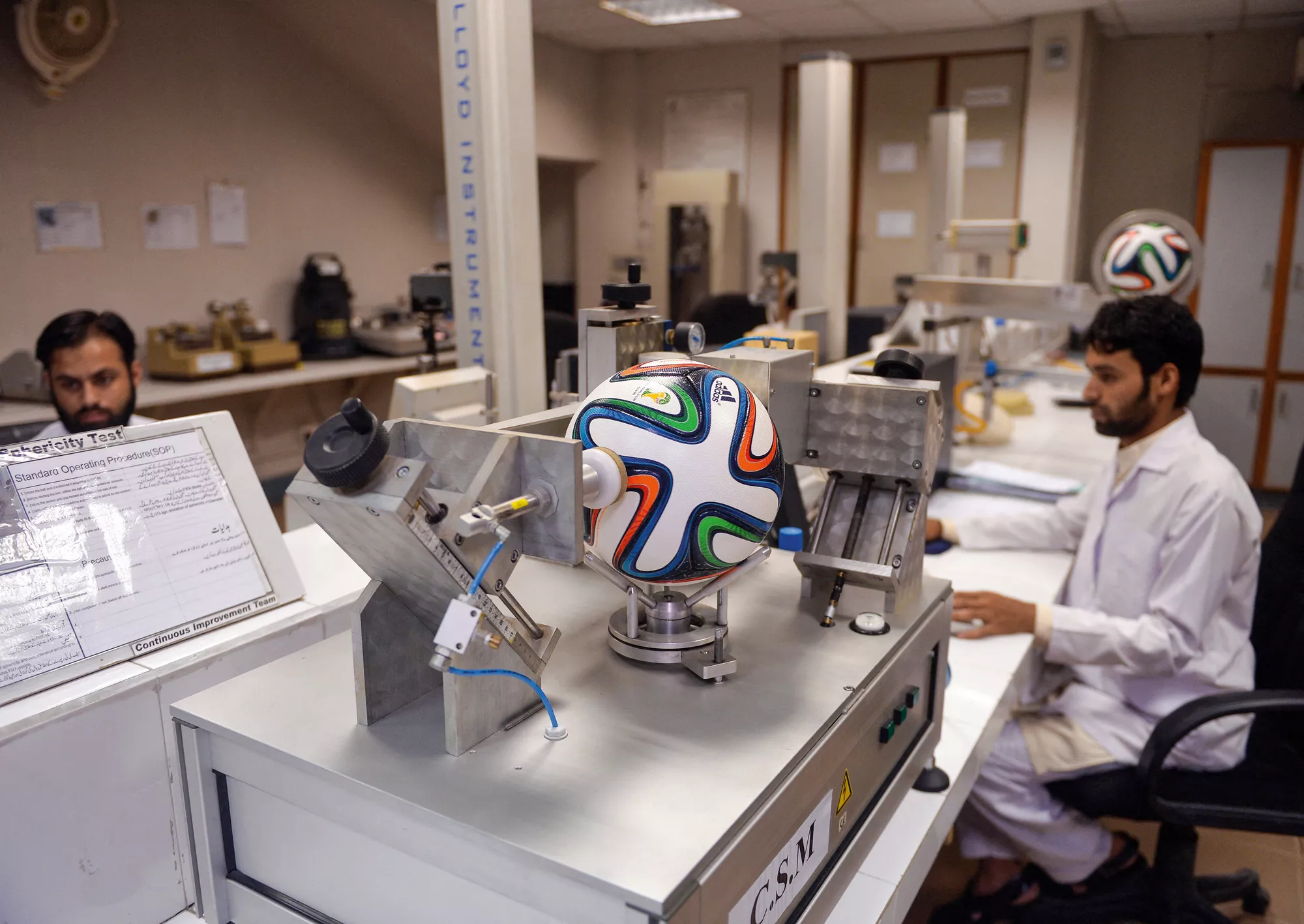
Quality control for newly made footballs, such as this one being made ahead of the 2014 World Cup, include checking their seams and weight.
Aamir QURESHI/AFP via Getty Images
“Now you see goalkeepers parrying more because the ball moves so much in the air.”
Fewer panels meant fewer seams and a smoother surface. That smoothness altered how the ball interacted with the air around it. At certain speeds, airflow around a ball can change suddenly—a phenomenon known as a drag crisis. When that happens, the ball slows and drops more sharply than expected.
“With the Jabulani, that transition happened at the kinds of speeds you see in long kicks,” Goff explains. “So it could suddenly decelerate in a way players weren’t used to.”
For players the effect was immediate.
“It’s almost like hitting a beach ball,” says Mark Overall, a goalkeeping scout who has worked across European and African football. “The ball just keeps moving.”
Overall has seen how these changes have altered the role of the goalkeeper. “When I was growing up, we were taught to catch everything,” he says. “Now you see goalkeepers parrying more because the ball moves so much in the air.
“The modern ball is more aerodynamically refined,” he continues. “Advances in surface texture and construction allow players to generate speed and control more efficiently.”
For outfield players, the differences are just as nuanced.
“The lighter ones can be pinging everywhere,” says Monica Bowley, an English women’s club captain. “Especially when it’s wet—they’re more plasticky, they slide more, and the pace along the ground is much faster.”
By contrast, more textured balls behave differently. “They’ve got more grip,” she explains. “They take a bit of speed off, so you can feel the pass better.”
These are small differences, she says, but they have a cumulative effect. Surface texture, material, even the type of pitch all influence how the ball moves and how players interpret it.
“It depends on the [playing] surface as well,” Bowley adds. “On a third-generation pitch [artificial grass], it can just float across, but on grass it might bobble or slow down.”
The ball is always in conversation with its environment.
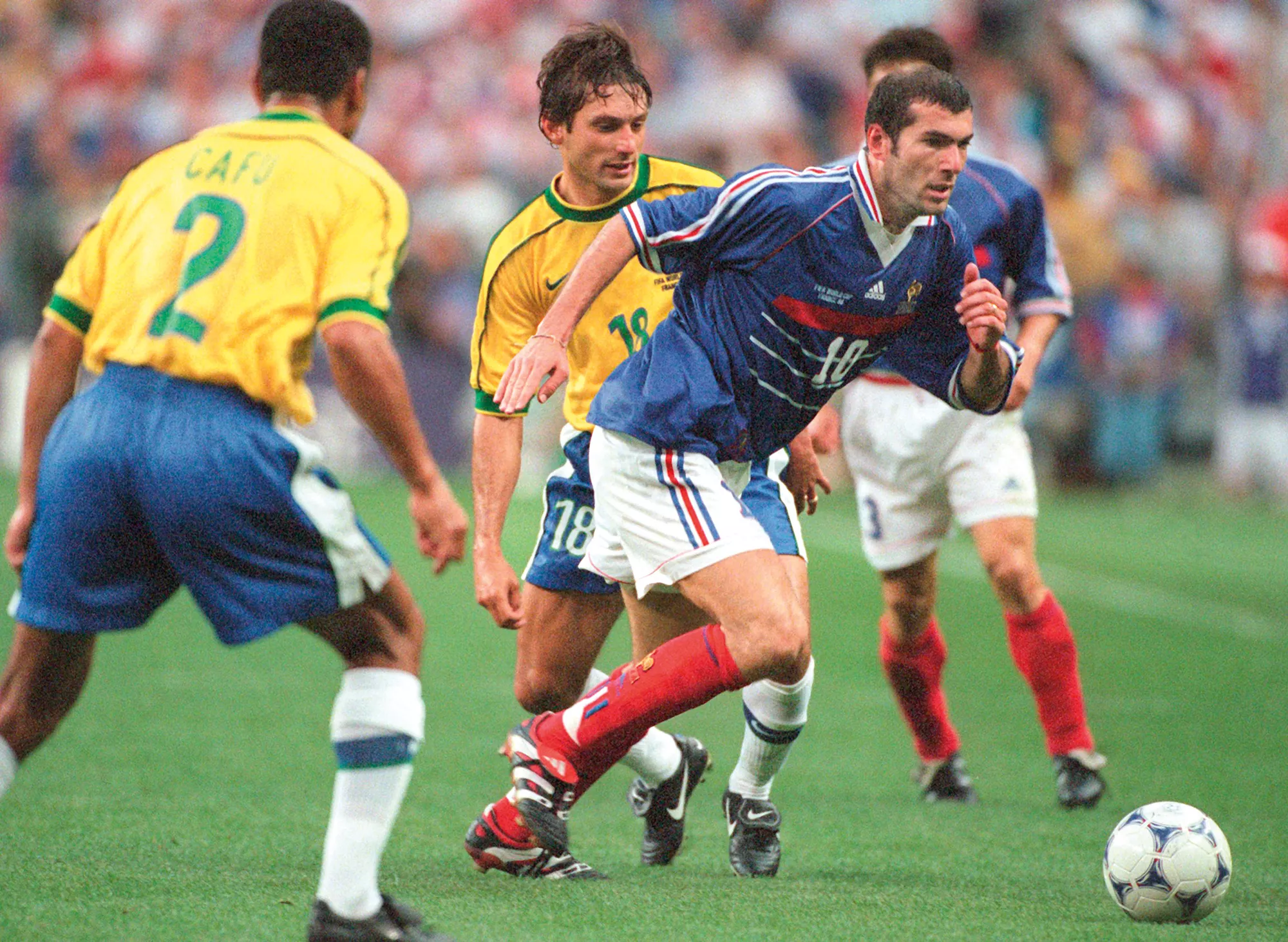
French midfielder Zinedine Zidane, right, dribbles the ball featuring colors—a first for the World Cup—around Brazilian defender Cafu (2), left, and midfielder Leonardo Araújo during the 1998 final in France. Recent generations of balls introduced more surface texture to stabilize airflow.
Oliver Berg/Picture Alliance via Getty Images
Beyond the Panel
In recent years, designers have pushed panel numbers down ever lower—from 32 to eight, then six, and now as few as four on the Trionda, this year’s World Cup ball.
At first glance, this suggests a smoother, less stable ball. But advances in surface engineering have compensated for that. Grooves, textures and seam placement now play a more significant role than panel count alone.
“The goal is consistency,” Goff says. “Players want the ball to behave in ways they expect.”
That consistency is not just a technical objective but also a response to experience. When a ball behaves unpredictably, it disrupts the rhythm of the game. Modern designs aim to avoid that. After the Jabulani, subsequent balls introduced more surface texture to stabilize airflow. The changes are subtle, but at the highest level, subtlety matters.
“Elite players can detect these differences immediately,” Goff says. “We’re nearing limits in terms of panel reduction—you can’t go below one panel. But there’s still room to adjust aerodynamics through surface design.”
Ultimately, any major change would need to be driven by players, fans and governing bodies.
“[Manufacturers] can only go so far,” Overall notes. “You can’t keep making it lighter forever. At some point, the game decides what it should be.”
But upgraded technology introduced by Adidas is going to impact the ball beyond its flight and movement.
The Trionda contains an embedded sensor within a panel, as opposed to the center, that tracks movement and transmits data in real time. These systems can detect the exact moment the ball is struck, providing officials with precise information to support decisions such as offside calls.
“There’s still room to adjust aerodynamics through surface design.”
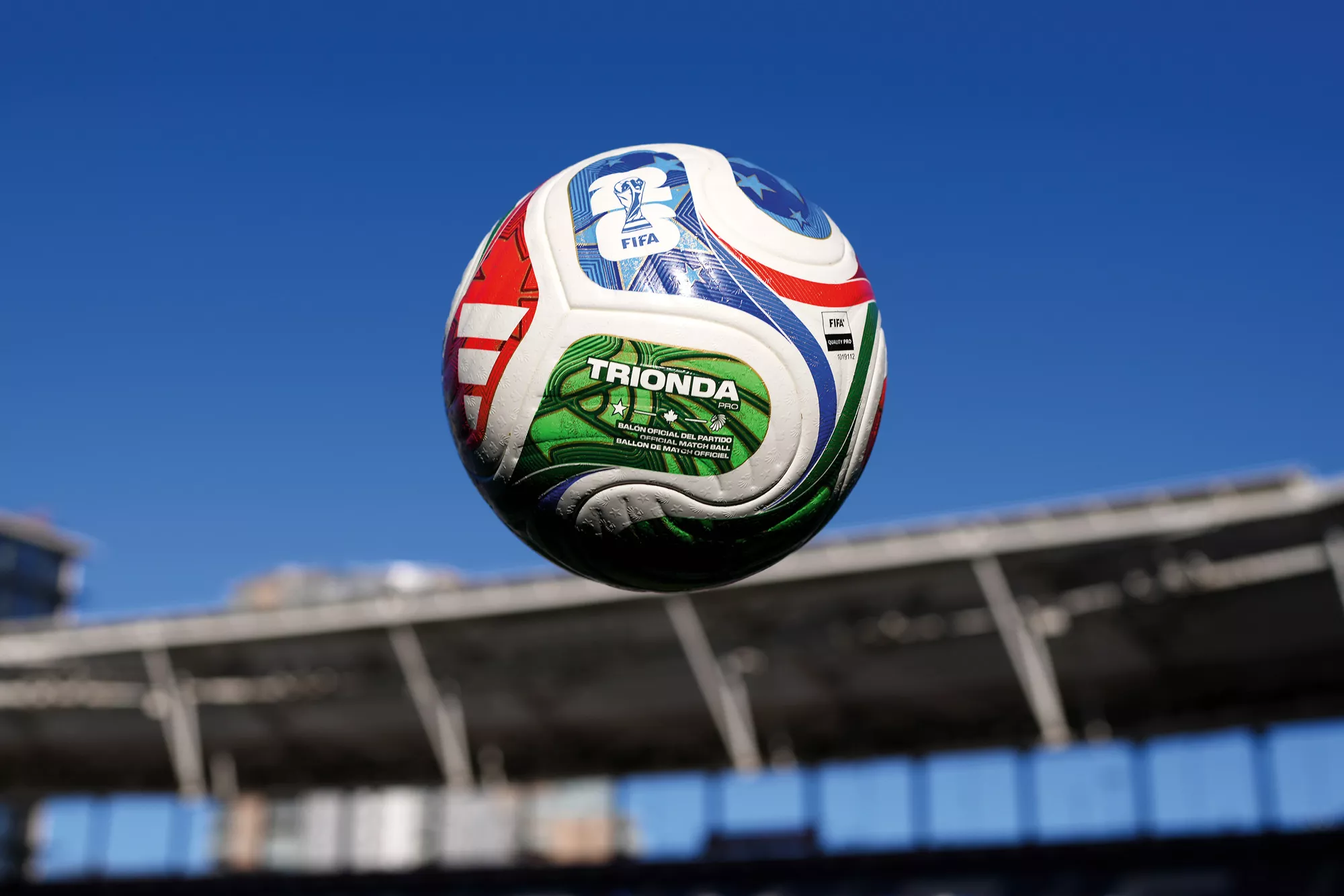
The official match ball of 2026, the Trionda—which in Spanish means “three waves”—honors the first World Cup ever to be hosted by three nations.
Claudio Villa/FIGC/FIGC via Getty Images
“It’s sending out a signal 500 times a second,” Goff says.
At only a couple of grams, the microchip is barely detectable, he adds. The ball still looks the same, but it now carries information as well as motion.
From workshops and factories, the ball travels across continents—kicked on local pitches and training grounds, and in the world’s largest stadiums. By then, it has passed through many hands and many ideas: shaped by craft, refined by engineering, tested by science and interpreted by players.
It is, in the end, still an imperfect object, one that has never been made entirely uniform—and perhaps never will be. For those who made it, that journey remains both distant and personal.
“When we see the ball on TV, it gives us immense pleasure,” Bibi says. “We know it started in our hands.”
More From AramcoWorld
Football, Food and the Taste of Home

You may also be interested in...
Għana Folk Music Helping to Keep Maltese Language Alive
Culture
Ghana, Malta's poetic folk music tradition, is in harmony with a reinvigorated sense of national pride—and is helping to protect the Maltese language.
Football's Other Score: World Cup Music Unites Fans Around the World
Culture
The collaborative nature of World Cup songs reflects the global scale of the tournament itself.
Threads of Memory at the Venice Biennale
Arts
History
Culture
At the Venice Biennale, which runs through November 22, 2026, the Moroccan, French and Saudi national pavilions show how craft and shared memory can resist cultural erasure.