Kabsa: From the Arabian Gulf to the World's Table
Everything in the pot arrived from somewhere else. Now kabsa, aka machboos, is going the other way, carried by chefs, by restaurant kitchens abroad and by one Saudi family who won't travel without it.
Written by Homara Choudhary, Photographed by Bader Awwad AlBalawi
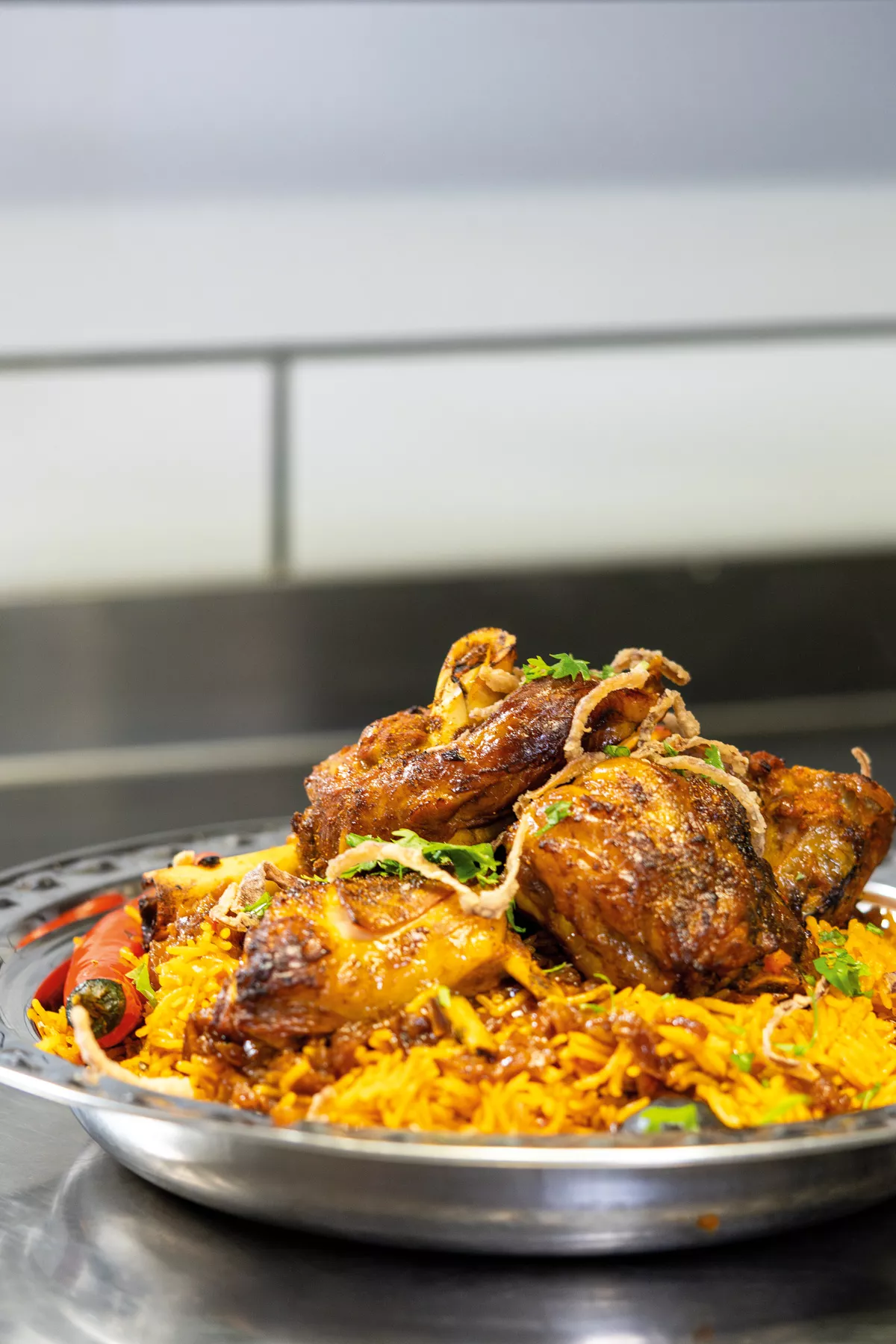
Lamb kabsa is ready to be served in Dammam, Saudi Arabia. Also known as machboos, the dish symbolizes Arabian Gulf hospitality.
On their first day in a vacation rental house near Paris, Intessar AlMumen unpacks a suitcase she filled at home in Dammam, on Saudi Arabia's Gulf coast: tomato paste, spices and rice, including Hasawi, the brown grain grown only around Al-Ahsa in eastern Saudi Arabia. Kabsa was never on the itinerary, but it is always on the family menu—even in one of the world's premier culinary capitals.
Her son Abdulhadi had the same instinct as a student in the United States, where he and his brother Hassan turned what they had learned from their mother into a dorm side hustle, selling the dish to classmates. "Every time they came to my place, they would insist and say, 'Make kabsa, make kabsa, make kabsa,'" he recalls.
Today the meat-and-rice dish is making its way to other palates. It is cooked and enjoyed well beyond the place it originated—the Arabian Peninsula—in restaurants from London to Paris, and from Philadelphia to San Diego in the United States. The world is full of comfort food built on meat and rice. What carries kabsa beyond the region is everything else in the pot, a record of trade routes that reached Arabia long before the dish existed, and a way of serving it that makes the single shared platter the whole point.
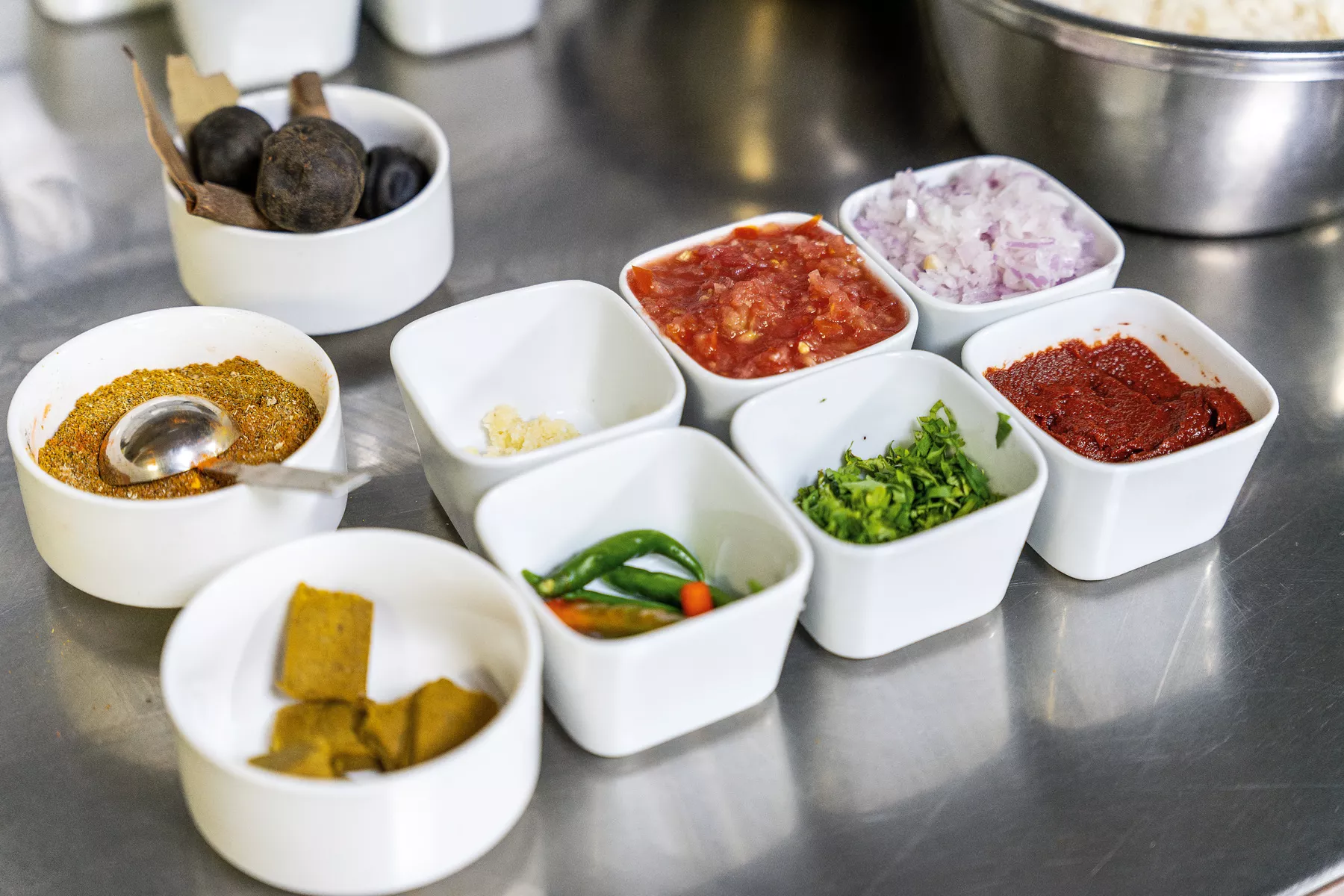
Ingredients typically include onions, crushed tomatoes, minced garlic, tomato paste, peppers, bay leaves, lūmī (dried lime), cinnamon, chicken or lamb broth, mixed spices and parsley for garnish.
What Is Kabsa?
Also known as machboos across the Arabian Gulf, kabsa is rice and meat cooked in one pot with tomato paste, aromatics and a blend of spices and brought to the table on a single sharing platter. Muhammad Tahlawi, a Saudi author and historian, calls it the national dish of every Gulf state, eaten once or twice a week in most homes. It is everyday food, he says, and also an expression of love and of welcome. A guest who is served it understands that.
As restaurant kitchens in the Gulf and abroad offer kabsa on their menus, it is becoming further ingrained as a symbol of the hospitality for which the region is known.
Desert Rose Cafe, inside the National Museum of Qatar, is part of that shift. Its chef, Noof Al Marri, has spent recent years serving machboos, on the same site as the collections, to an international audience of visitors who have come to see the country.
"My journey began at home, where I learned traditional Qatari cooking from my mother and grandmother," Al Marri says. "They taught me that every recipe carries a story and every meal is an expression of hospitality." Serving machboos today, she says, is her way of "honoring our heritage while presenting it in a way that today's diners can appreciate and enjoy."
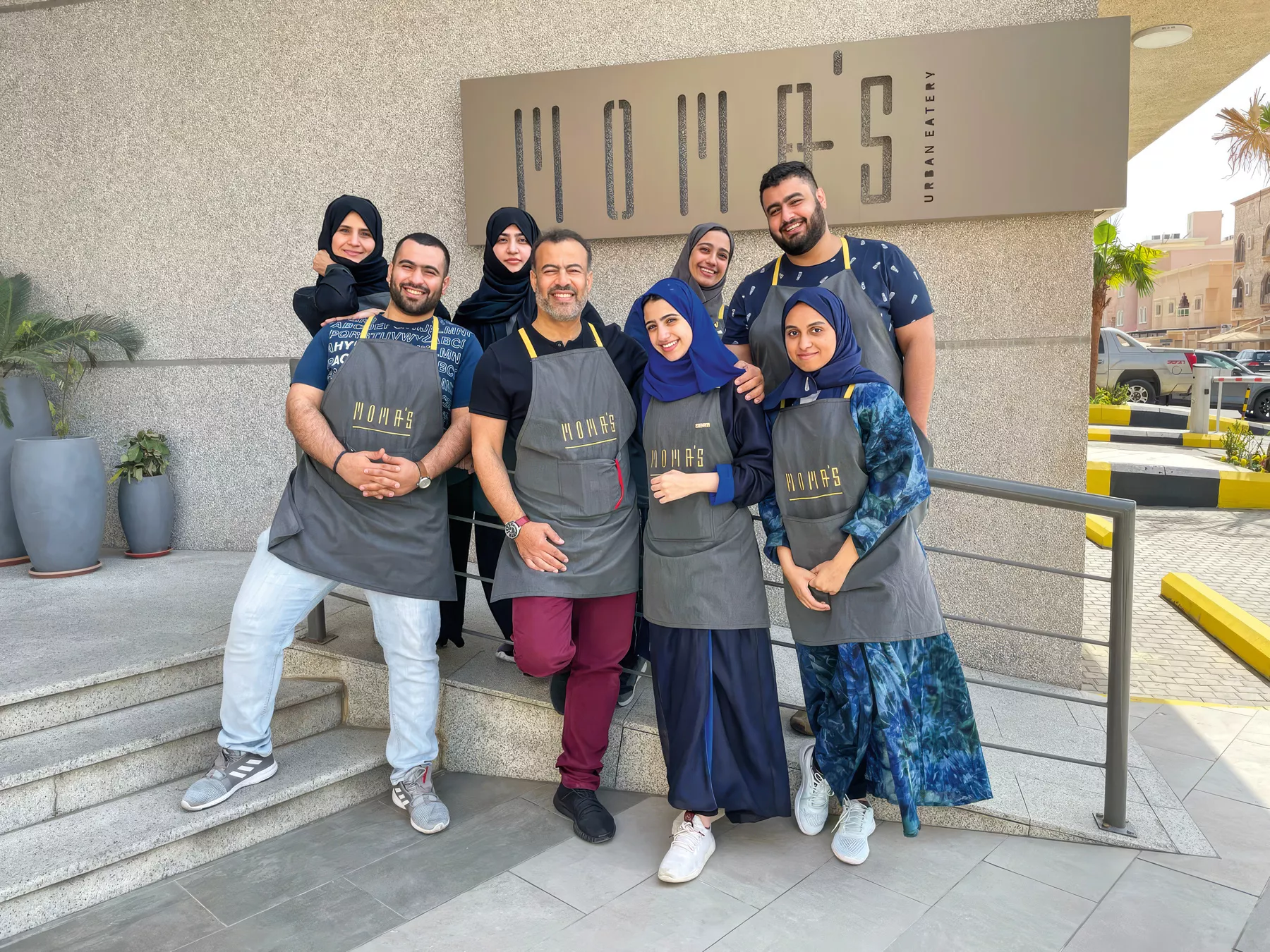
Intessar AlMumen, rear left, runs Moma’s Urban Eatery with her sons, including Abdulhadi AlMumen, rear right.
COURTESY OF ABDULHADI ALMUMEN
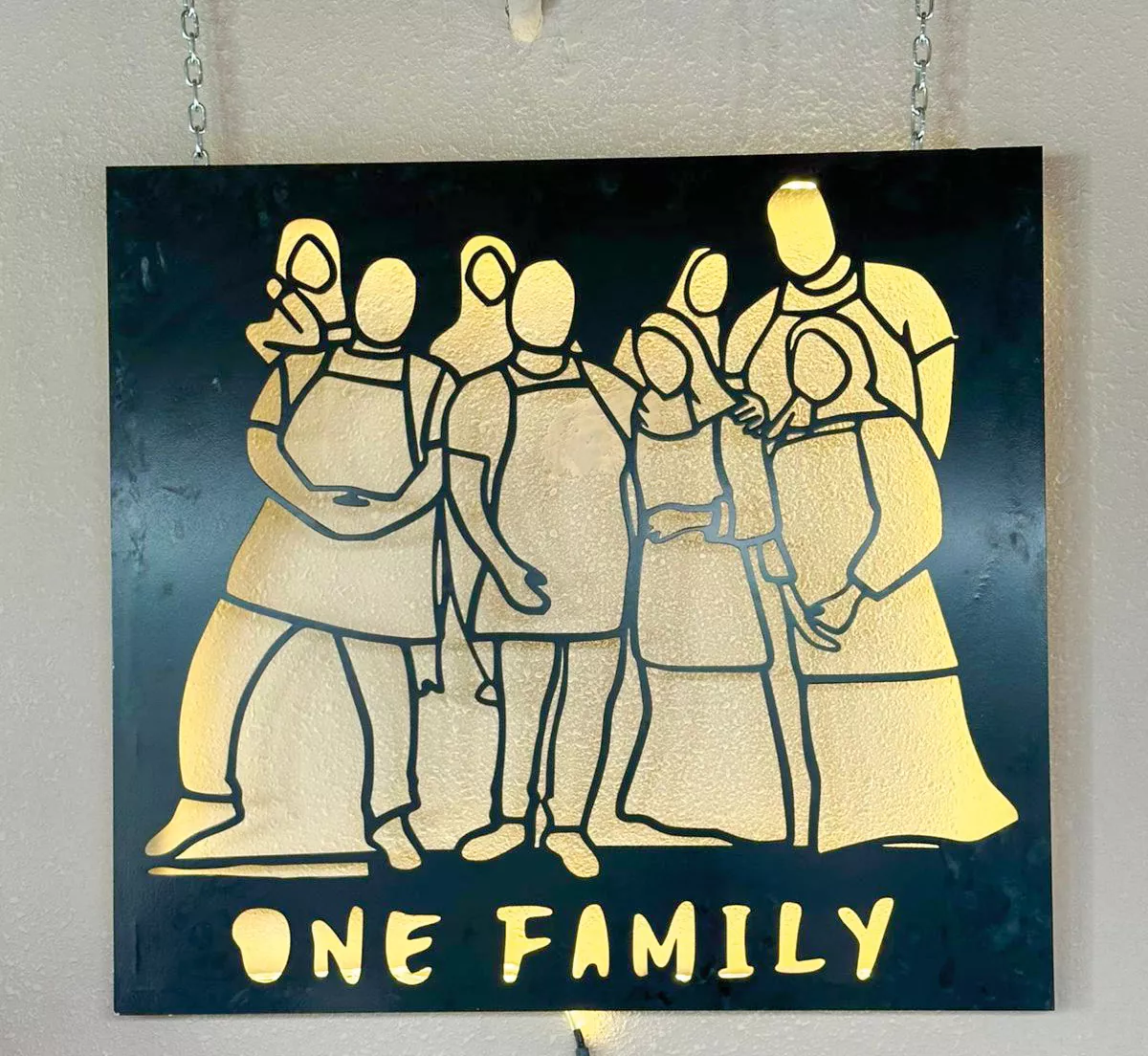
A sign at the restaurant mimics an AlMumen family photo.
But she will not give up the core of it: "While innovation is important, I believe we must protect the authentic flavors, family recipes and cultural values that make our cuisine unique." What has changed, she notes, is how it is interpreted abroad. "Machboos is no longer seen as simply a rice dish. It is becoming recognized as a symbol of Qatar's culture and hospitality."
That hospitality is practiced and taught, and outsiders often mistake it for something innate, according to Astrid Kensinger of VCUarts Qatar, the Education City campus of the US's Virginia Commonwealth University School of the Arts. There she runs its Intangible Lab, which studies what a culture passes on without writing down.
She does not dispute the size of the gesture: "Machboos is never something you serve as a single plate for a single person; it is a community engagement. It is huge. It's this monster plate of generosity."
Tahlawi, who spent 25 years at Saudi Aramco and keeps a study full of cookbooks, dates changes that led to the dish to about 300 years ago, and the decisive step, rice and meat cooked together in one pot, to roughly a century ago. Kabsa is younger than a good deal of what is served beside it.

Saudi author and historian Muhammad Tahlawi calls kabsa the national dish of every Gulf state.
COURTESY OF MUHAMMAD TAHLAWI
Where Did Kabsa Ingredients Come From?
Almost nothing in the pot is native to Arabia. "Spices like cinnamon, mace, fenugreek, cumin, cardamom—none of those grow in the Arabian Peninsula," Kensinger says. Frankincense is the exception. Everything else arrived by sea.
Cinnamon is the one to which she keeps returning. "By looking at this one single spice, cinnamon, you have an epic tale of power, domination, imperialism, colonization, money," she says. True cinnamon grows nowhere but Sri Lanka. Cooking with any of it, in her reading, is an enormous act: "By having machboos, you are eating these trade routes. You're consuming hundreds of years of networks; you are what you eat."
Al Marri echoes the idea for her country in particular. "Machboos reflects Qatar's history as a trading nation," she says.
Tahlawi traces three routes by which the world reached the peninsula: "The first is the pilgrimage to Makkah and Madinah, which for 14 or 15 centuries has brought people from everywhere, carrying their cooking with them. The second is [Saudi Arabia's] Eastern Province, trading across the water with Persia, India and as far as Zanzibar. The third is the peninsula's position on the silk and spice routes."
The spices themselves, he says, came from India, Sri Lanka, East Africa and as far as Canton, aka Guangzhou, China. The pilgrimage route he describes has been running since the seventh century CE. The sea and caravan routes are older, 2,000 or 3,000 years by his reckoning.
Lūmī carries its route in its name. Persians call it limoo amani, "the Omani lime." Iraqis call it nūmī basra, "the Basra lime." It is made by leaving limes in the sun until their water has evaporated, a technique that came from people moving herds across the country with no way to keep food cold. It is still produced around Karbala in Iraq and Muscat in Oman.
The tomato is by far the newest ingredient. The New World plant, unknown anywhere in Asia, Africa or Europe before the 16th century, reached the Arab world later still. Tahlawi traces its arrival to Aleppo, modern-day Syria, where John Barker, the British consul from 1799 to 1825, encouraged local cultivation. From there it spread by trade and by pilgrimage. The base Intessar AlMumen builds in a Paris kitchen could not have been made in Arabia before the 19th century.
How Rice Arrived in Arabia
Rice is newer than most of the spices. Before it, wheat fed the peninsula. Tahlawi lists what people ate instead: margoog, gursan, mataziz—all made from flour worked into small breads and cooked in a stew with meat and vegetables. Those were the dishes you set in front of a guest you wanted to honor.
Then, he says, a severe drought hit central Arabia. Harvests failed. Families from the Najd went north to Iraq and the Levant looking for work. One of them reached Zubair, near Basra, and wrote home. The letter, which Tahlawi dates to around 1750, describes a food the man had never seen before, something the locals called timmin. It was rice. Wheat held on for another century and a half. British colonial trade in the late 19th and early 20th centuries moved rice out of the Indian subcontinent in bulk to be sold through Iraq across the Gulf.
"First rice and meat were cooked separately," Tahlawi explains. "Then someone thought to cook the rice in the stock the meat had been boiled in. Then the meat was roasted apart and laid on top of the rice at the end. Finally, the meat was cooked with the rice, in one pot."
That last step is kabsa, and it stopped there. What came after was not more evolution but variation, region by region and household by household. Chicken, he adds, arrived later and took the limelight.
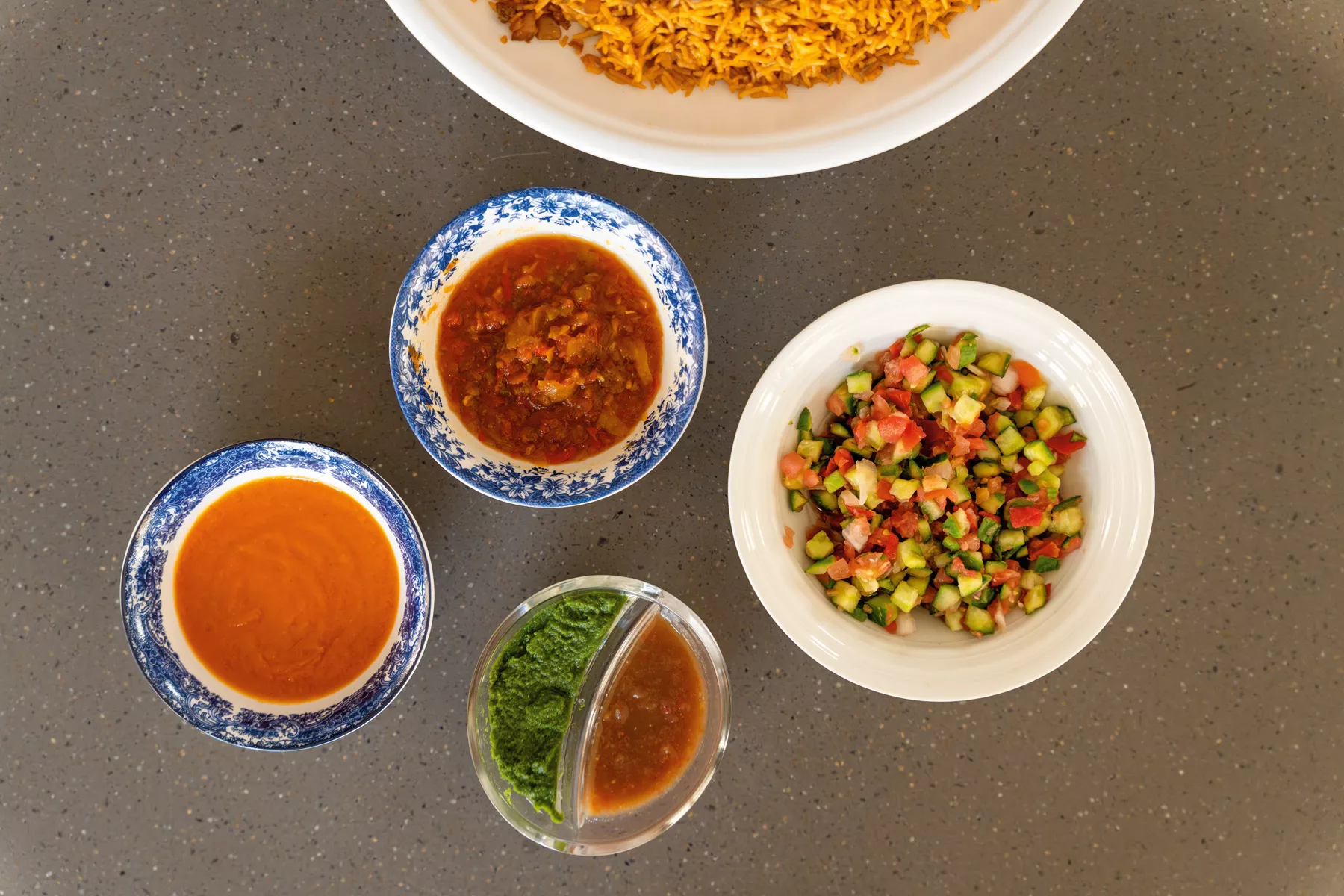
Various sauces including daqous, a sharp tomato salsa, are served with kabsa.
WALEED DASHASH
Making Kabsa
The name tells you how the dish is made. Kabs means "to press" or "to squeeze"; in cooking, Tahlawi says, it means to put something on top of something and press it down. Meat and stock go in first, rice goes above, and the lid stays shut.
Traditionally in the Gulf, the rice is long grain, and it drinks up the broth. The meat is usually lamb or chicken, sometimes camel. On the Gulf coast, it can be hamour (grouper), kingfish or shrimp, and lately squid. Beef is almost never used. Onions are fried in ghee or butter. Tomato colors the base. Saffron and turmeric do the same job in different households. And lūmī gives kabsa its sourness and most of its aroma.
Tahlawi is particular about the spices. "You use solid spices," he says. "You don't use ground spices because it gives a bitter taste." The meat is boiled with them, then lifted out, and the stock is strained until it runs clear before the rice goes anywhere near it.
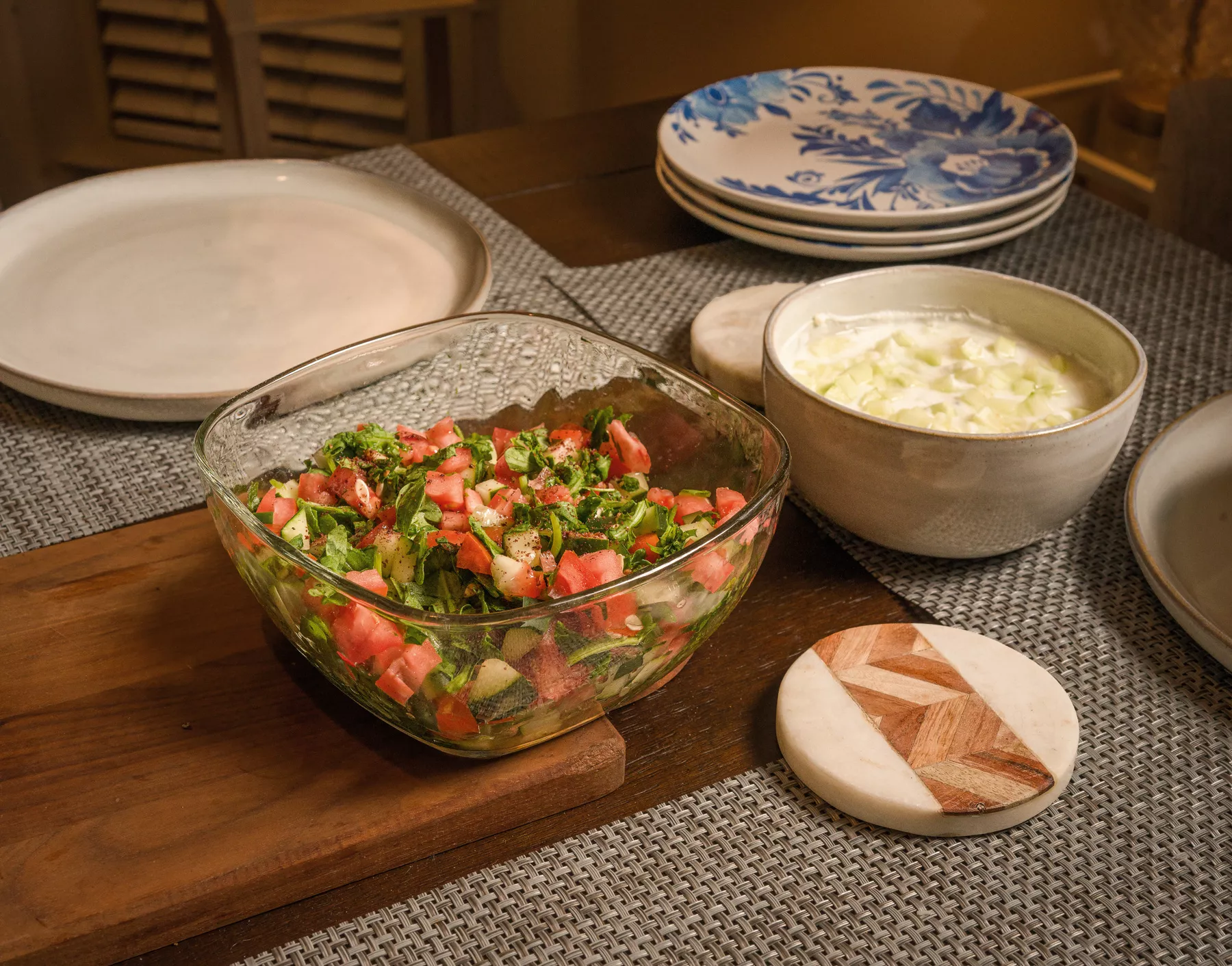
Traditional green salad and cucumber-yogurt salad are common side dishes.
WALEED DASHASH
Fried onions, toasted almonds or pine nuts and raisins go on at the end. Those, he says, are gift wrapping: "They do not actually change the way you cooked the dish."
Intessar AlMumen would not concede that the last additions are only decoration. A former schoolteacher with a degree in Arabic literature, she now runs a restaurant with her sons, and her husband, Abdulfattah, translates for her.
The onions must be chopped by hand, never by machine, she says, so the juice stays inside them, and cut to a size that caramelizes rather than collapses. She wants onions grown in Saudi Arabia because they carry less water than the rest. Her spice mix is not bought off a shelf either. One woman blends it for her, and she asks for it lighter on the cumin so the other spices come through.
The butter matters just as much. She melts it, waits for the salted solids to settle and lifts that base into the tomato. "This is one of their secrets," her husband says. "Not many people do that."
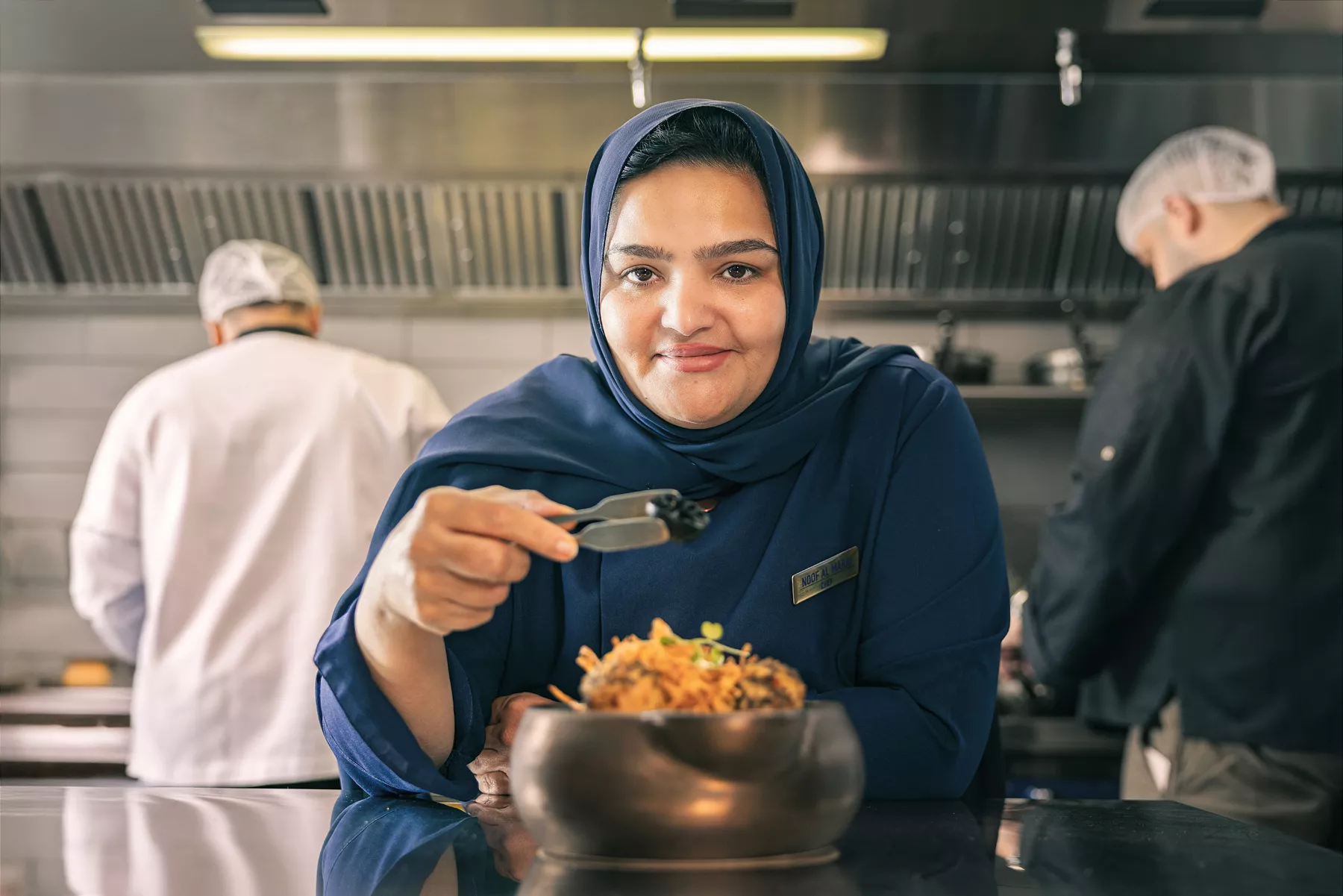
Chef Noof Al Marri keeps machboos on the menu of the Desert Rose Cafe in the National Museum of Qatar.
“Machboos is no longer seen as simply a rice dish. It is becoming recognized as a symbol of Qatar’s culture and hospitality.”
Who Owns Kabsa?
Kensinger sees ownership in intimate terms. In separate research on the desert truffle, three of her participants named machboos, unprompted, as their comfort food. "It's the food that makes many people think of Grandma," she says. "It makes them feel the comfort of home."
And every version is signed. "You can identify a grandmother by the spice of the food you're eating," she says, "because it will smell like the grandmother."
The region's cuisine, in Tahlawi's view, remains less familiar abroad than, say, the hummus and falafel of its neighbors in the Levant and Egypt, where many culinary historians agree those foods originated.
He is not troubled by other countries cooking the Gulf's dishes, namely kabsa. To settle the question of ownership, he reaches for a tailor. A suit can be double-breasted or single, three buttons or two. "But nobody on Earth can claim that they have started or launched suits," he says. "I don't think anybody should have the right to define it."
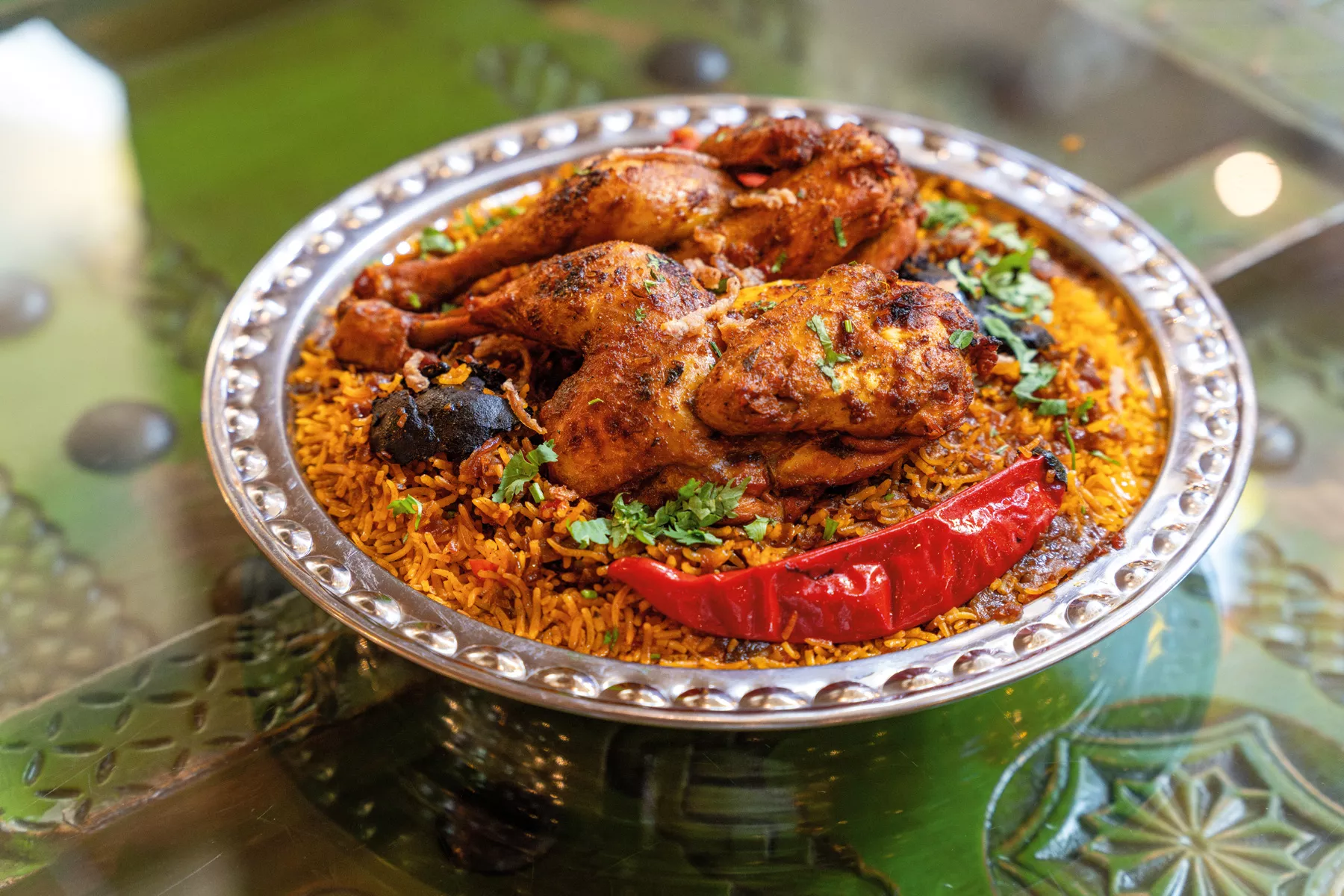
Chicken kabsa, like other versions, is made with long-grain rice that drinks up the broth.
ALSO LEAVING HOME
Other dishes from the Arabian Peninsula have found their way onto tables abroad. Among them:
Jareesh
Crushed wheat cooked with meat and milk until it thickens to something like porridge. It belongs to the Najd in central Saudi Arabia, where it is served at wedding breakfasts. In Tabuk, in the north of the country, the grain is still broken on a stone quern called a raha. Wheat fed central Arabia before rice arrived, which makes jareesh older than kabsa, though both are still eaten today. In 2023 the Culinary Arts Commission named jareesh the national dish of Saudi Arabia. Saudi kitchens in London now serve it.
Saleeg
From the Hijaz, in western Saudi Arabia and named for its method, since saleeg means “to boil.” The chicken is simmered until the stock takes its flavor, then lifted out and roasted. Short-grain rice cooks in that stock and milk until it collapses into something closer to porridge than pilaf, finished with butter or ghee and served with daqous, a sharp tomato salsa. It is the softest thing on a Hijazi table and belongs to the celebration cooking of Makkah and Taif.
Harees
Wheat and meat again, handled differently. The grain is boiled for hours and then beaten together with the meat until the two stop being separate things and the dish turns smooth, closer to a thick cream than to the coarse grain of jareesh. It belongs to Ramadan tables and to weddings. In 2023 Saudi Arabia, the United Arab Emirates and Oman together had it inscribed on UNESCO’s Representative List of the Intangible Cultural Heritage of Humanity, and Gulf kitchens in London now serve it alongside kabsa.
Where To Eat Kabsa Now
In London, Hijazi Corner, which calls itself the first Saudi restaurant in Europe, draws its cooking from the western region of Saudi Arabia. Across town on Holloway Road, Diwan Kitchen serves kabsa alongside jareesh. In Philadelphia, Malooga, on Chestnut Street in Old City, has chicken kabsa on the menu. In San Diego, a kitchen called, simply, Kabsa opened in 2023 and built its whole menu around the dish, with lamb and with chicken, serving ma'soub and 'areekah for dessert.
Back in Paris, one part of the AlMumens' kabsa never leaves the house. It is the crisp, slightly burnt crust at the bottom of the pot, prized at home and never set before guests. When her father visits, Intessar divides it between him and her husband, the two men who want it most.
It is the argument the dish has been having for centuries: what gets shown to the world, and what stays at the bottom of the pot for the people who already know it's there.
About the Author

Bader Awwad AlBalawi
Bader Awwad AlBalawi is a photographer, writer and filmmaker based in Khobar, Saudi Arabia. His work explores travel, street life and cultural transitions.
Homara Choudhary
Homara Choudhary is an international multimedia journalist, presenter and moderator, who has worked for major networks including BBC, ITV and Al Jazeera. She has also moderated for Web Summit and produced content for Doha Debates and Media City in Qatar.
You may also be interested in...
This Chili Bean Dip Comes Together So Fast, It's Like Cheating
Food
A heaping bowl of Persepolis restaurant's Chili Bean Dip comes together in no time.
Couscous for Lunch or Dinner: Algerian Pasta Soup With Labneh
Food
The berkoukes are giant couscous balls cooked into soups and stews, with little differentiation across North Africa and the Levant.
A Generous Bowl of Guacamole With Love From a Turkish Chef
Food
Surely, Yavuz Ozborme’s fine-tuning of the avocado dip in a quest for continuous improvement is a metaphor for adjusting to life since he and his brother came to London and opened Buffalo Grill in Greenwich.