Painting Samarkand: How Uzbek Artists Preserve Memory
In the studios of Samarkand, Uzbekistan, generations of artists are turning disappearing customs and artistic traditions into something that can survive on canvas.
Written by Aibarshyn Akhmetkali, Photographed by Danil Usmanov
Mirsaid Samatov, “The Rooster’s Call,” 100 x 100 centimeters, oil on canvas. “As I grew older, I realized that everything changes, even monuments. That’s when I felt this urge to preserve what remains in my memory,” the artist says.
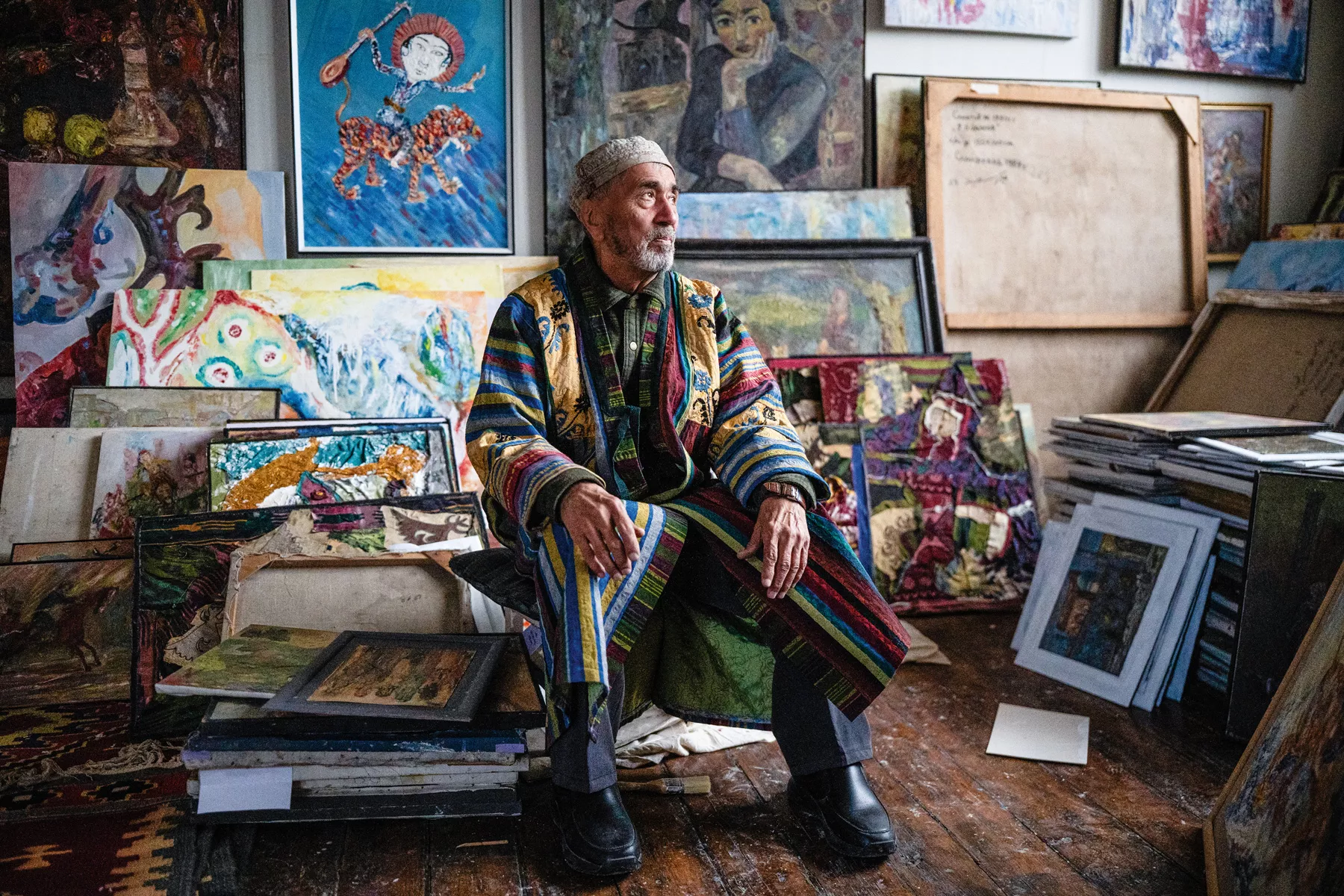
At 76, Mirsaid Samatov sits on a low chair in his dimly lit Samarkand studio, painting scenes he can no longer find outside the Uzbek city’s walls: wandering musicians moving from house to house, children gathering in courtyards for celebrations, a bride circling a fire as she joins her husband’s family.
He remembers watching these rituals as a boy growing up in Samarkand’s old town. Now he paints them as a way of keeping their memory alive.
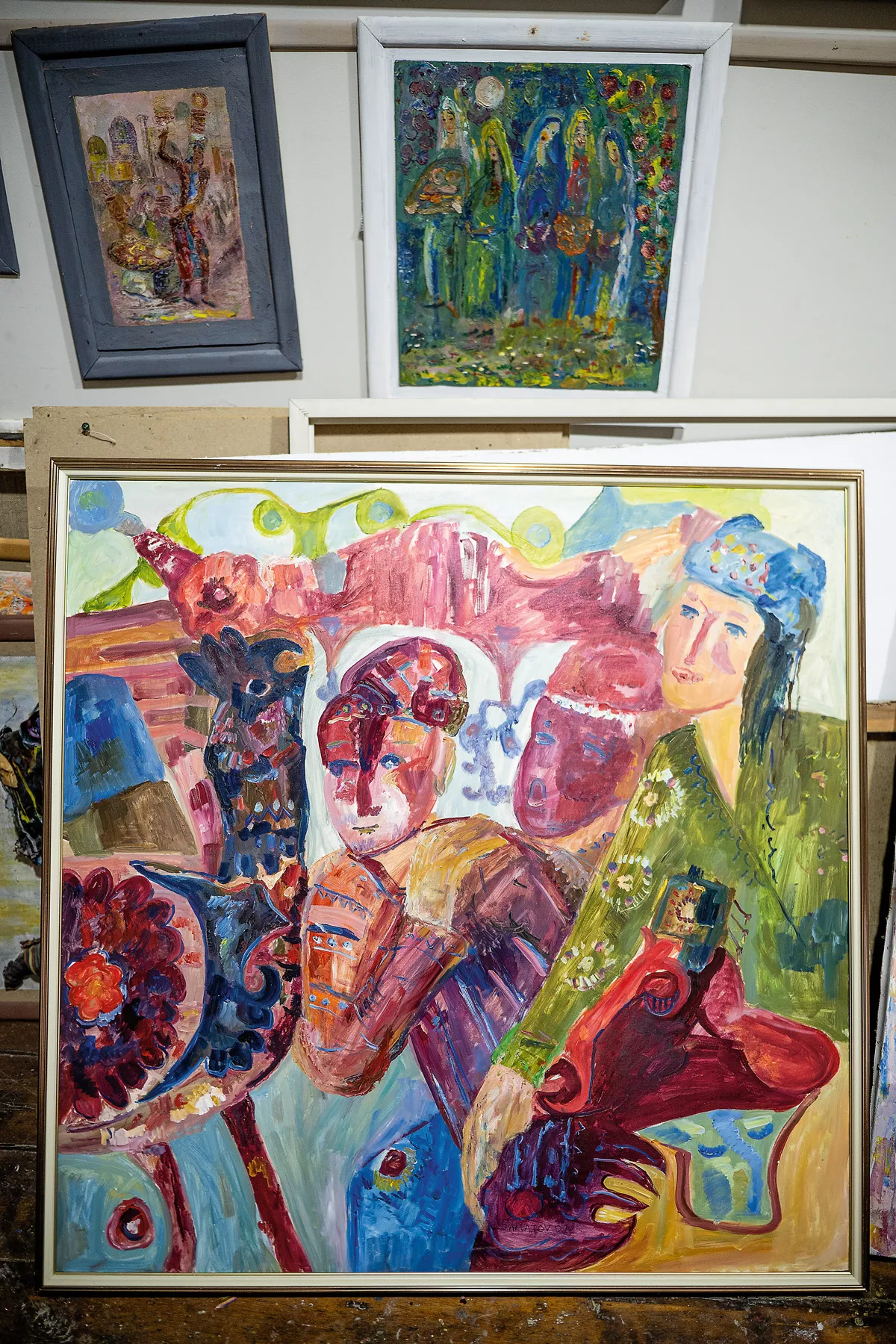
“The Rooster’s Call,” 100 x 100 centimeters, oil on canvas.
The painting in front of him features silhouettes of horses. Asked what he is working on, he turns away from the unfinished work: “Oh, it’s just a [traditional] race. I always work on something but never know what it will turn out to be,” he says. “There used to be these entertaining customs back then. I used to watch them when I was 6 or 7 years old—still young enough to be allowed to join in. I don’t see them anymore.”
For Samatov painting is a way of making those vanished scenes visible again.
Across the studios around Samarkand’s Registan Square, several artists of different ages and styles are capturing a city that is changing around them. Their paintings draw on disappearing customs, artistic traditions and their own experiences of Samarkand.
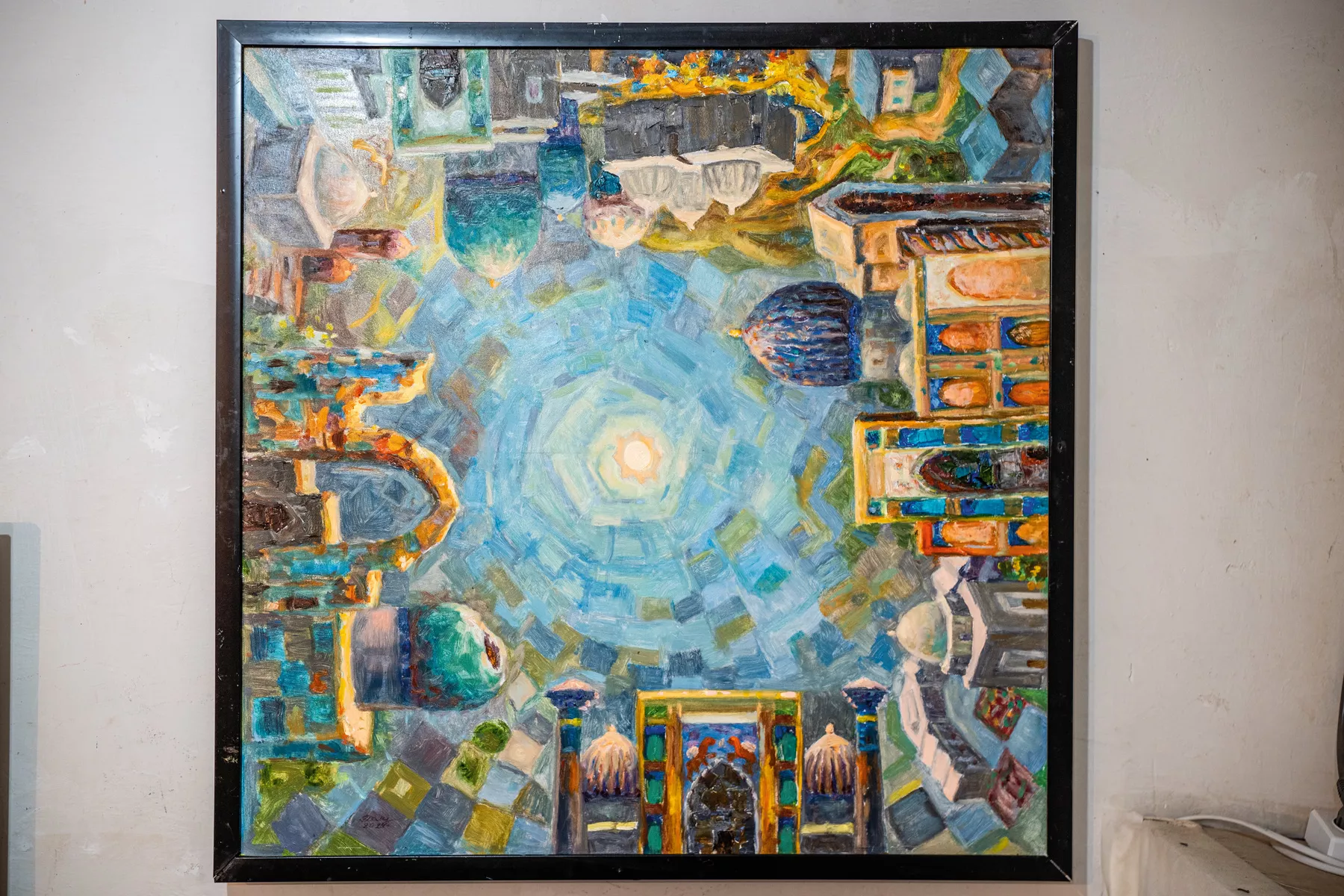
Abib Ismailov, “Blue Azure of Samarkand,” 2007, 60 x 60 centimeters, oil on canvas.
Recording Memories of Place
Samatov’s artworks return repeatedly to the communal world he remembers from childhood—celebrations, musicians, wedding rituals and neighborhood life—as well as to the monumental Islamic architecture for which Samarkand is known.
An architect before developing an interest in art, he began painting at 26 and has continued for some five decades.
“I’m from Samarkand. So naturally, as an architect, I was attracted to monuments. I have a lot of [paintings of] the monuments,” he says. “And another topic [of interest] is our folk customs and traditions.”
In his work, the two subjects become different ways of recording place: one through the structures that remain, the other through people and practices that may not.
In his 2004 painting “Birth of a Child,” stilt walkers rise above a crowded street as musicians, drummers and dancers gather to welcome a newborn. Loosely drawn faces and figures give the scene the hazy quality of a childhood memory.
“I used to paint a lot from life, especially architecture and nature. But as I grew older, I realized that everything changes, even monuments. That’s when I felt this urge to preserve what remains in my memory,” says Samatov.
That includes “Birth of a Child.”
“People would come over to congratulate the family. There was music, drums, the surnay and the karnay [traditional Central Asian wind instruments]. All the kids would gather in the courtyard, dance and just have fun,” Samatov recalls.
“Nature and his surroundings shape a person. I paid close attention to capture that.”

Ismailov was educated in the tradition of influential artist Pavel Benkov’s school, absorbing elements of it before developing his own style.
“That custom, too, has disappeared now. It’s gone.”
According to Yeni Kim, an illustrator and assistant professor in visual communication design at Hongik University in Seoul, South Korea, art can bring a vanishing tradition back into cultural conversation.
“It invites people to look at it, become curious about it, discuss it and perhaps connect it with their own memories and experiences,” she explains. “In this sense, I think artists can act as culture bearers. They can transmit memories, stories, customs and ways of seeing from one generation to another.”
But an artist is not a neutral historical authority; memory is interpreted as it is translated onto canvas.
“An artwork should not necessarily be treated as an objective historical record,” Kim says, “but its interpretation can itself become meaningful. It can show us not only what a tradition was but how people remember it, respond to it and carry it forward.”
Some customs in Samatov’s paintings reach beyond his own childhood to those handed down through generations. One depicts a bride beside a fire in a ritual Samatov associates with the region’s pre-Islamic traditions.
“She’d recite the salomnoma—it was a greeting from the bride to her new home,” he explains. “… Family members then carried her around the fire. It was interesting, quite a spectacle,” says Samatov.
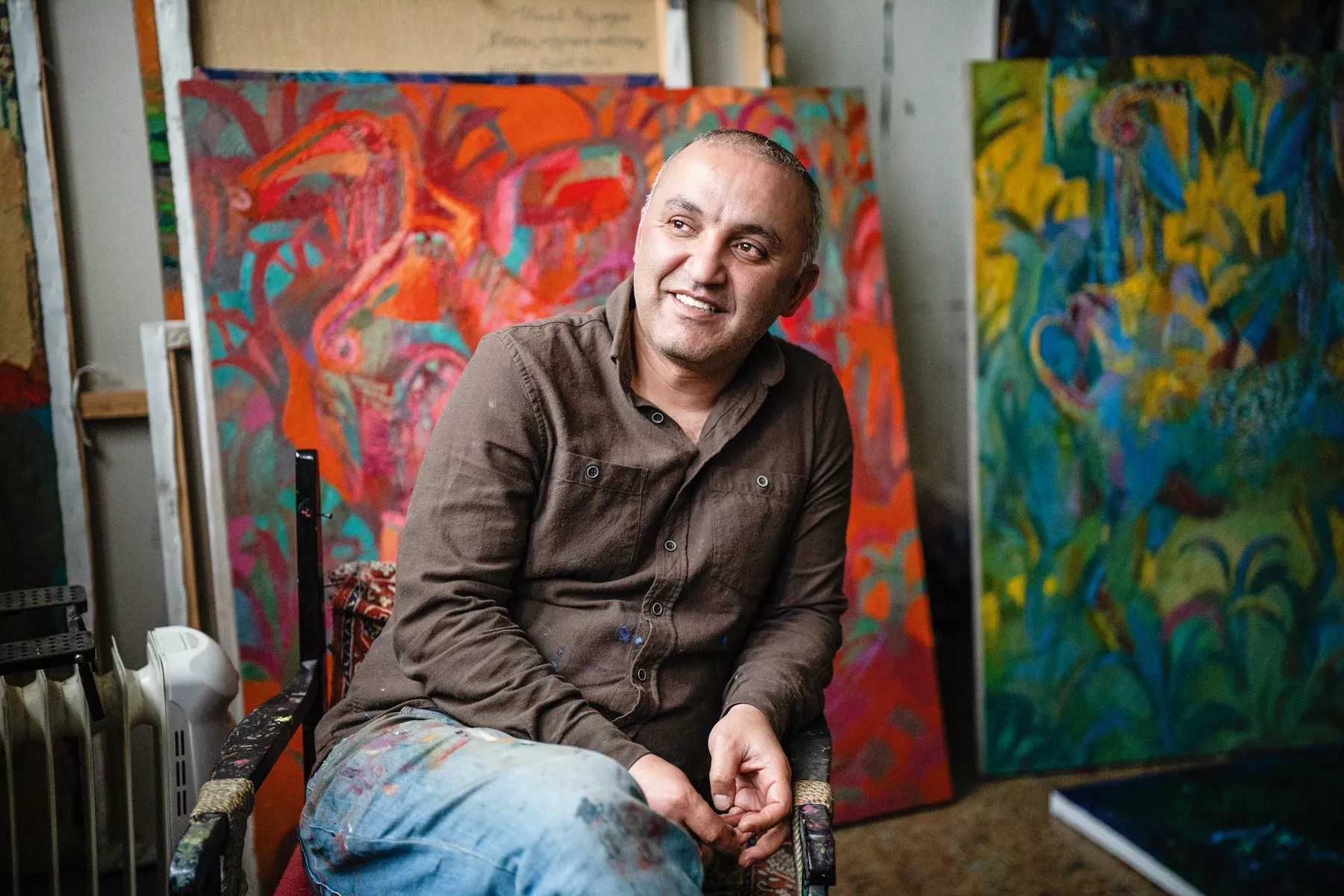
After nine years in Tashkent, Uzbekistan, Isaev returned home to Samarkand, where he draws inspiration from the city’s domes and majolica, its glazed architectural tilework.
“You know, we work more with emotions and impressions. ... Sometimes I’m surprised by what others see.”
How Are Art Traditions Passed Down?
Memory does not pass only through families and rituals. Artists absorb things too: techniques, ideas about light and color, ways of composing an image and looking at the world.
Those kinds of legacy run through the work of Abib Ismailov, 86, who has spent a lifetime painting Samarkand and its people while watching artistic styles evolve around him.
Born in 1939, Ismailov grew up when artists from elsewhere in the Soviet Union were working in Central Asian cities. Among the influential figures in Uzbekistan was Pavel Benkov from Kazan.
Nigora Akhmedova, an Uzbek art historian specializing in 20th-century and contemporary Central Asian art, says Benkov laid the foundations of art education in Uzbekistan.
“There were many artists, but there was no systematic education—he gathered like-minded people around him,” she says. “Thanks to him, Samarkand’s art school was considered the best even during the Soviet era” and was where professional artists of Uzbek ethnicity first formally studied.
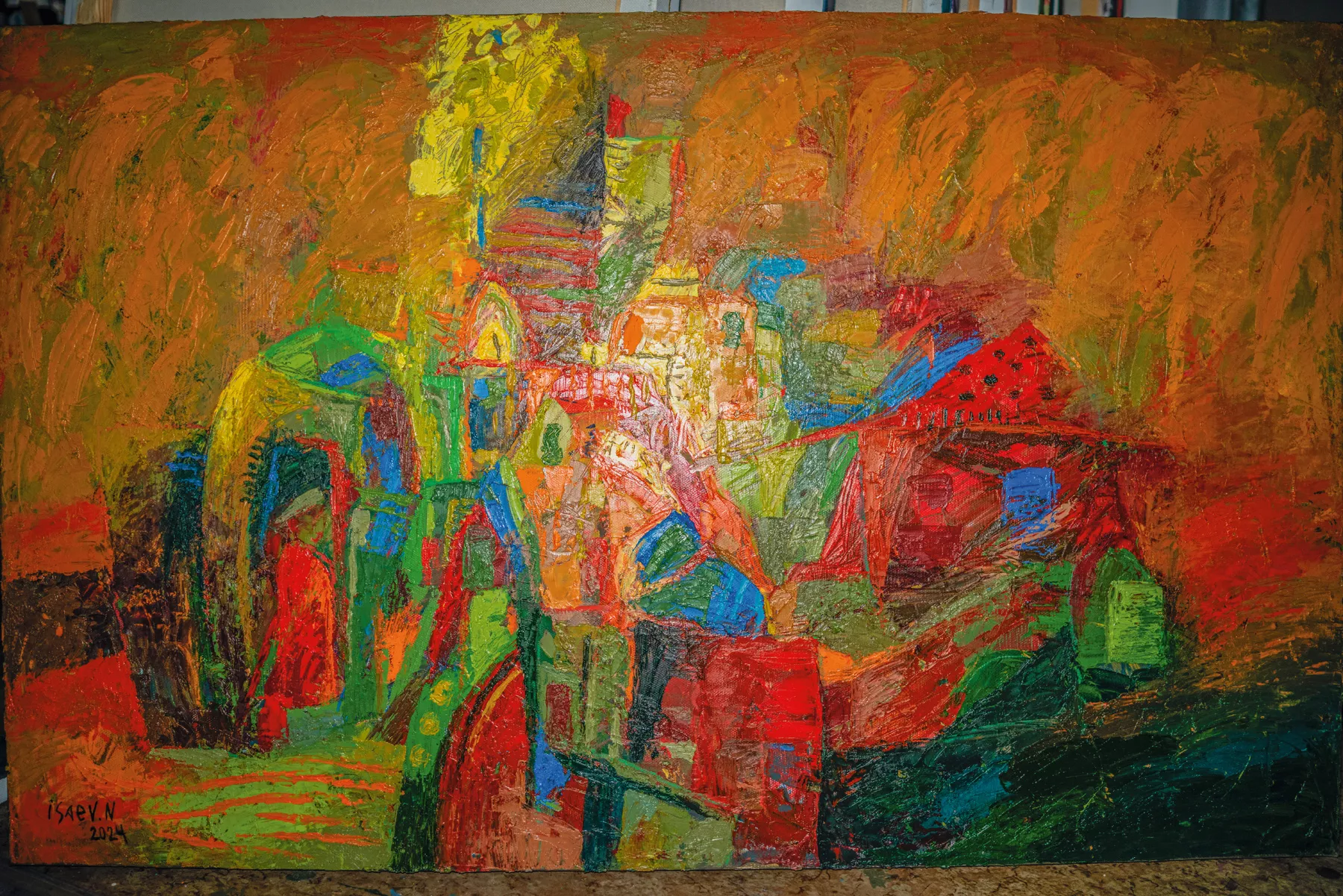
Nuriddin Isaev, “Between heaven and earth,” 2024, 75 x 120 centimeters, oil on canvas.
Ismailov was educated in the tradition of Benkov’s school, absorbing elements of it before developing his own style.
“Benkov’s school and influence taught me the love of nature, which I carried throughout,” he says. “Nature and his surroundings shape a person. I paid close attention to capture that.”
Akhmedova describes Benkov as the “artist of the sun,” noting his attention to light and everyday life.
Ismailov similarly makes buildings more than backdrops, bringing people, especially women, to the foreground.
Pointing to his 1971 painting “Rural Carpet Weavers,” he describes women from the mahalla, or traditional neighborhood, weaving carpets for dowries. “The tradition has survived in some areas to this day,” he says.
Samarkand in a Contemporary Palette
Inheritance does not require imitation. In the next studio, a younger artist draws on many of the same sources—architecture, ornament, place—and allows them to become something less literal.
Nuriddin Isaev, 42, works across figurative, symbolic and increasingly abstract forms in vivid colors. Earlier works incorporated recognizable figures and architecture; his current practice moves more freely among color, ornament and abstraction.
“I went through this entire academic training process from start to finish,” says Isaev. “Then, in 2011, after I had finished my master’s degree, I wanted to move away from what I knew. I wanted to work more freely.”
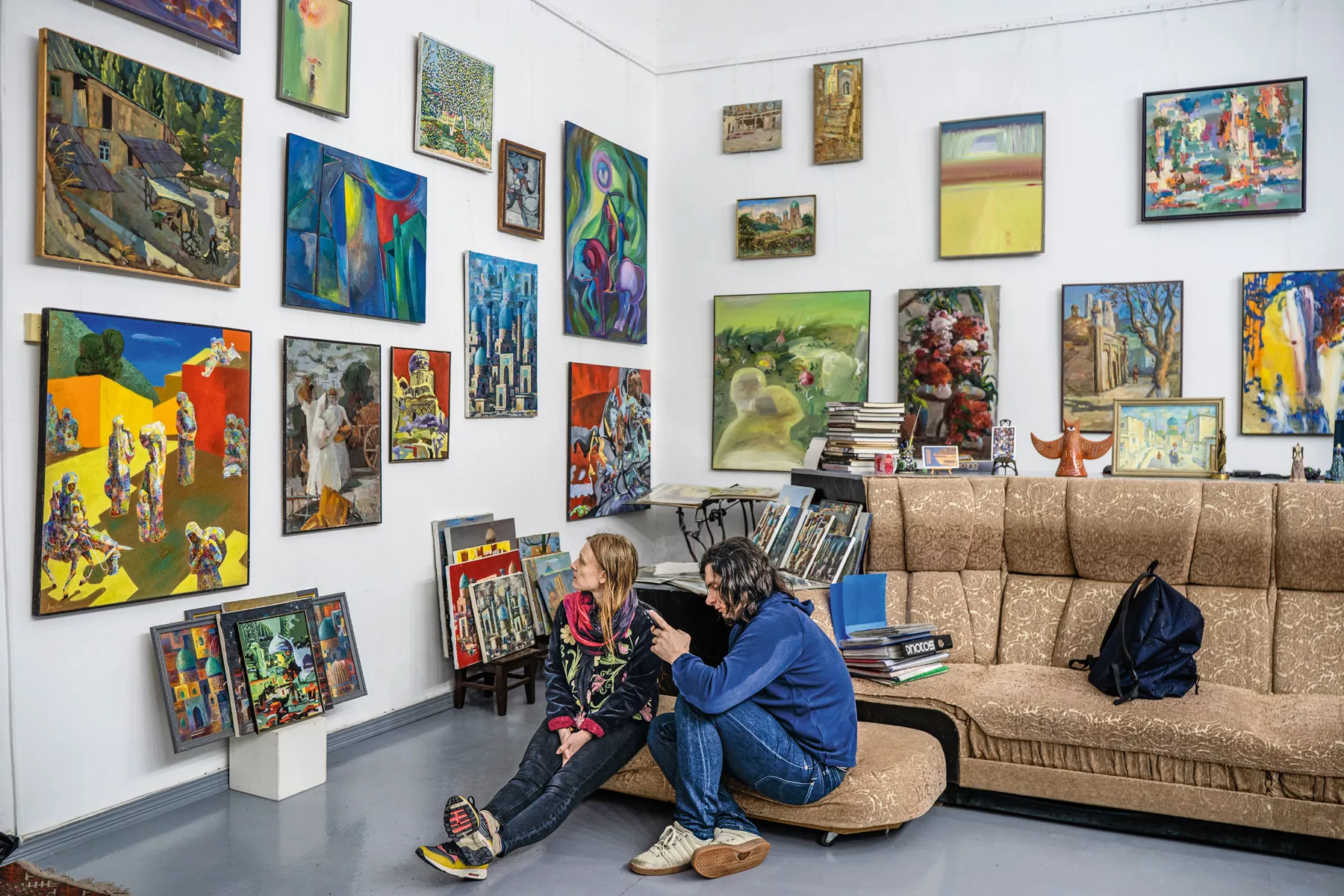
Tourists visit the gallery of the Creative Association of Artists, Academy of Arts of Uzbekistan, in Samarkand.
After studying and living in Tashkent for nine years, Isaev says he developed most as an artist after returning home to Samarkand, where he draws inspiration from the city’s domes and majolica, its glazed architectural tilework.
Those sources need not remain recognizable. The geometry and saturated colors of the tilework can be separated from the buildings themselves, reappearing as pattern and color on canvas.
Kim, the professor, says an artwork does not need to provide a literal record of a place to create a connection with it.
“Someone who knows nothing about Jeju [an island in South Korea] or Uzbekistan may encounter an image and become interested in the people, relationships, environments and traditions represented there,” she says. “The image may not communicate everything by itself, but it can create curiosity and an emotional or imaginative connection that encourages us to learn more.”
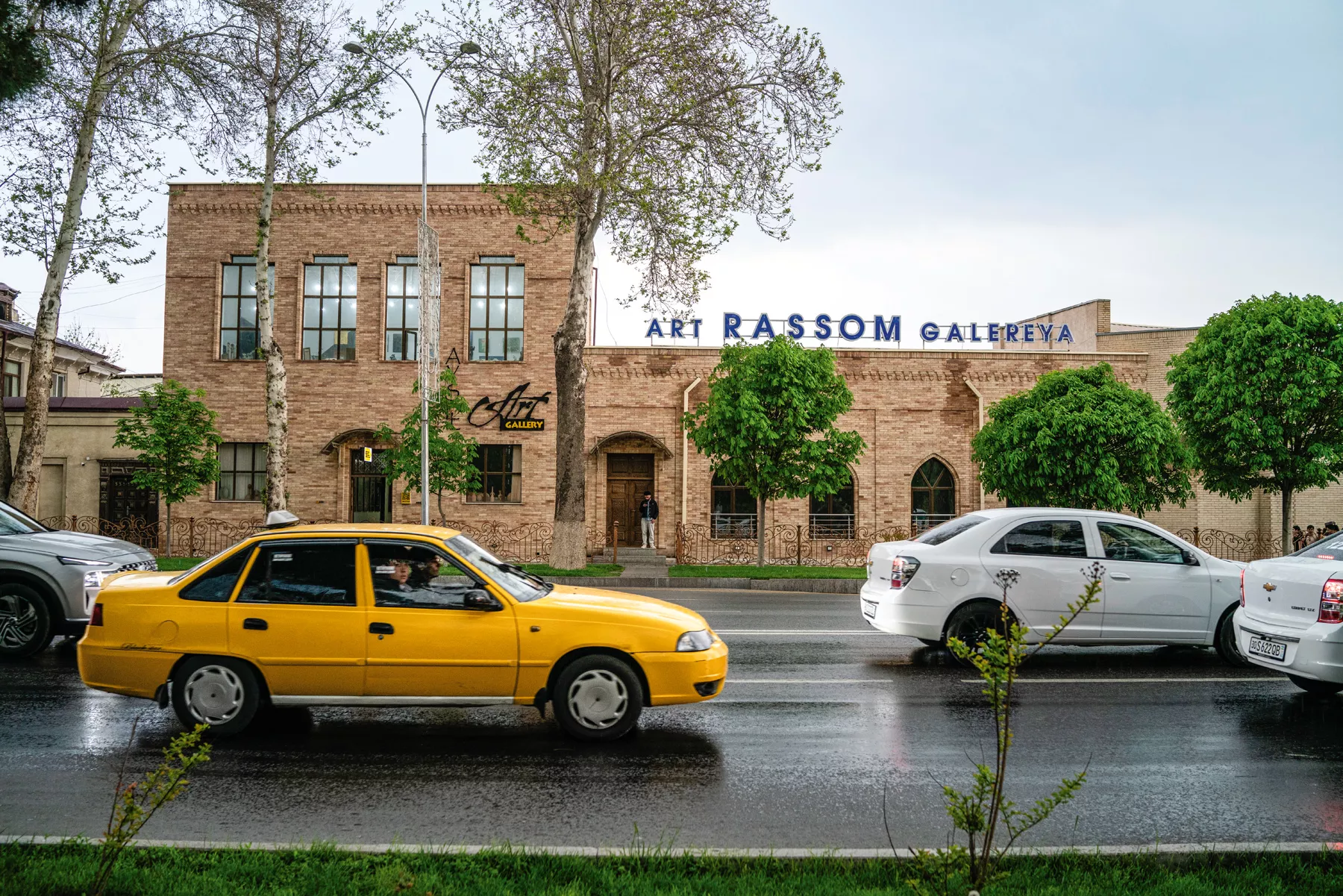
In studios across from Samarkand’s Registan Square, several artists are capturing a city that is changing around them.
Akhmedova cautions against tracing individual motifs in Isaev’s work directly to older Central Asian traditions.
“Isaev was among this new generation of artists … tired of pomegranate … of skullcaps and … of ornamentation,” Akhmedova says. “Suddenly, this new generation started experimenting with these expressive styles and distortions.”
For Isaev, Samarkand is turquoise and ultramarine—the colors of its domes.
Those blues dominate his “Thoughts of Samarkand,” in which a woman’s face emerges from shades of blue, one eye open and the other closed.
“You know, we work more with emotions and impressions,” he says. “There are some things I can’t really explain. Sometimes I’m surprised by what others see.”
Some of the imagery, Isaev says, has begun to remind him of the Sogdians, the seventh-century CE people who inhabited ancient Samarkand, then centered on the hills of Afrasiab. They are known for having created pre-Islamic wall paintings at that site.
Where Samatov uses recognizable figures to re-create a remembered social world, and Ismailov brings an inherited artistic tradition to his depictions of Samarkand, Isaev pushes further away from literal representation.
Their visual languages differ but overlap: Architecture, textiles and color migrate into figurative painting, symbolism or abstraction.
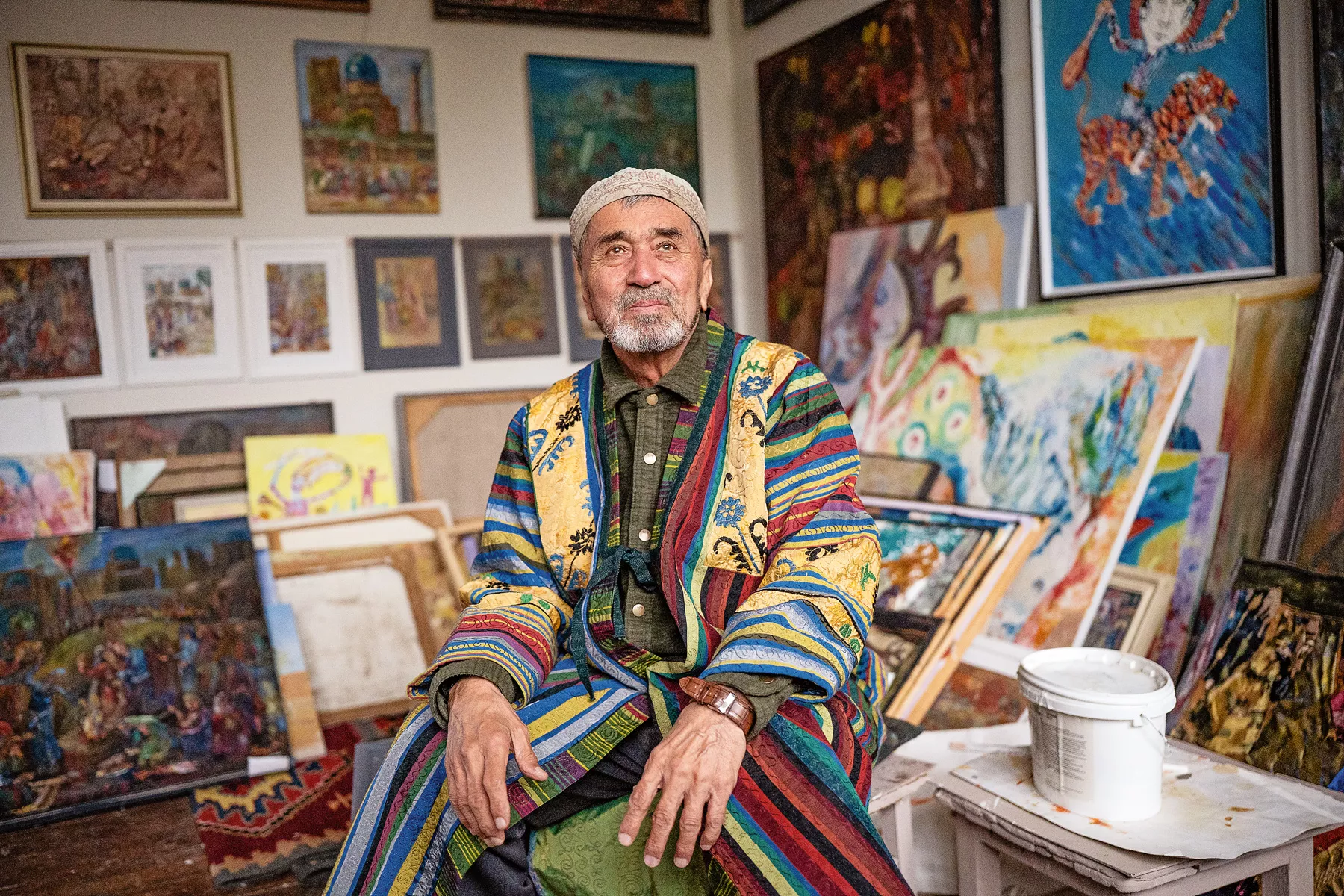
Mirsaid Samatov in his painting studio.
For Samatov the memories behind his paintings belong to a particular place and generation. But the experience of carrying such memories, he believes, does not.
“People living in different cultures, they have those deep memories too,” he says.
A viewer elsewhere may know nothing of the celebration Samatov remembers or the meaning carried by a local pattern. But the impulse behind them is familiar: to hold onto places, people and experiences that time has begun to alter.
“There are monuments that are being built [to stand] as buildings, and there are monuments created by the people,” says Samatov. “What is a memory? … It’s what remains.”
He looks at the cultural landscape around him as something already changing. “It is fading away,” he says, “and it might one day only remain in paintings.”
About the Author
Aibarshyn Akhmetkali
Aibarshyn Akhmetkali is a contributing writer to AramcoWorld based in Astana, Kazakhstan. Her work mainly focuses on the culture, history and arts of Central Asia.
Danil Usmanov
Danil Usmanov is a documentary photographer dedicated to capturing the untold stories of Central Asia. His work has been featured in The Guardian, Die Zeit, Meduza, Le Monde, New Lines Magazine and Der Spiegel.
You may also be interested in...
Stratford to Jordan: Shakespeare’s Echoes of the Arab World
Arts
History
Shakespeare’s works are woven into the cultural fabric of the Arab world, but so, too, were his plays shaped in part by Islamic storytelling traditions and political realities of his day.
How Gulf's New Museums Are Championing Cultural Memory and Heritage
Arts
The result of decades of planning, new facilities in Saudi Arabia and the rest of the Arabian Gulf reflect the region's cultural renaissance and effort to preserve its heritage.
Cartier and Islamic Design’s Enduring Influence
Arts
For generations Cartier looked to the patterns, colors and shapes of the Islamic world to create striking jewelry.