Artist Stefania Artusi Khalfi Maps Palermo's Arab Society
An artist looks past the history books to uncover the hidden landscape of Sicily's capital.
6 min
Written by Jack Zahora, Photographed by Tara Todras-Whitehill
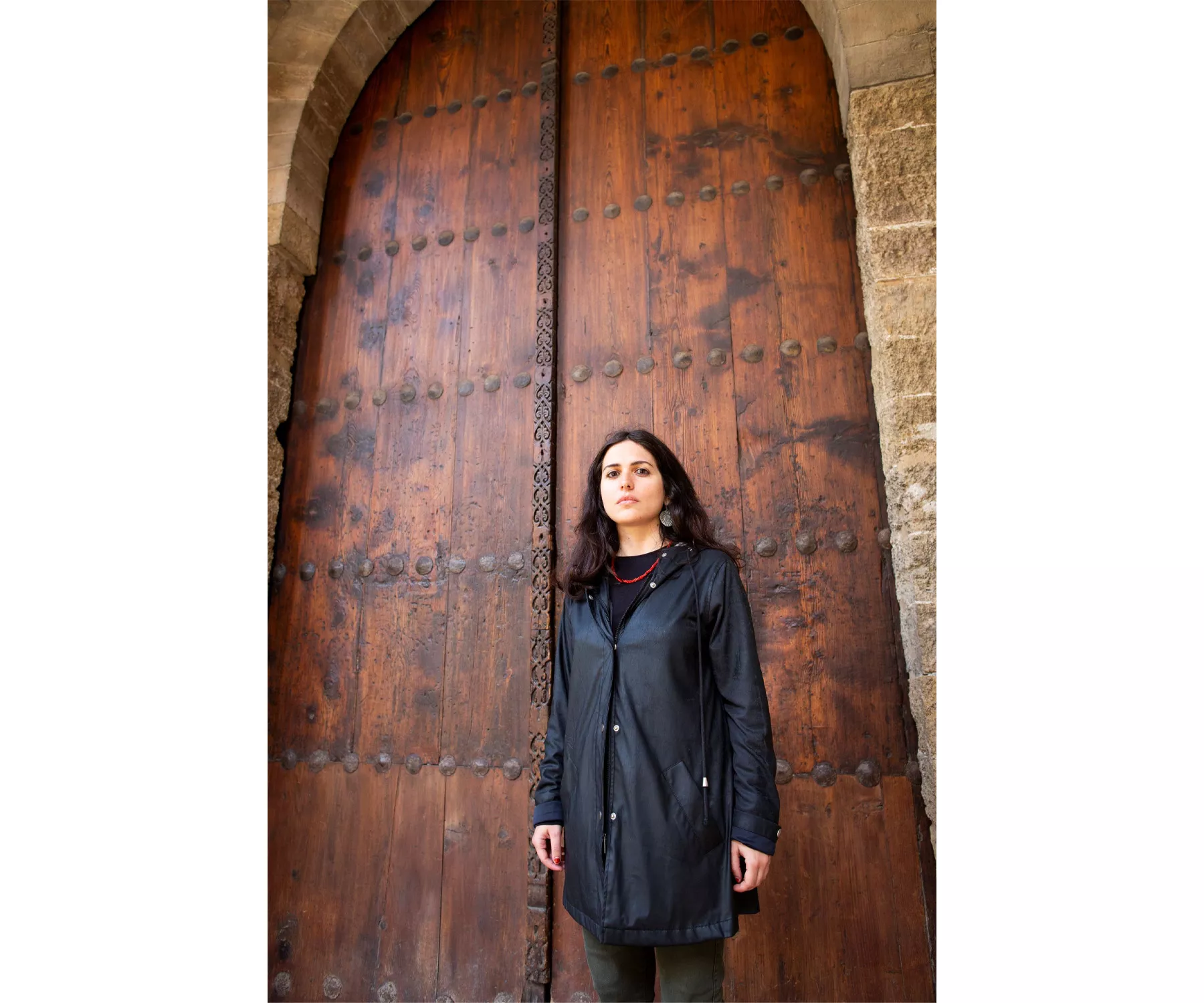
Stefania Artusi Khalfi walks past the Palermo Cathedral, a dominant Roman Catholic landmark in the Sicilian capital, which during Arab rule of the island (827 CE-1091 CE) functioned as the city's main congregational mosque, Masjid al-Jami'.
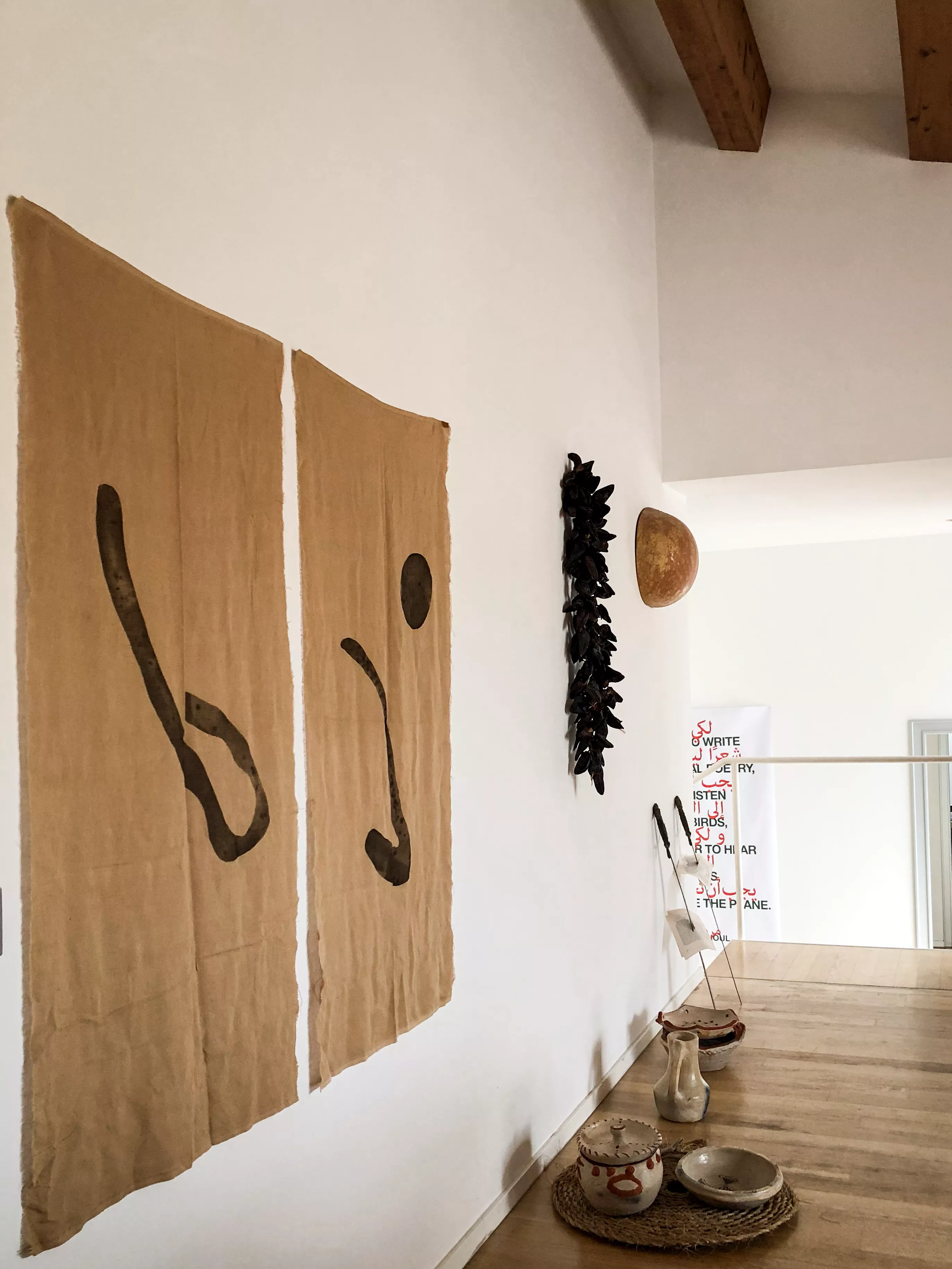
It's one of about three dozen points in the city that the 35-year-old artist has mapped out on pieces of linen, in what she describes as an artistic series of itineraries important to Arab travelers, both ancient and modern. They make up her installation "Sarab," Arabic for "illusion."
"I deconstructed this map, summarizing it through symbols that I painted onto fabrics that are taken from the negative spaces among the different locations," Artusi Khalfi explains.
Artist Stefania Artusi Khalfi recognizes parallels between her layered cultural identity as a Sicilian and Palermo's many examples of Arab-Norman architecture, such as the Church of St. Caldo, which was erected in 1154 CE. Top "Sarab," Artusi Khalfi's art project, includes "Untitled I," left, and "Untitled II," center. "Sarab" provides a roadmap of Sicily's past and present Arab communities with artwork printed on linen, accompanied by audio recordings from each site that reveal their historical and cultural significance.
However, overlaying her piece on a modern-day map of the city would draw attention to several geographical inconsistencies. "Much of what I am trying to call attention to is a Sicily that no longer exists because the spots are either in ruins or have been erased from history books," she says, "but nevertheless are still very dear to the local Muslim community."
In the upper left-hand corner of the map is the Bab al-Abna, an old Arabic gate that is believed to have once stood as the prime entrance to the city. In the opposite corner is the Qasr al-Silsila, a likely reference to any one of the ancient Arab palaces that were destroyed following the Norman conquest of the island. And along the right of the map is a mention of the Sar al-Kaji-likely a reference to the Shari' al-Qadi (the Street of the Judge), the Arab thoroughfare from which today's Capo Market takes its name.
Artusi Khalfi describes "Sarab" as her personal reimagining of the city. British historian Diana Darke goes a step further, noting that such works attempt to undo revisionist history, which she too has tried to achieve through her book Islamesque: The Forgotten Craftsmen Who Built Europe's Medieval Monuments.
She says the concept of Romanesque, which classifies the style of architecture in Europe from 900 CE-1200 CE, "was only invented in the 19th century," adding that "we've just blindly followed it without really questioning it."
Darke says that while researching her book, she had difficulty finding academic studies that link the Sicilian architecture that still stands today with the island's period of Arab rule, let alone histories that tell of a disappeared landscape toppled centuries ago.
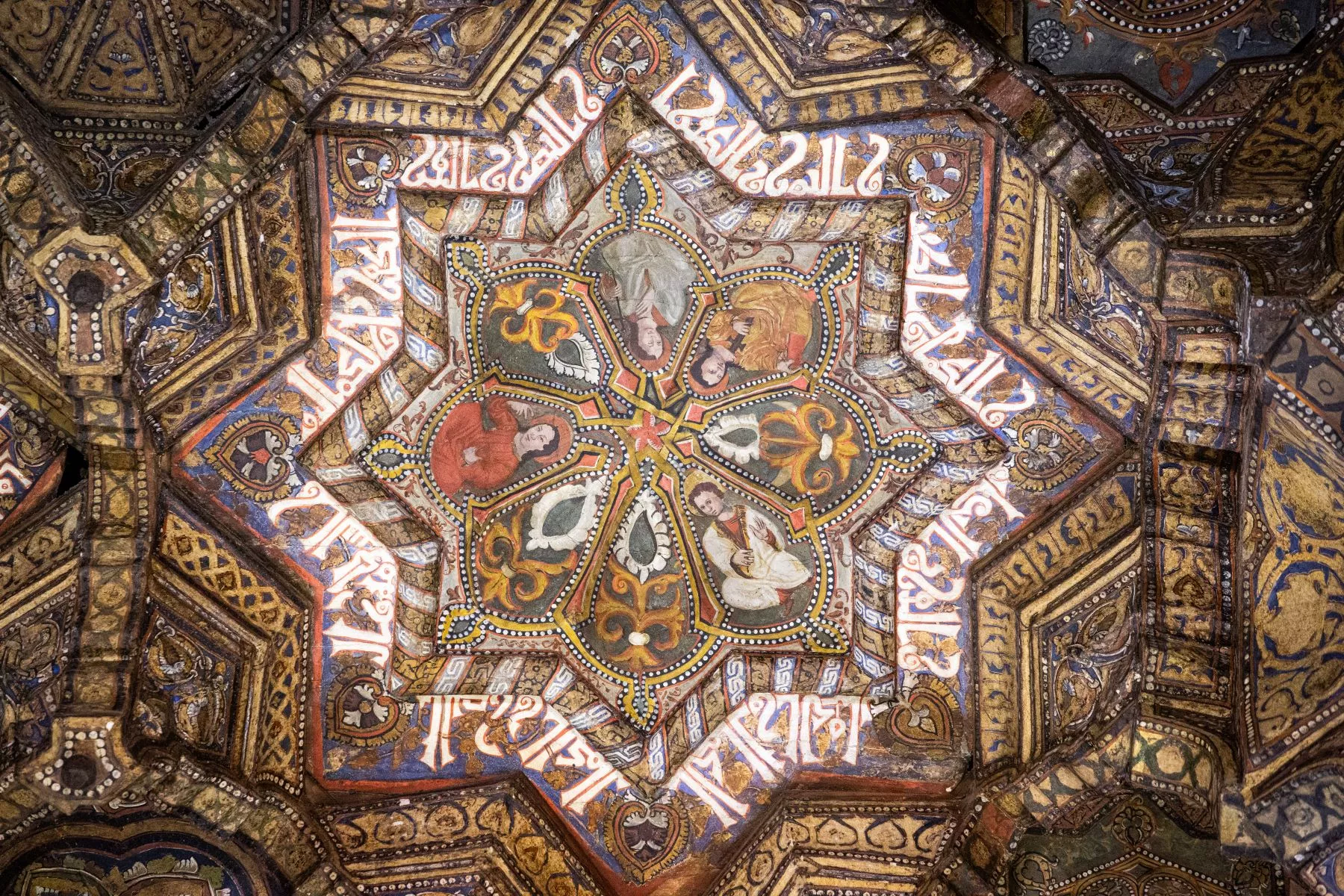
The muqarnas ceiling is seen inside the Palatine Chapel in Palermo, Sicily, Sunday, April 27th, 2025. Muqarnas are a type of three dimensional design in Islamic architecture and some of the designs on the ceiling include Arabic.
"I certainly couldn't find in any academic, printed, pre-existing stuff anything that really brings out the origins," she says. Darke adds that in many cases, such research requires the aptitude of a forensic scientist. "When you look at all the buildings of Norman Sicily, you can see the continuity from Muslim architecture because they used local Muslim craftsmen. ...it was the Muslims at this time-and we're talking eighth, ninth, tenth and into the eleventh century [CE]-who dominated the construction world, all across Europe."
Artusi Khalfi, who's also working toward a doctorate in history, says this reality is very personal to her. "This heritage is not really taught in school, and there's not much awareness that this is part of our common culture."
Growing up, Artusi Khalfi says, she struggled with acknowledging and embracing a sense of multiculturalism that comes with being Sicilian. "[The name] Artusi comes from my great-great-great-uncle on my father's side, the famous author who created Italy's first cookbook, La Scienza in Cucina e l'Arte di Mangiar [Science in the Kitchen and the Art of Eating Well]. But [the name] Khalfi is actually from my mother's lineage-Maghrebi Jews living in Algeria," she says. "And I kind of rejected that part of my identity as a teenager."
Her interest, she says, is not rooted in religion but in understanding how Sicily's layered histories continue to shape the present.
It wasn't until she relocated to Berlin that Artusi Khalfi began to seek out her past. While earning a degree in visual arts, she became homesick. "I found myself shopping at Turkish supermarkets and eating at Lebanese and Afghan restaurants because they had dishes that reconnected me to Sicilian food culture and hospitality." However, Artusi Khalfi couldn't understand at the time why that connection between southern Italy and the Islamic world existed in the first place.
"I started to speak with my grandmother, and also started to read historical books about Sicily and Palermo, because I really wanted to know more-something was missing, and I wanted to know why." Her recent installation, she adds, reflects a literal yearning to connect the dots.
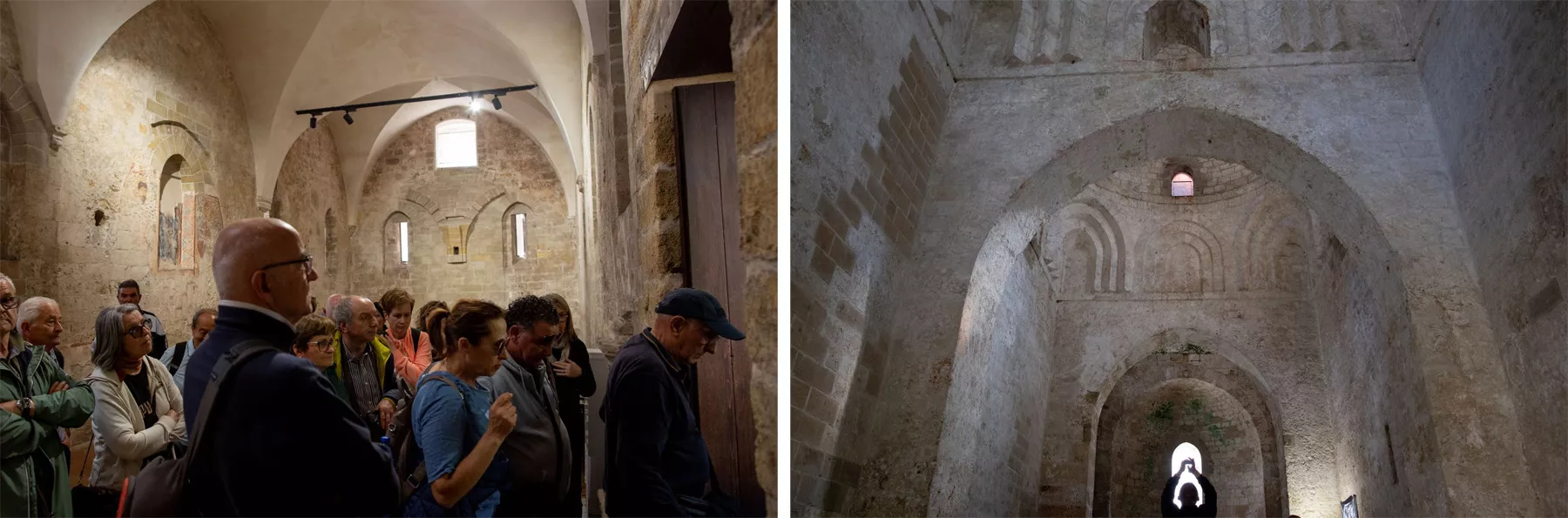
Arab influences of the "Arab hall" inside the monastic church of San Giovanni degli Eremiti (St. John of the Hermits) in Palermo include pointed arches. The "Arab hall" was likely a mosque.
Her academic and artistic work began to focus not only on the Maghrebi emigration across the Mediterranean but on the 40,000 people living in Sicily who come from North Africa, according to government census data.
At the center of this community, and in Artusi Khalfi's map, is the Moschea di Tunisia a Palermo (Mosque of Tunisia in Palermo). In cooperation with the congregation and Imam Hashem Radwan, Artusi Khalfi organized a sound installation in 2021 called "The Emerald City," which saw adhan, the Muslim call to prayer, ring out in Palermo for the first time since the Italian state banned it in 1861.
It was through this project that Artusi Khalfi met Giulia Liberatore, a social anthropologist and lecturer of Islamic and Middle Eastern studies at the University of Edinburgh. "We were sort of looking for people to work with us on their own engagements with [Sicily's] Islamic past, which led us to create a program called Absence Presence," Liberatore says. The program looks at three parts of the world, including Palermo, through a series of artistic, historical and religious perspectives. Through Liberatore's work and connections with the University of Edinburgh, Khalfi was able to access the scholarship that supports her"Sarab" installation.
"Many of the places on Stefania's map are actually from the interviews that myself and [documentary photographer] Kate Stanworth did with different members of Palermo's Muslim communities (e.g. Bengalis, Tunisians and Palestinians), along with those who are non-Muslim but are interested in this Islamic past," Liberatore says.
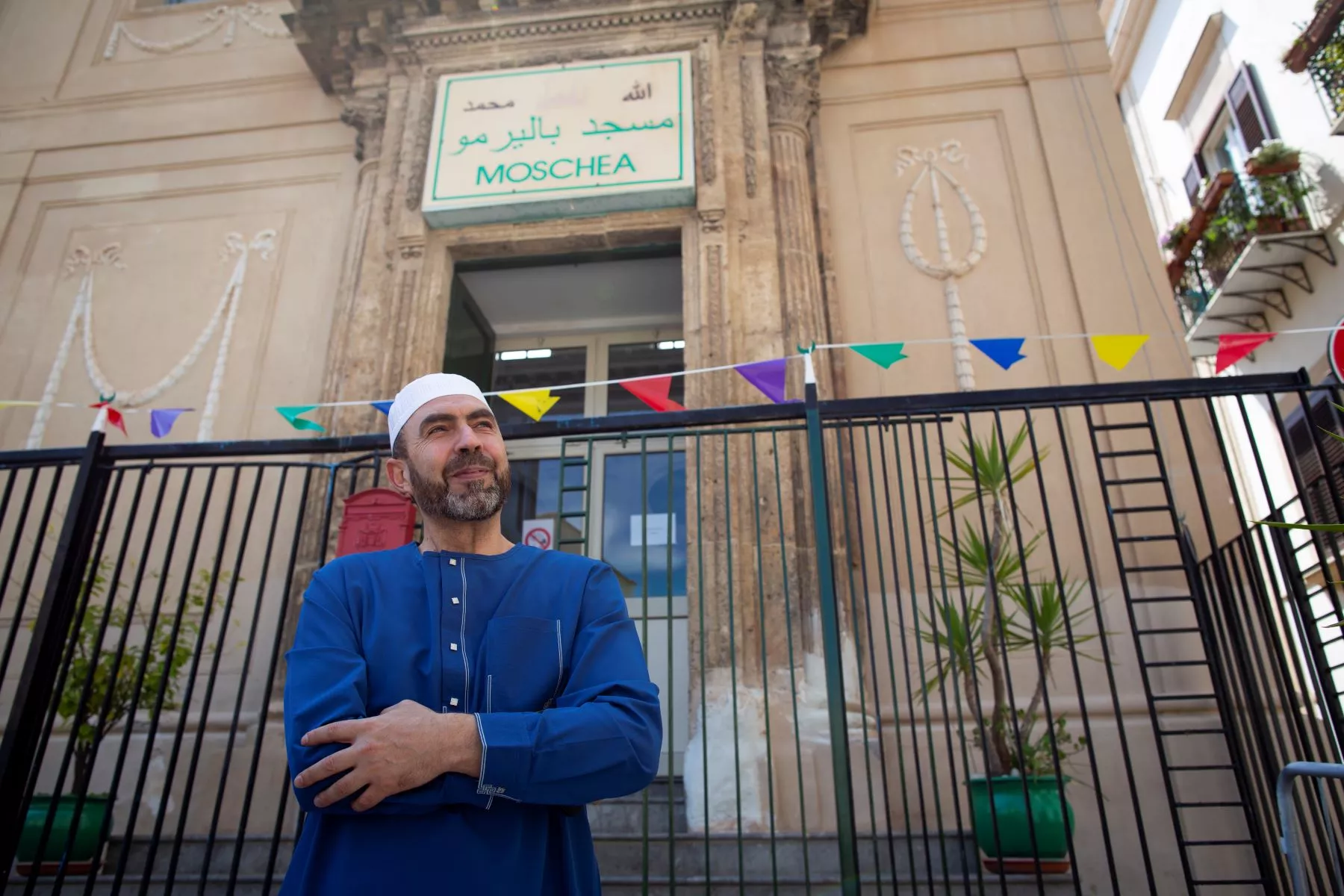
One point on Artusi Khalfi's map is the Moschea di Tunisia a Palermo (Mosque of Tunisia in Palermo). In cooperation with Imam Hashem Radwan, she organized a sound installation in 2021 that saw adhan, the Muslim call to prayer, ring out in Palermo for the first time since the Italian state banned it in 1861.
However, Liberatore says that as a social anthropologist, her interest in Artusi Khalfi's work goes beyond historical record and delves more into the question of why people like her are interested in reconnecting with their Islamic roots.
She says artworks such as"Sarab" not only bridge the gaps in Sicilians' awareness about their own heritage but also act as a mechanism to help relatively recent arrivals to the island feel more at home.
"Take, for instance, Sicily's huge Bengali community," says Liberatore. "They generally don't know about Sicily's [Islamic] past. So, we're trying to help communities like theirs hear these stories."
Back at Palermo's historical district, Artusi Khalfi stands in front of the Church of Saint Caldo, a prime example of Arab-Norman architecture from the 12th century CE, which boasts three red domes over the nave, similar to those seen on North African mosques.
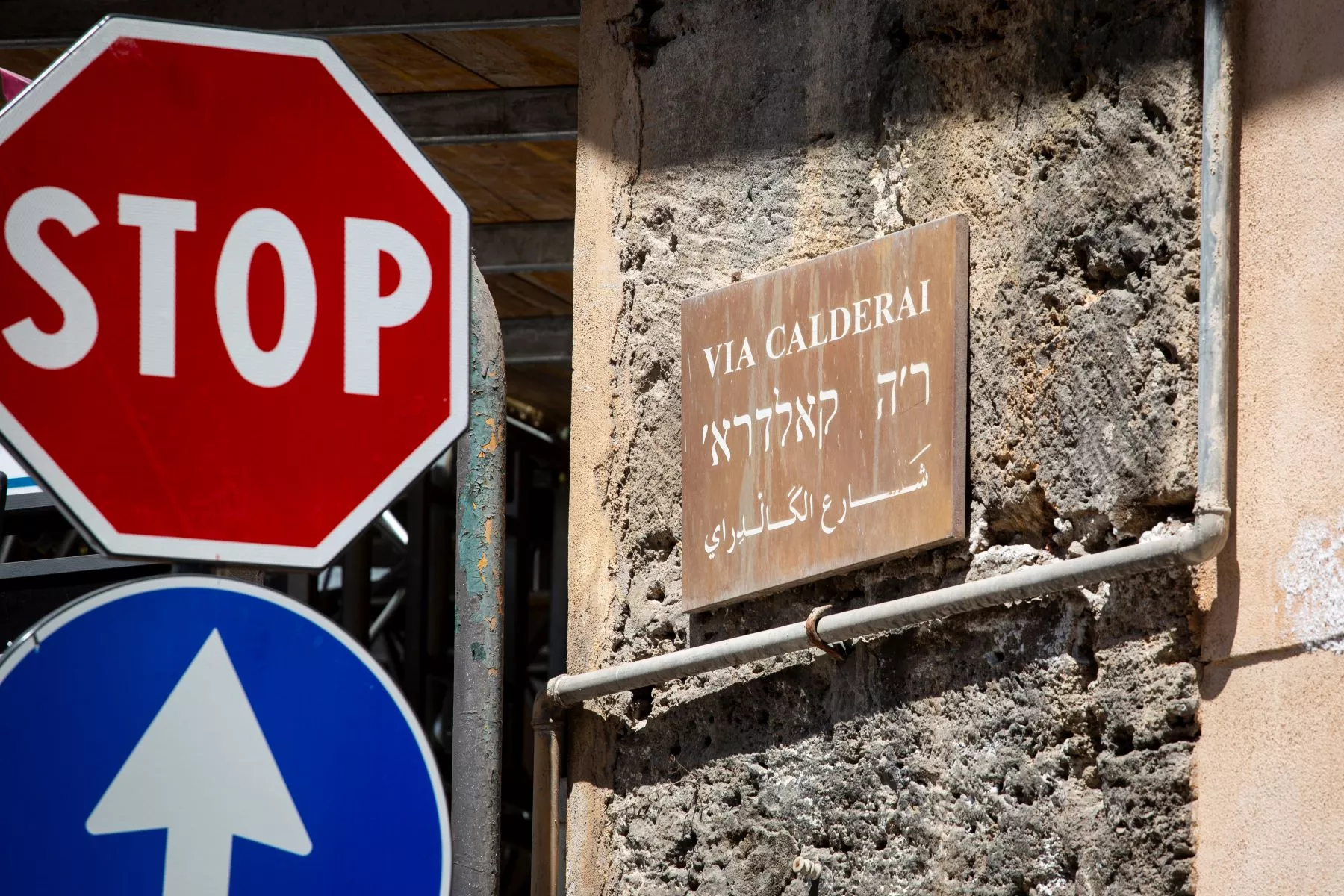
A street sign in English, Hebrew and Arabic reflects Maghrebi emigration across the Mediterranean Sea to Sicily.
She mentions the Arabic slang word harqa, which means "burning." She says Maghrebi migrants use it to describe the act of leaving the past behind for something new. It's not so dissimilar to how her younger self tried to forget her own relatives' journey across the Mediterranean.
"However, I still prefer to identify as a Sicilian," she says. "But to me, being Sicilian recognizes that I have a layering of cultural identities. And that's something that's woven into my artwork, a never ending work to understand where you come from, and who you are."
About the Author
Jack Zahora
Jack Zahora is an award-winning journalist whose work has appeared on various major outlets including National Public Radio and Al Jazeera English. He’s also the Chief Content Officer and managing partner of TW Storytelling Agency, a media company that’s based in Lisbon, Portugal.
Tara Todras-Whitehill
Tara Todras-Whitehill is an award-winning photojournalist and CEO of the TW Storytelling Agency, based in Lisbon, Portugal. Her passion is empowering NGOs, social impact teams, and journalists with impactful storytelling.
You may also be interested in...
Sisters Behind HUR Jewelry Aim To Honor Pakistani Traditions
Arts
Culture
What began with a handmade pair of earrings exchanged between sisters in 2017 has evolved into a jewelry brand with pieces worn in more than 50 countries.
Football’s Power and Drama Inspire Art Around the World
Culture
For the 2026 World Cup, as in the past, the game offers artists fertile ground, concentrating into 90 minutes a wide spectrum of human experience.
Meet the Author Who Invites Children To Discover ‘Star of the East’
Arts
Culture
In Umm Kulthum: The Star of the East, Syrian American author and journalist Rhonda Roumani illuminates the life of a girl from the Nile Delta who rose to become one of the most celebrated voices in the Arab world.