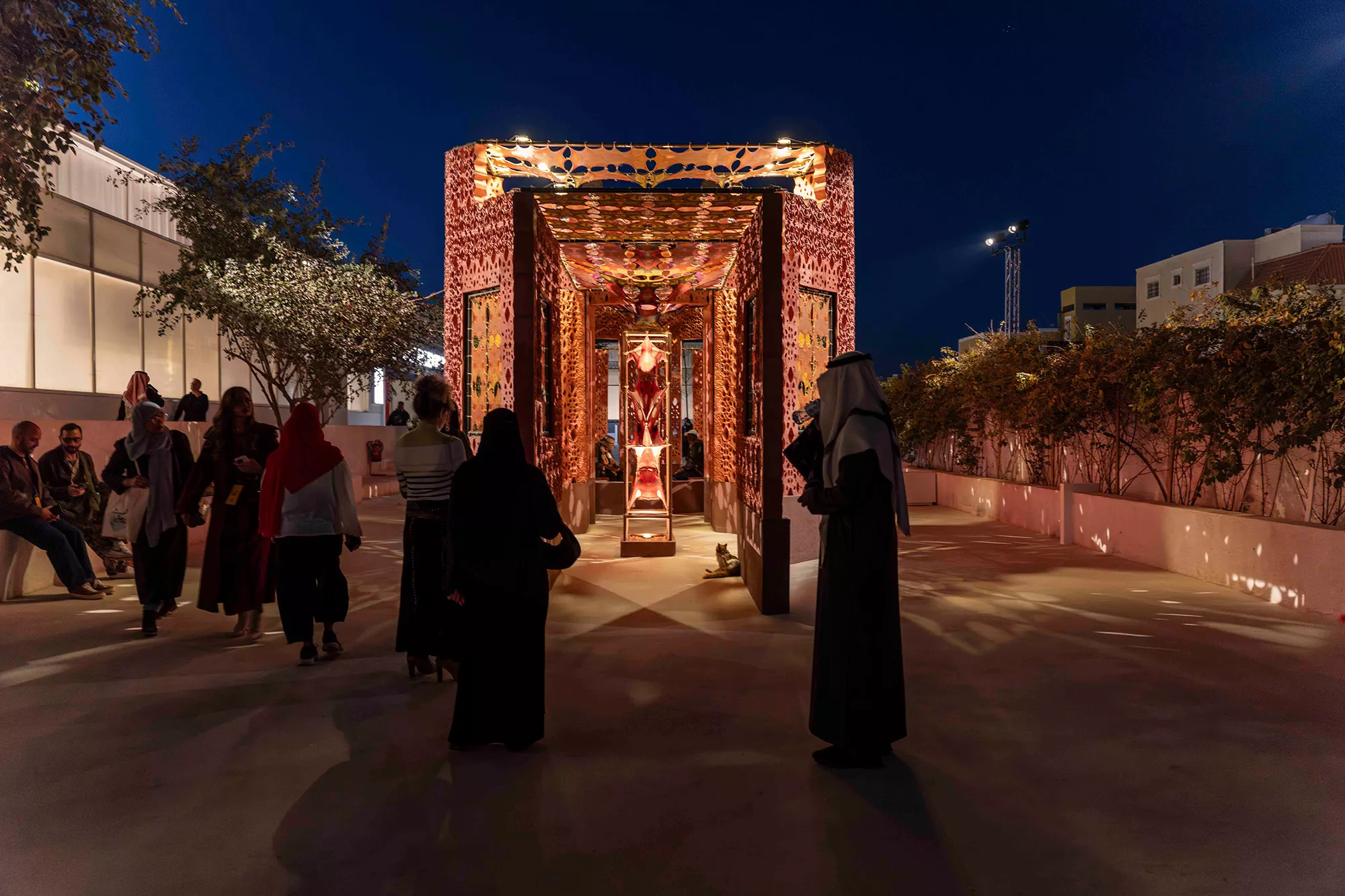
Rhythms and Processions Ignite Diriyah Contemporary Art Biennale
The exhibit that takes place in Saudi Arabia is inspired by the Arabian Bedouins’ nomadic journeys, and their connective force across history, culture and art.
6 min
Written by Rebecca Anne Proctor Photographed by Bader Awwad AlBalawi
A woman wearing a long white robe runs through the Tabuk desert. A spectator observes the woman, Saudi artist Ahaad Alamoudi—framed by the terrain’s rocky mountains and smooth sands, wind whipping through her hair—in forward motion but also the landscape moving around her.
Titled “The Run” (2026) and part of a single-channel video presented during the Diriyah Contemporary Art Biennale, the work is set against the backdrop of the desert. The powerful piece prompts the viewer to ask whether Alamoudi is running toward or away from something. While that fact remains unrevealed, the act of moving places this video among works that most symbolically reflect the theme of this edition of the biennale.
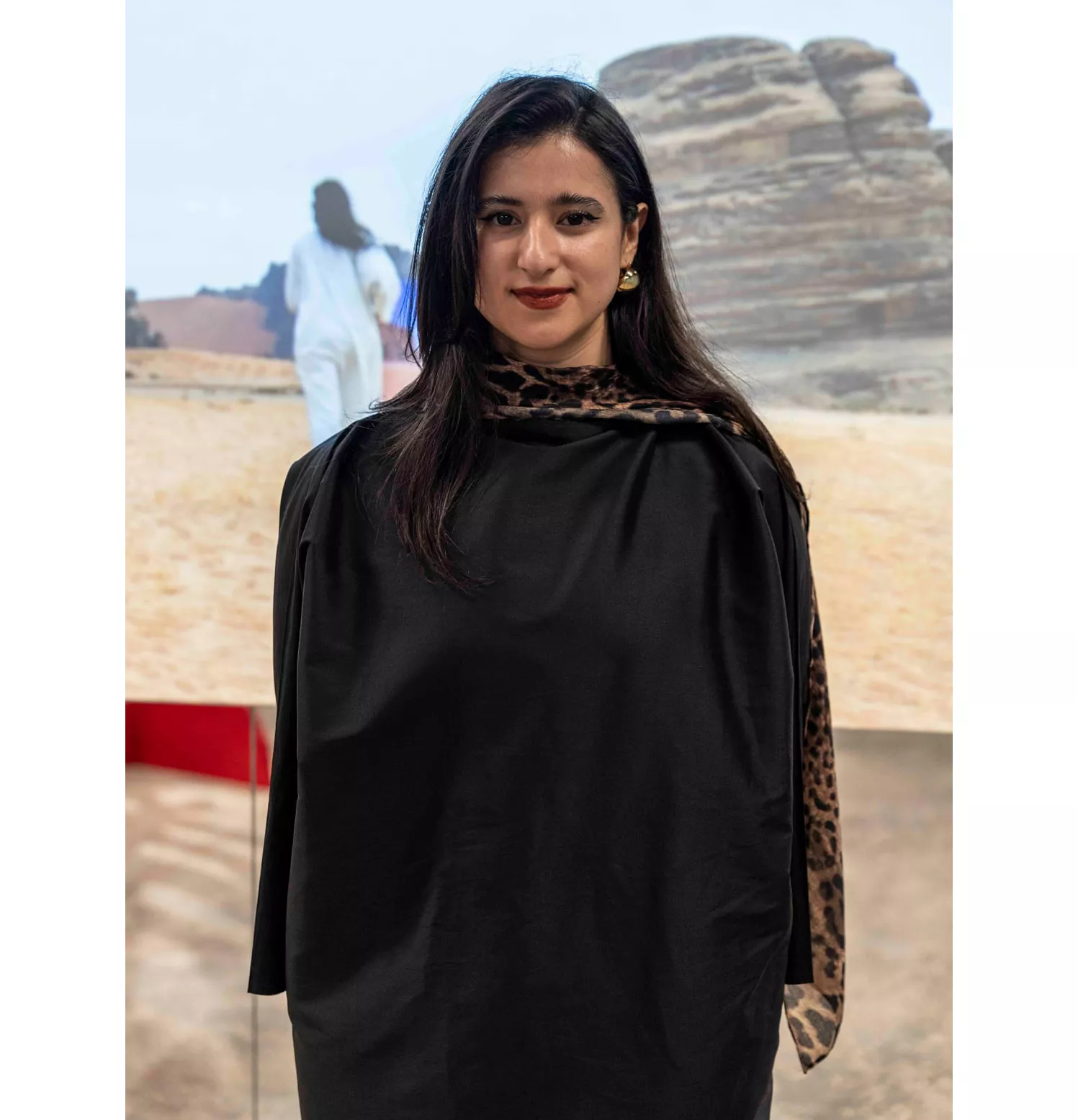
Ahaad Alamoudi poses in front of her video “The Run” at the Diriyah Contemporary Art Biennale.
“In Interludes and Transitions” suggests the idea of movement as an indisputable force that binds people, culture and creativity across time. The biennale’s title in Arabic— Fi Alhil wa-Altirhal—stems from a colloquialism that denotes the cycles of encampments and journeys among nomadic tribes on the Arabian Peninsula. It evokes the idea of community, connection and creativity born from such journeys to offer a sense of continuity in a world where only change or movement is constant.
“The piece is about infinite motion,” Alamoudi explains. “You see me running, but you never see an end. You never see me reach anywhere. And every time I go through an image, another image appears within the desert. It’s this continuous loop—this continuous procession that we’re moving towards.”
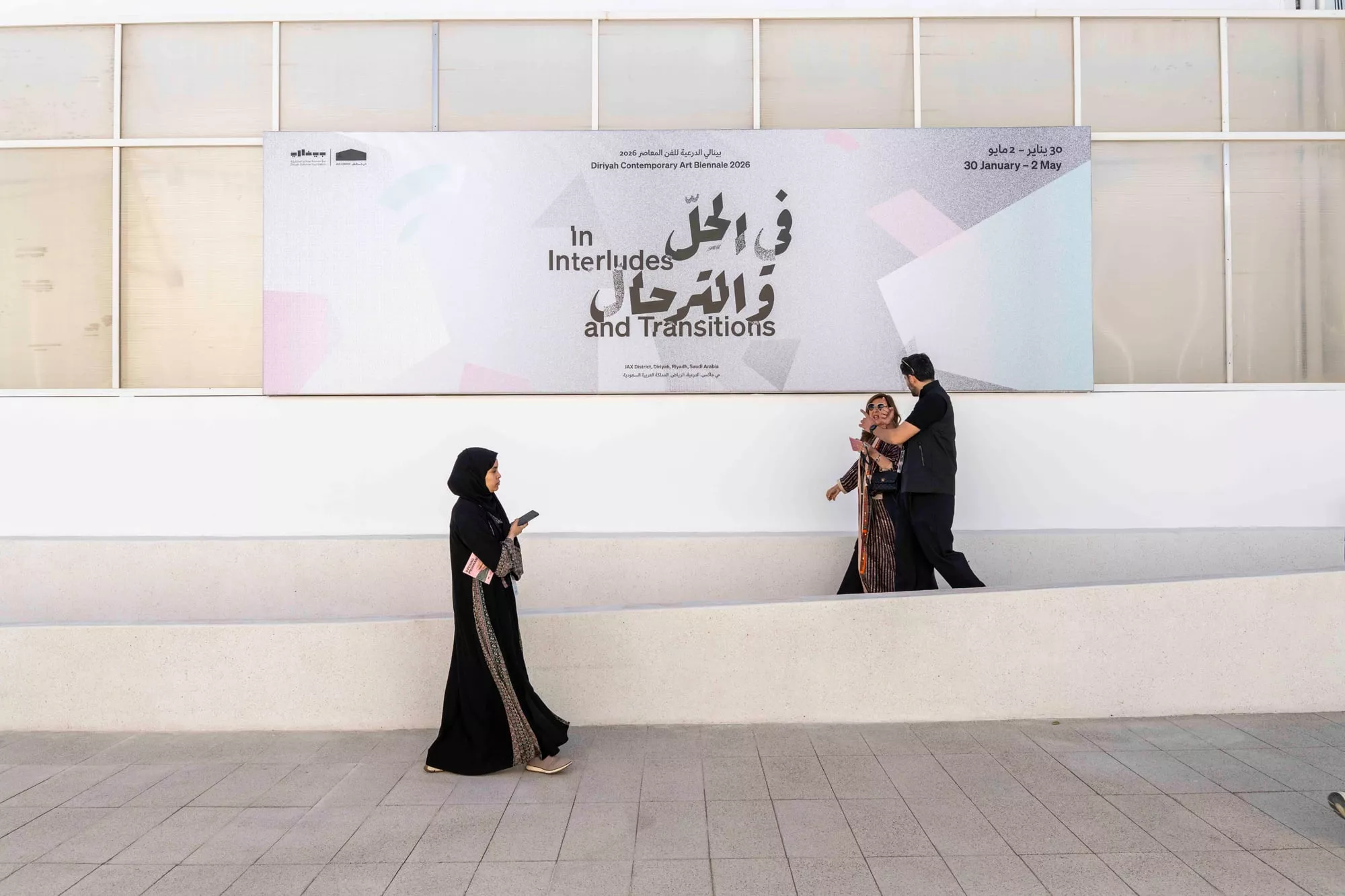
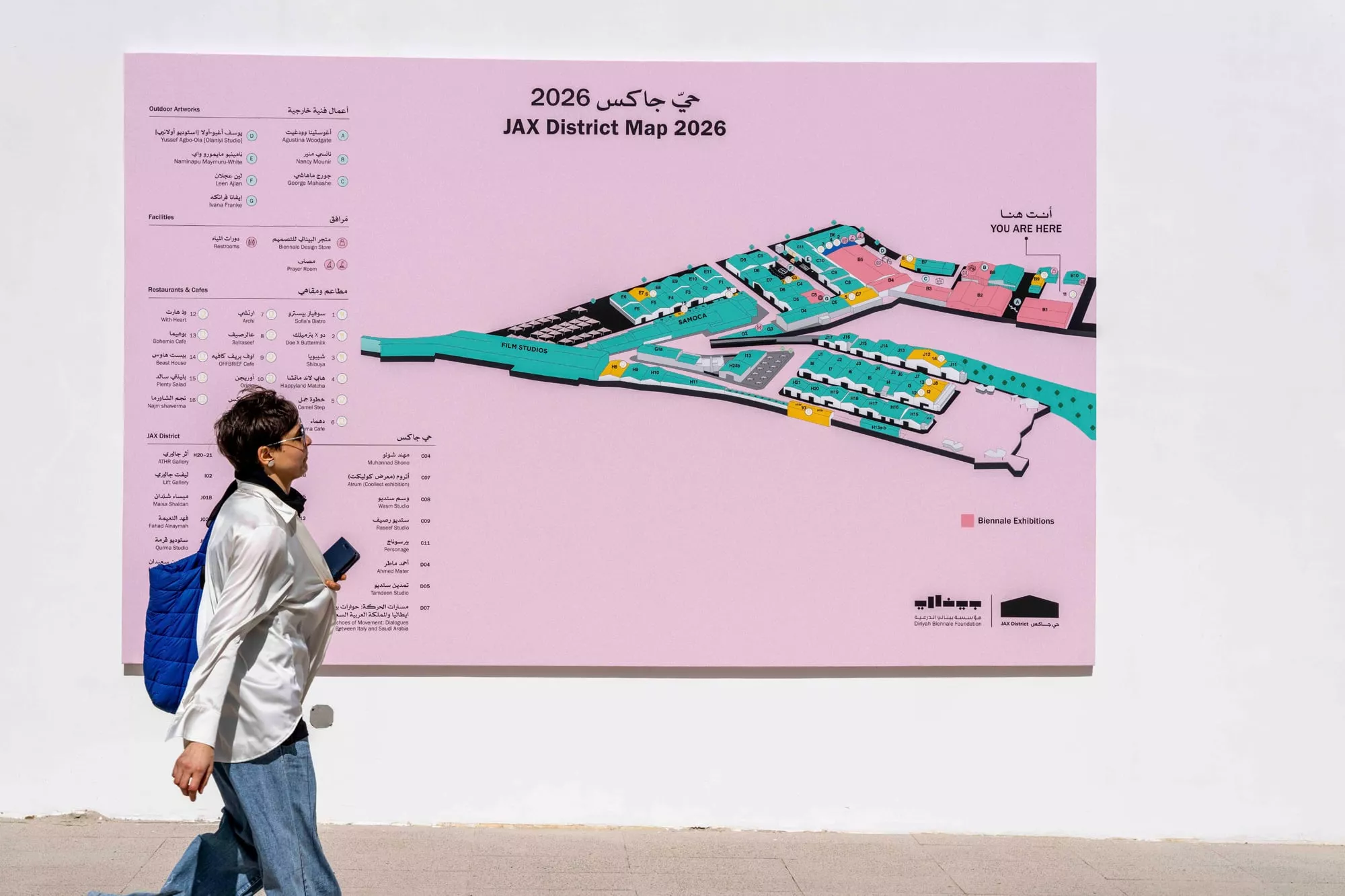
Signage welcomes visitors to the Diriyah Contemporary Art Biennale in the Jax District of Diriyah in Riyadh, Saudi Arabia
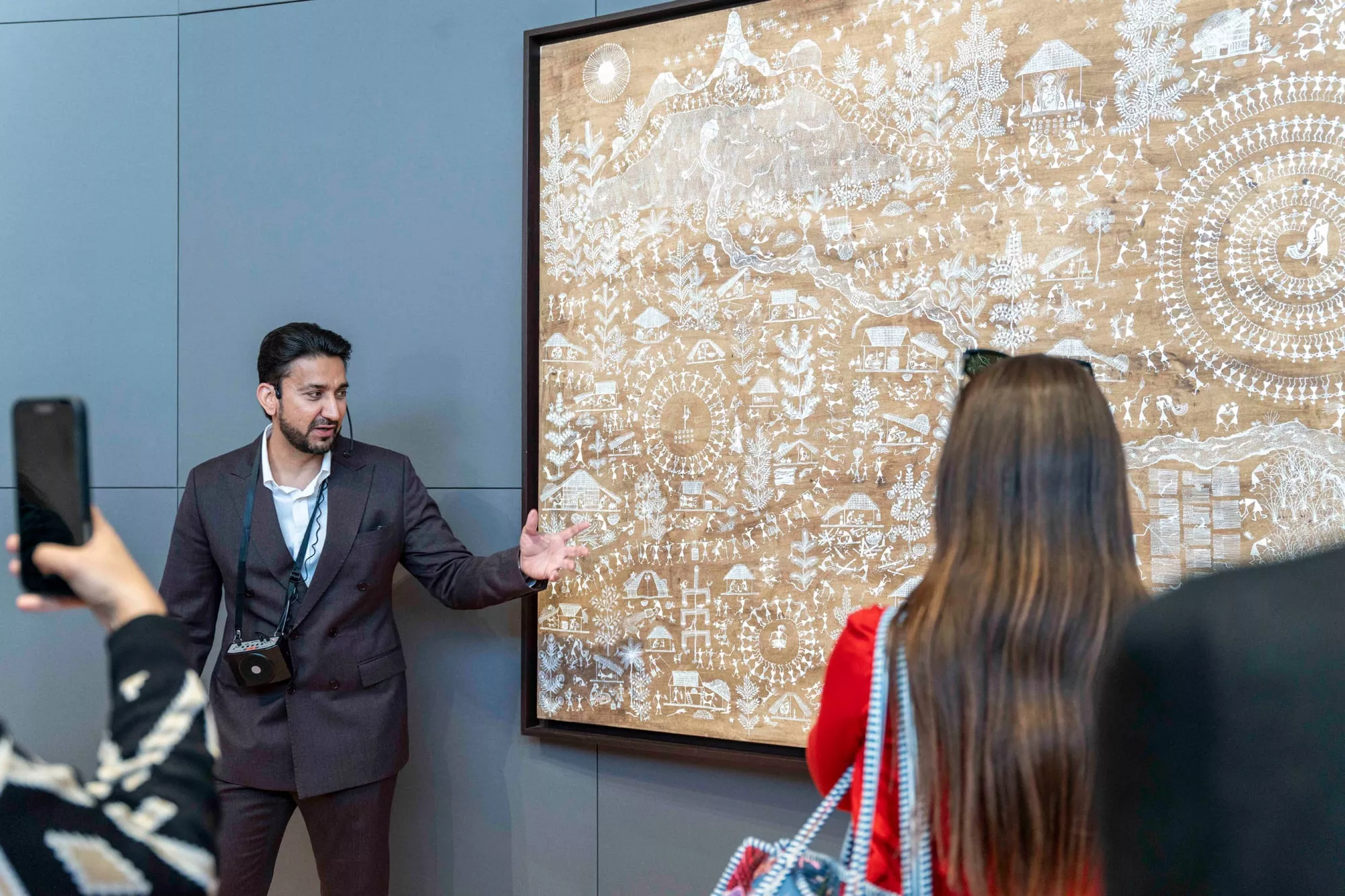
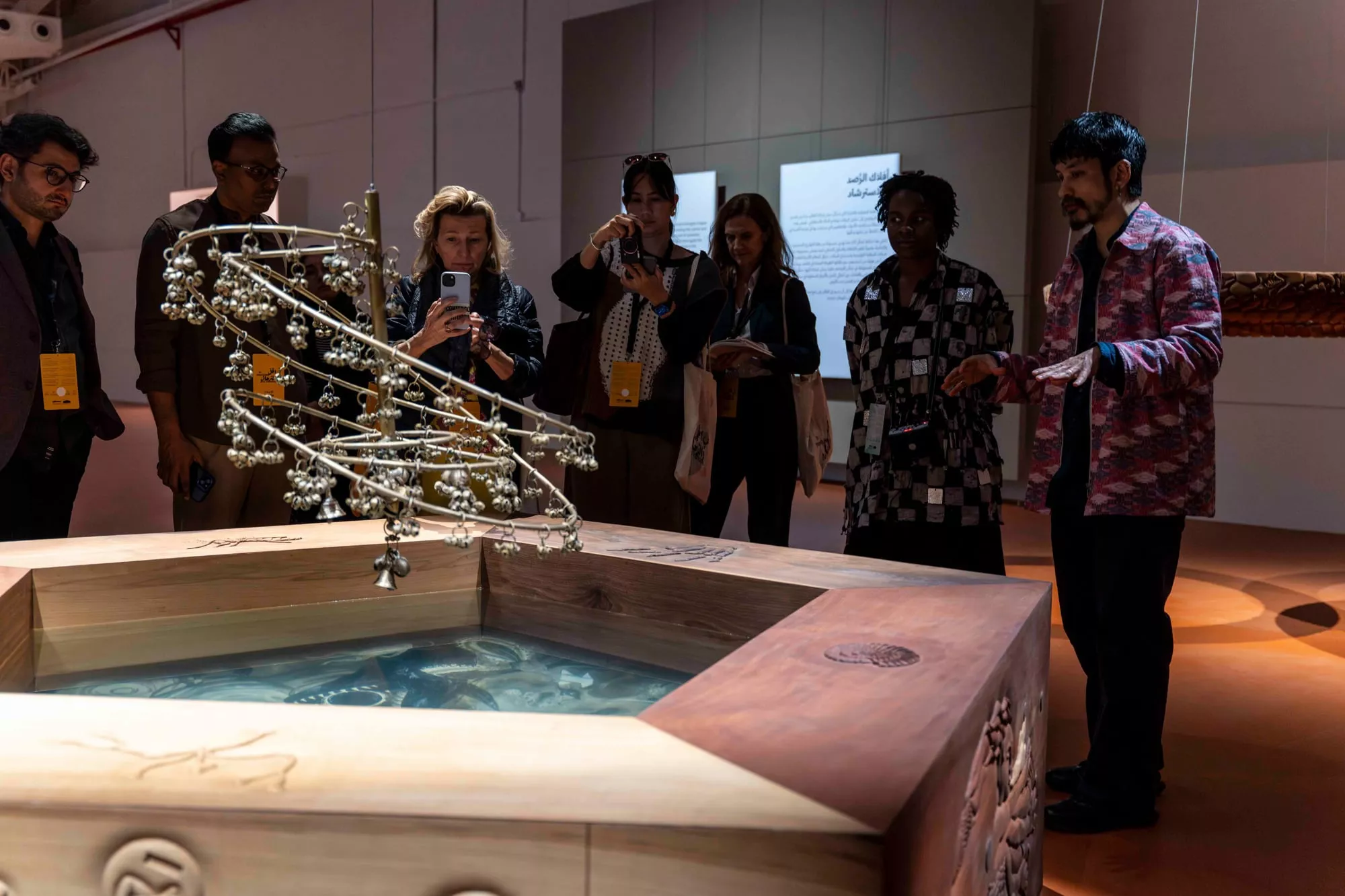
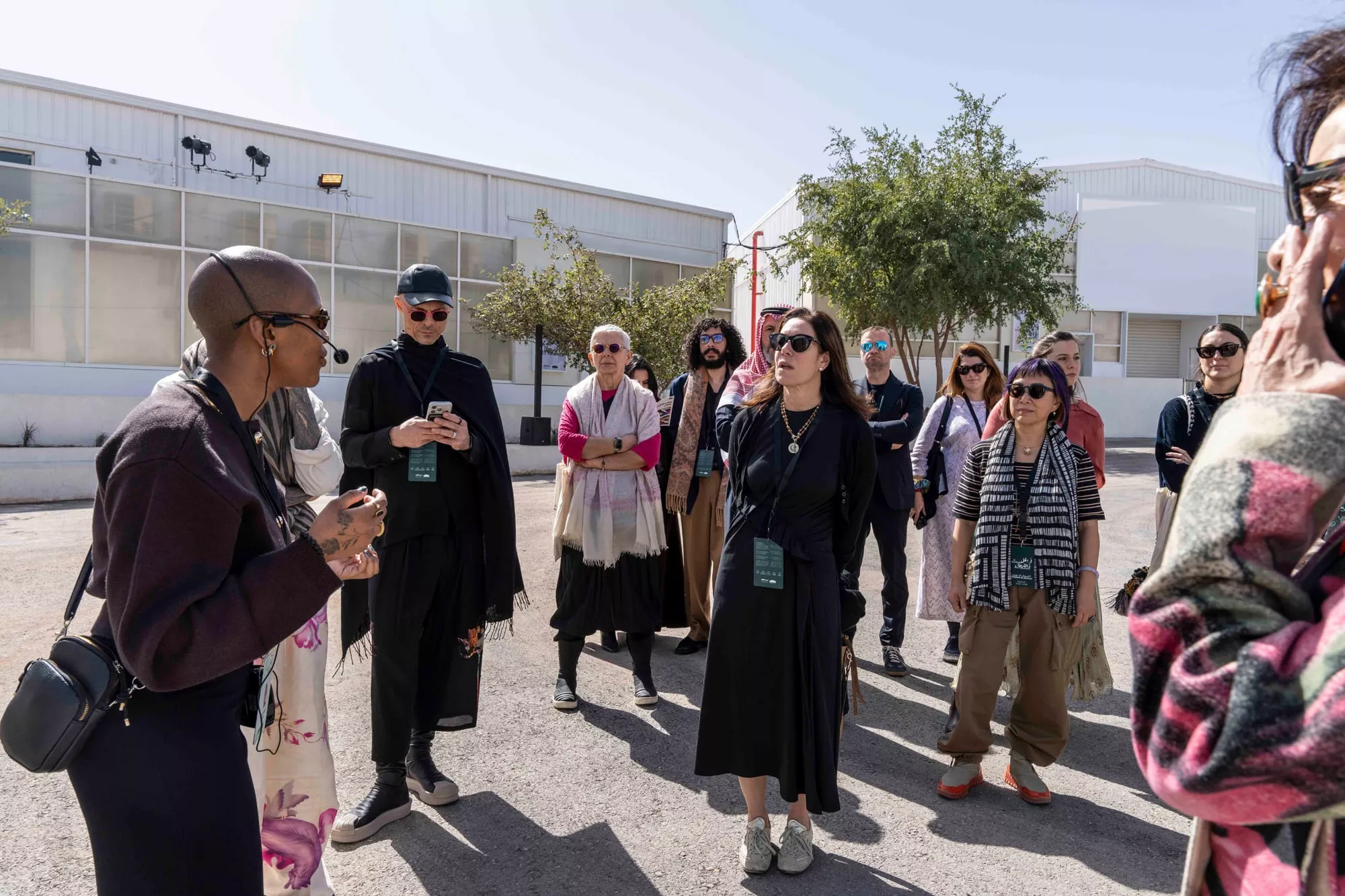
Co-Artistic Director Sabih Ahmed speaks about a piece by Rajesh Chaitya Vangad during a guided tour.
Alamoudi states that the piece is “about a reflection of this moment in time” and how symbols, screens, silence and forms of movement shape our collective imagination
The biennale, which runs until May 2 at the Diriyah Biennale Foundation in the creative hub known as the Jax District of Diriyah in Riyadh, features 100 works by over 70 artists from 37 countries in a variety of media, including painting, film, sculpture and mixed media installations.
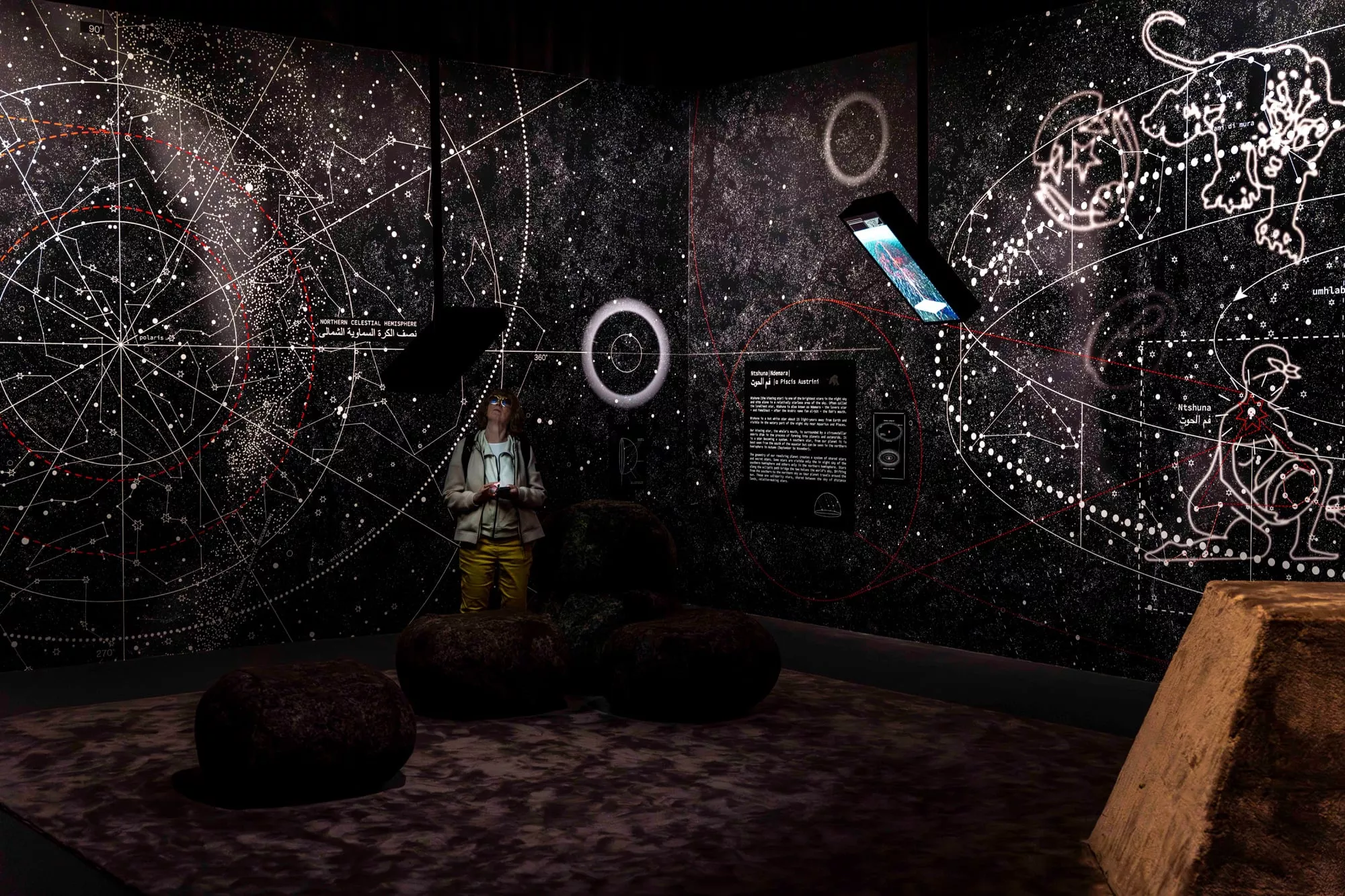
The pieces are placed in a poetic, almost rhythmic, manner—an ode to how histories, cultures and migrations across time metaphorically dance together. Positioned across five warehouses, the biennale is divided into four thematic movements—Disjointed Choreographies, A Forest of Echoes, A Collective Observation and A Hall of Chants—demonstrating how movement across time and space is a means for cultural production, an unseen force that unites people, places and events.
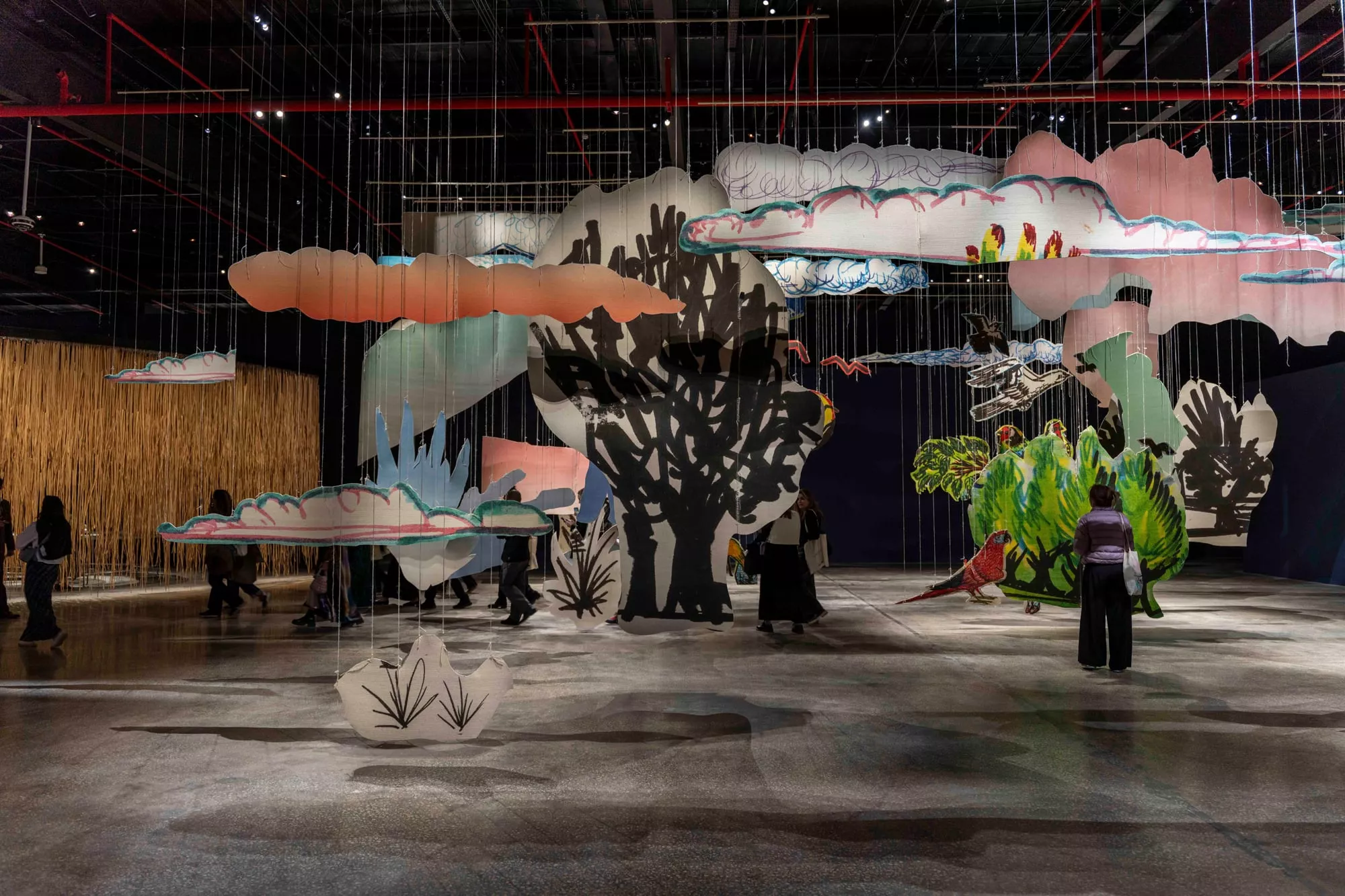
Petrit Halilaj’s “Very volcanic over this green feather” calls to mind both beauty and destruction.
Imagination on display
The first exhibition hall, Disjointed Choreographies, features the performative “Very volcanic over this green feather” (2021), a large-scale installation of suspended colorful drawings that Petrit Halilaj made when he was a 13-year-old in the Balkans. The drawings were part of a therapy program for children in a refugee camp.
Here movement is evoked through the gently swaying paper forms of Halilaj’s installation. Its content merges scenes of utter violence—buildings on fire and military tanks—with fantastical birds and volcanoes, demonstrating how joy and terror can coexist.
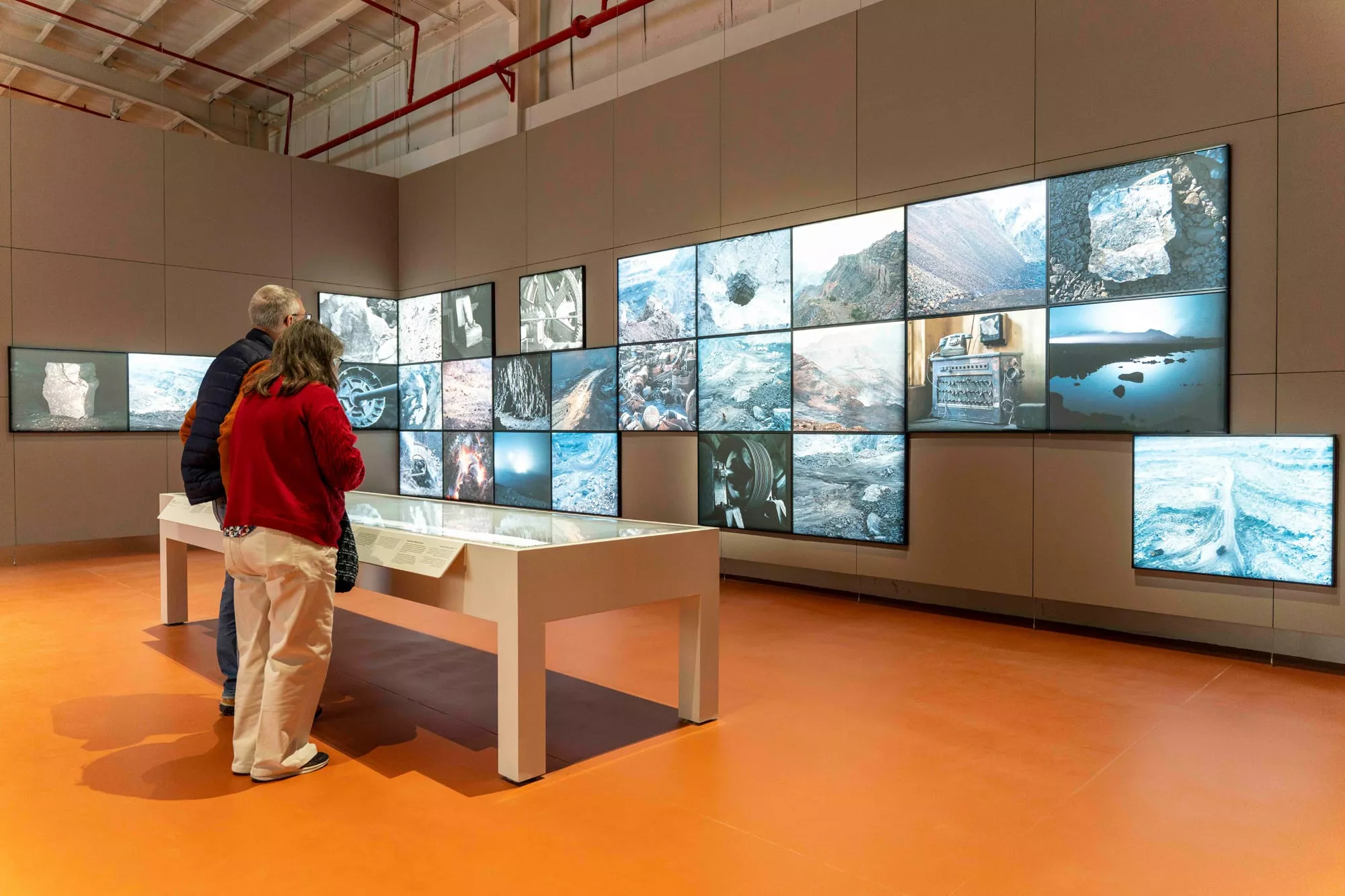
Visitors view Sarker Protick’s “Awngar” photography artwork.
Works depicting the imaginary realm continue in A Forest of Echoes. They offer moments of comfort and inspiration from some of the more solemn, realistic creations. Representations of diverse forms of life interlace the spiritual, biological and technological realms of our world.
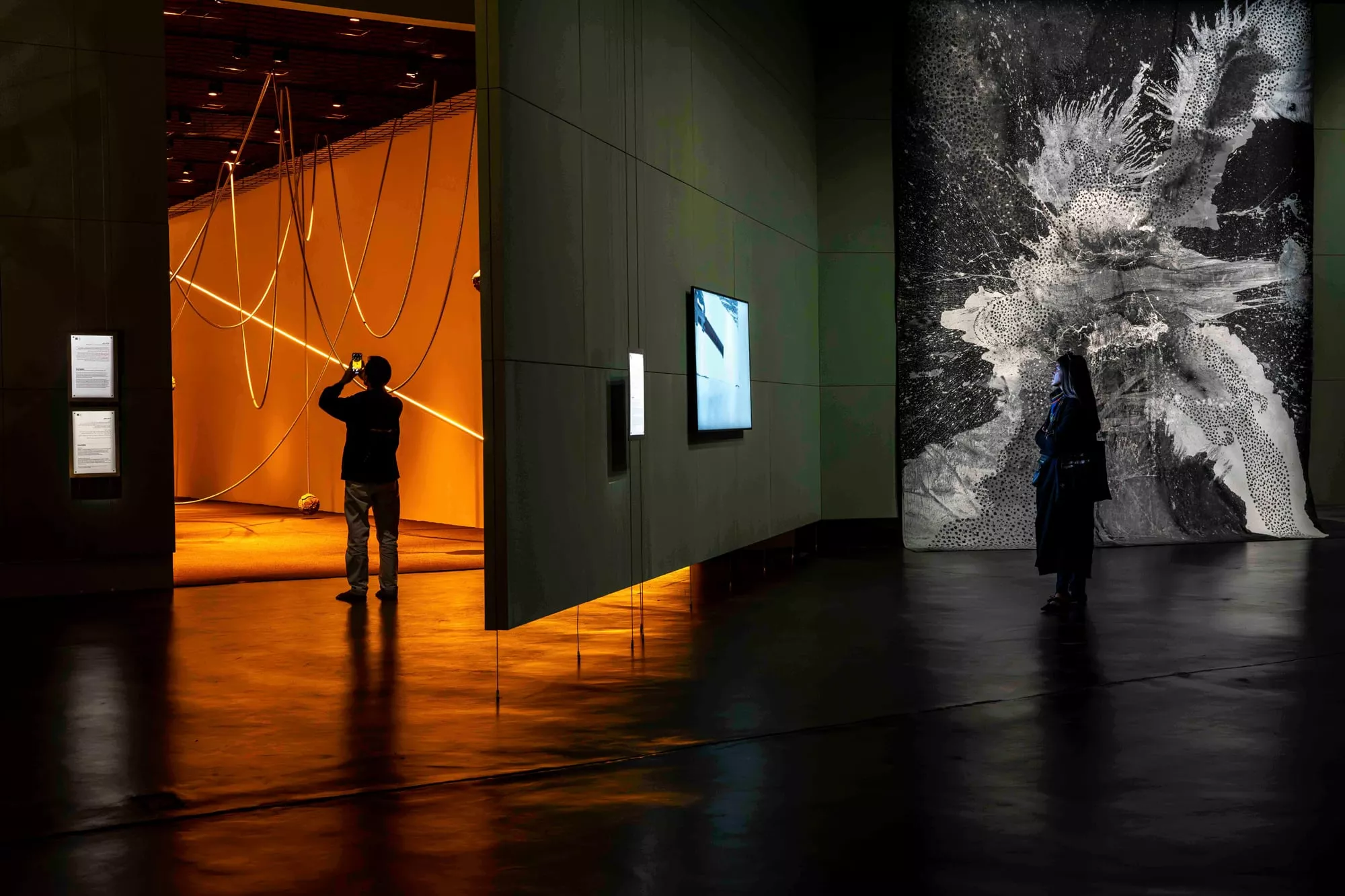
Here Saudi artist Faisal Samra’s “Immortal Moment III (Post Shock Creatures 02)” (2026), a mixed-media work on tarpaulin tent cloth and video showing what appears to be an explosion of various substances, serves as an analogy to the artist’s own life within cosmic time.
The poetic, almost rhythmic placement of works in the third edition of the Diriyah Contemporary Art Biennale serves as an ode to how histories, cultures and migrations metaphorically dance together.
The poetic, almost rhythmic placement of works in the third edition of the Diriyah Contemporary Art Biennale serves as an ode to how histories, cultures and migrations metaphorically dance together.
The poetic, almost rhythmic placement of works in the third edition of the Diriyah Contemporary Art Biennale serves as an ode to how histories, cultures and migrations metaphorically dance together.
The poetic, almost rhythmic placement of works in the third edition of the Diriyah Contemporary Art Biennale serves as an ode to how histories, cultures and migrations metaphorically dance together.
The poetic, almost rhythmic placement of works in the third edition of the Diriyah Contemporary Art Biennale serves as an ode to how histories, cultures and migrations metaphorically dance together.
The poetic, almost rhythmic placement of works in the third edition of the Diriyah Contemporary Art Biennale serves as an ode to how histories, cultures and migrations metaphorically dance together.
The poetic, almost rhythmic placement of works in the third edition of the Diriyah Contemporary Art Biennale serves as an ode to how histories, cultures and migrations metaphorically dance together.
The poetic, almost rhythmic placement of works in the third edition of the Diriyah Contemporary Art Biennale serves as an ode to how histories, cultures and migrations metaphorically dance together.
The poetic, almost rhythmic placement of works in the third edition of the Diriyah Contemporary Art Biennale serves as an ode to how histories, cultures and migrations metaphorically dance together.
Works based in reality
In A Collective Observation, visitors are brought back to Earth through works that explore how a diversity of knowledge systems and technologies shape the ways we sense and experience the world.
Of note is Bangladeshi artist Sarker Protick’s “Awngar” (2024-’26), a recent series of photographs from the historical region of Bengal, comprising parts of India and Bangladesh. It examines the ruins of the British Empire through abandoned British railway infrastructure in what was once an undivided Bengal. Protick’s images offer captivating dystopian landscapes that are clouded in dust and other remnants of industrial extraction. Awngar, explains Protick, is a poetic Bengali term meaning “fire” as well as “internal struggle.”
“Some of my works try to encapsulate that we are going back in time or [that] from the past we are coming to the present,” he says.
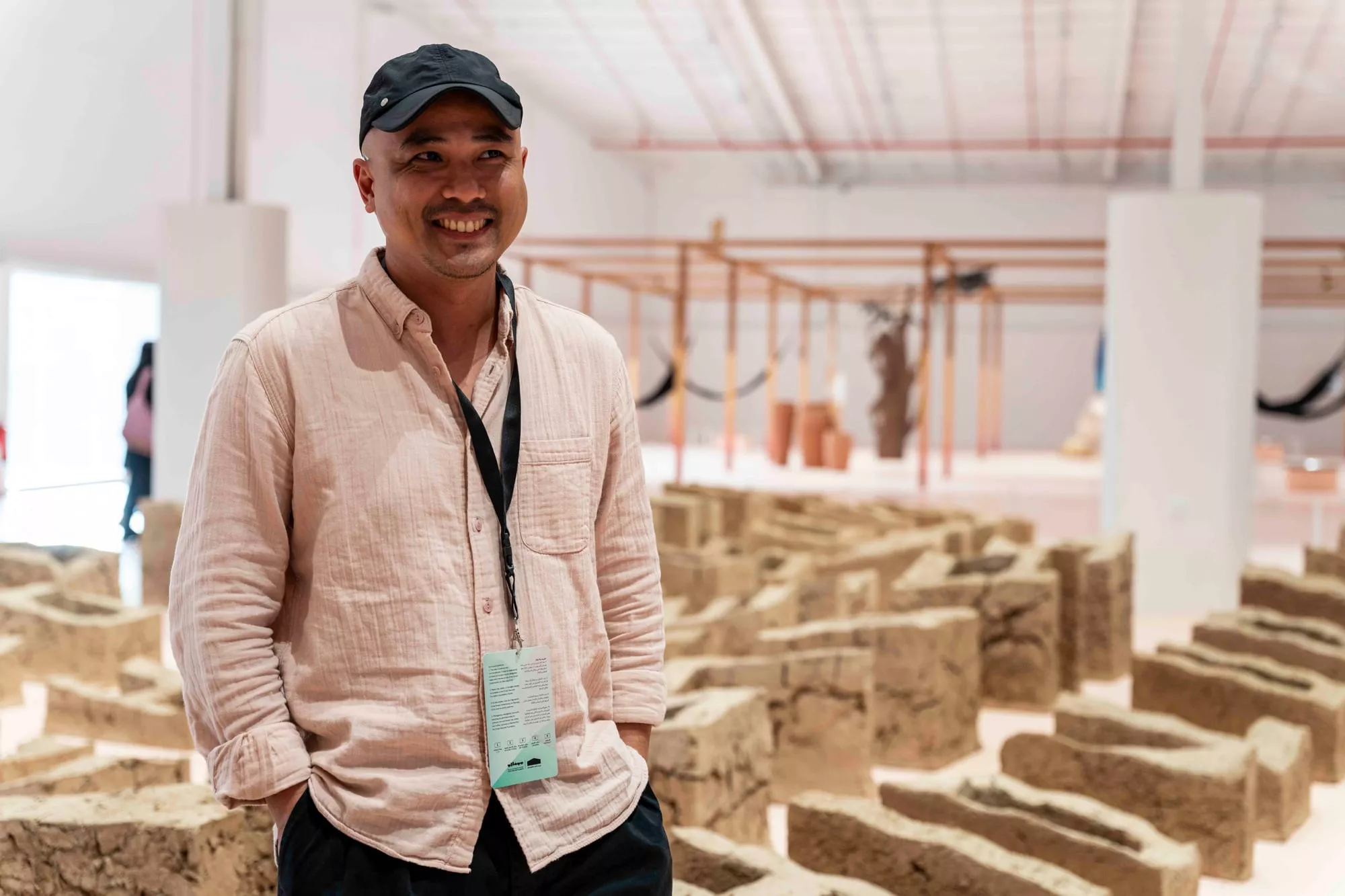
Pio Abad created a mud-brick installation, “Vanwa.”
In A Hall of Chants, upbeat and often playful creations by artists from Saudi Arabia and beyond depict our oft complicated relationships with place and language.
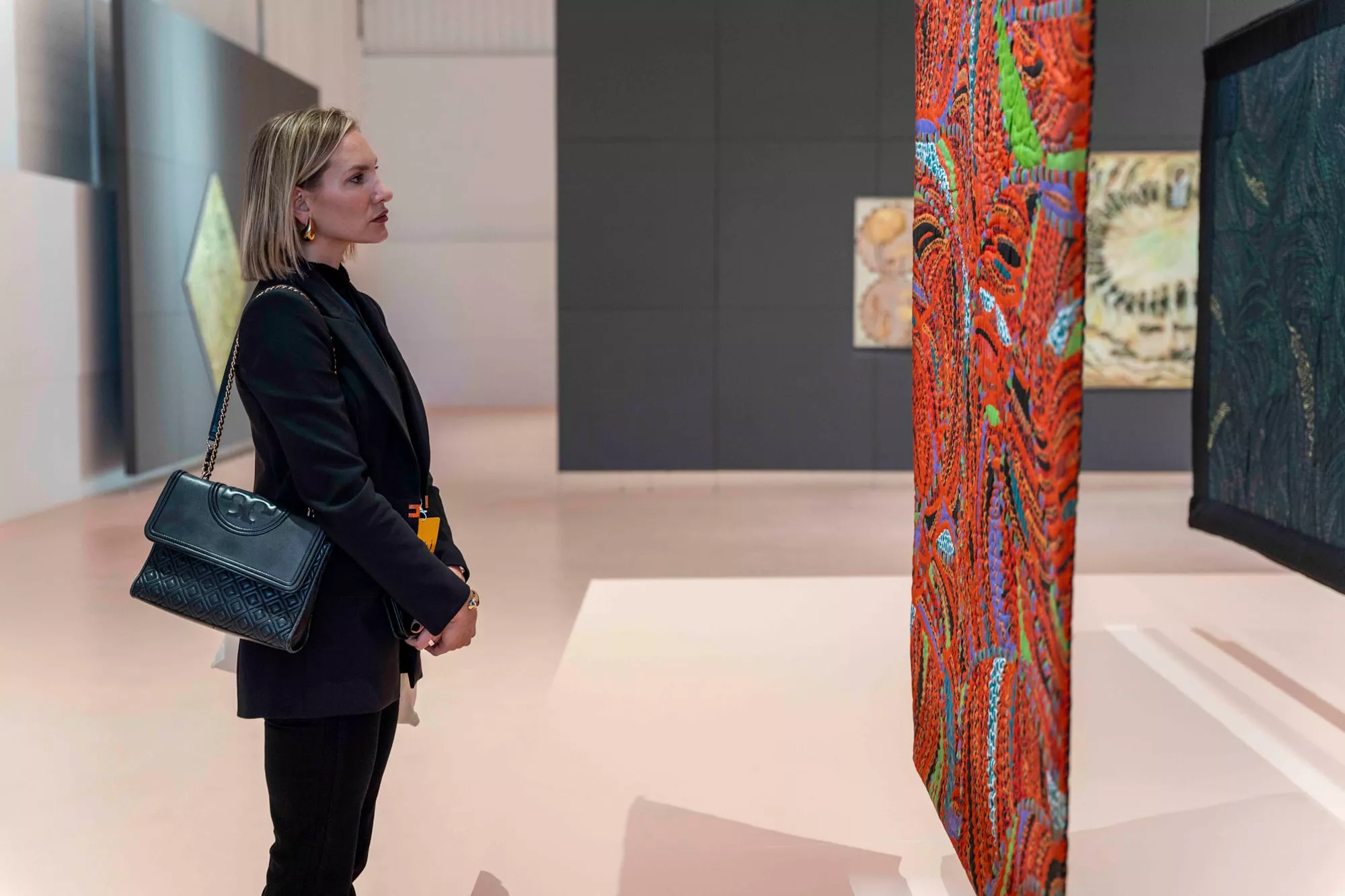
Highlights include the vibrantly hued “Asian Abstractions” (1983-’92) by the late Filipina artist Pacita Abad and the 99 mud-brick sculptures of her nephew Pio Abad’s large installation “Vanwa” (2023-’26). The latter draws on Abad’s heritage; he is descended from the Ivatan, an indigenous group from the Batanes and Babuyan islands of the northern Philippines. The work embodies vernacular building techniques and spells out a traditional Ivatan poem.
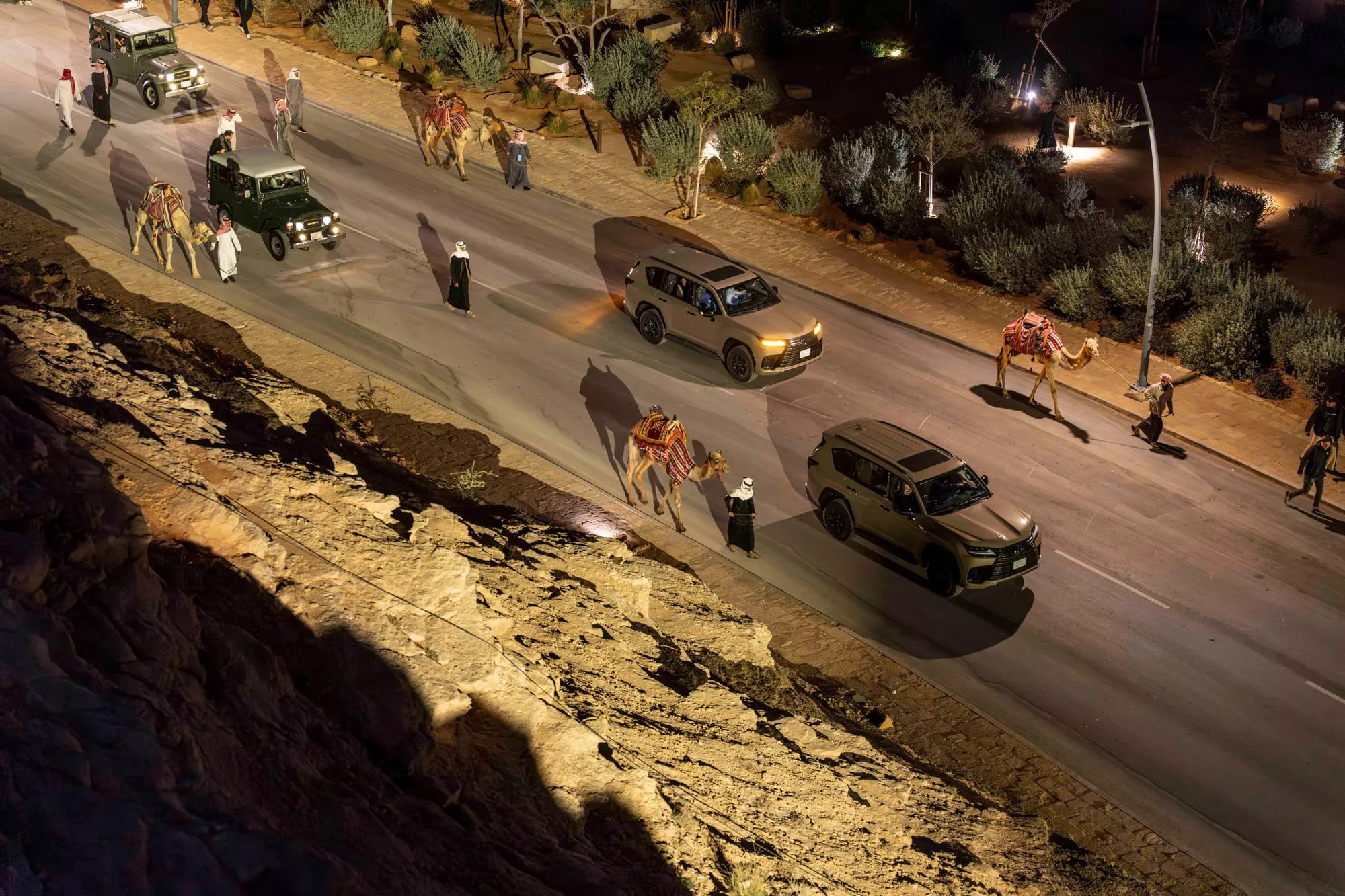
Mohammed Alhamdan’s “Folding the Tents” enacts the biennale theme of procession.
The biennale perhaps most poignantly and deliberately enacts the idea and physical act of procession in “Folding the Tents” (2026) by Saudi artist Mohammed Alhamdan. On the biennale’s opening night, a procession of Toyota pickups roared through the dry river valley of Wadi Hanifah alongside camels in a spectacle known locally as chasse.
As onlookers watched and participating Saudi men and women laughed and smiled, Alhamdan’s work grounded the biennale in contemporary Saudi culture, demonstrating how the procession of the Arabian Bedouins has been adapted over time and is still very much alive.
About the Author
Bader Awwad AlBalawi
Bader Awwad AlBalawi is a photographer, writer and filmmaker based in Khobar, Saudi Arabia. His work explores travel, street life and cultural transitions.
Rebecca Anne Proctor
Rebecca Anne Proctor is an independent journalist, editor and broadcaster based between Dubai and Rome. She is a former editor-in-chief of Harper’s Bazaar Art and Harper’s Bazaar Interiors.
You may also be interested in...
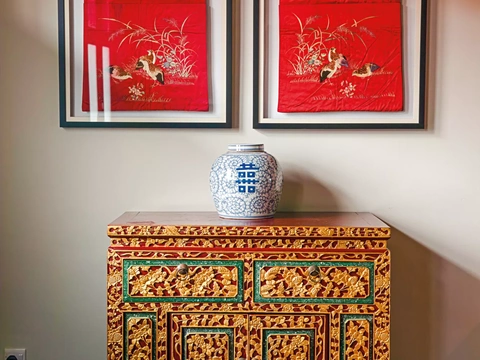
A Conversation With the Keeper of Malaysia’s Peranakan Memory
Malaysian hotelier Chris Ong has amassed an impressive Peranakan heritage collection of at least 10,000 artifacts.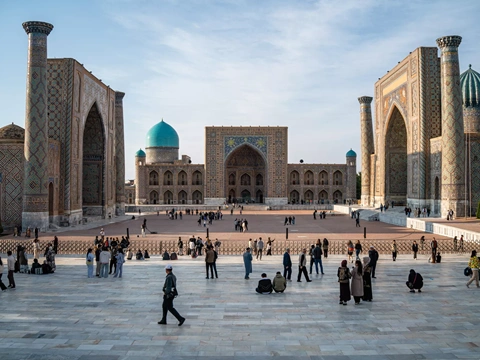
Inside the Fight To Preserve Samarkand’s Ancient Wonders
With earthquakes, weather, tourism and time threatening some of the world's most celebrated Islamic architecture, restorers ensure that the knowledge behind the monuments survives alongside the buildings themselves.
Connecting Across Cultures: A Conversation With Author Nawar Shora
Through humor and shared stories, Nawar Shora explores how understanding builds trust across cultures and communities.