Threads and Clay: Three Pavilions Keeping Cultural Heritage Alive at the Venice Biennale
At the Venice Biennale, which runs through November 22, 2026, the Moroccan, French and Saudi national pavilions show how craft and shared memory can resist cultural erasure.
Step under the canopy of woven fibers in Morocco’s pavilion at the Venice Biennale, and the bustle of the prestigious arts and cultural festival’s opening days seamlessly fades away. As light filters through layers of organic hued handwoven textiles, the subtle marks of hundreds of artisans’ hands come into sight. It is a serendipitously uplifting and quiet encounter—one that reflects the transmission of history and craft—in precisely the manner envisioned by the late Cameroonian Swiss curator Koyo Kouoh.
Koyo Kouoh, artistic director of the 61st International Art Exhibition of the Venice Biennale, titled “In Minor Keys,” passed away in 2025 before the exhibition opened. In her curatorial statement, she described the exhibition as a response to “the anxious cacophony of the present,” inviting visitors instead to “shift to a slower gear and tune in to the frequencies of the minor keys.”
Realized after Kouoh’s death, the biennale, which opened in May and runs until November 22, 2026, asks visitors to engage with art through emotion, sensation and reflection. As she wrote, it offers "a radical reconnection with art's natural habitat and role in society" by foregrounding "the emotional, the visual, the sensory, the affective, the subjective." At its heart is Kouoh's belief that artists help us understand the social conditions of our time.
In line with Kouoh’s curatorial mission, throughout the biennale an emphasis is placed on the revaluation of artisanal craft and indigenous practices to preserve traditional cultures and reclaim heritage. Three national pavilions, in particular, explore the importance of preserving intangible and tangible culture through artworks created using slower, handmade processes to act as forms of resistance against cultural erasure.
Morocco’s “Asǝṭṭa,” France’s “Comme Saturne (Like Saturn)” and Saudi Arabia’s “May Your Tears Never Dry, Those Who Weep Over Stones” each approach this idea in their own way. Together, however, they champion the idea of cultural transmission through artisanal craft-based works to preserve historical memory, passed down across generations, hand by hand.
The Moroccan Pavilion: Rituals of Memory and Space
For Moroccan artist Amina Agueznay, innovation and tradition are inseparable. Representing Morocco in the country’s first official national pavilion at the Venice Biennale, she sees cultural transmission as a process of continual renewal rather than preservation alone. “You need to have a vernacular or traditional object to then be able to develop it into something different,” she says.
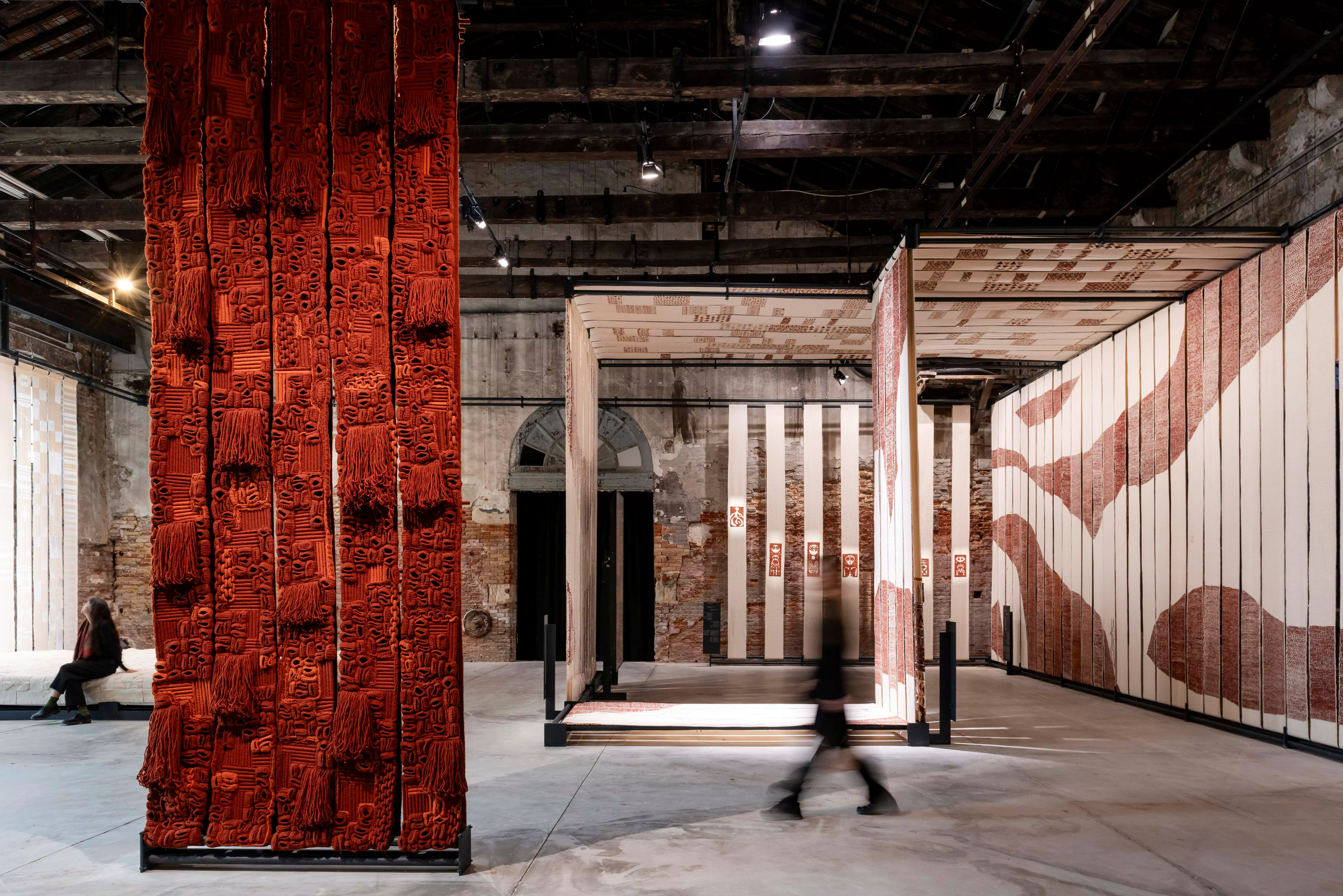
Entering the Moroccan Pavilion, located within the Arsenale—the vast former naval dockyards that make up one of the biennale’s primary spaces—is an immersive sensory experience into the tactile ritual of weaving. Titled “Asǝṭṭa” and curated by Meriem Berrada, the installation fills the space with a monumental 300-square-meter textile structure suspended overhead like woven architecture. Agueznay created the work with 166 Moroccan artisans, predominantly women, from Casablanca, Marrakech, southern Morocco and communities across the Atlas Mountains, enveloping visitors in layered membranes of handwoven fiber.
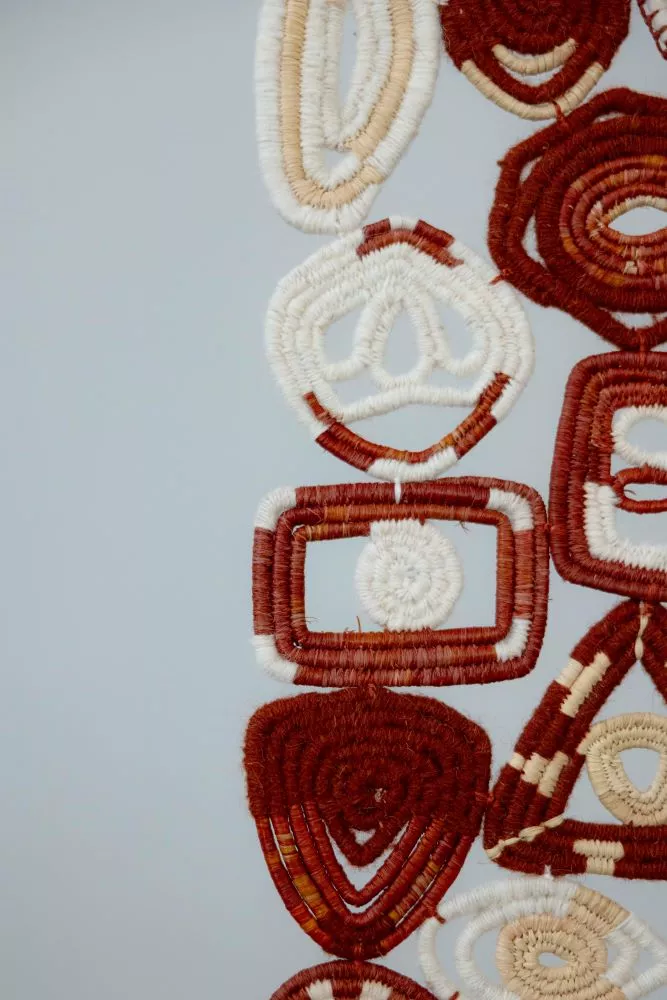
“Asǝṭṭa” (detail), 2026, by artist Amina Agueznay. Courtesy of the Moroccan Ministry of Youth, Culture and Communication © Ayoub El Bardii Top: Co-created with 166 Moroccan artists, “Aseṭṭa” features prominently at the Pavilion of the Kingdom of Morocco at the Venice Biennale. Courtesy of the Ministry of Youth, Culture and Communication of the Kingdom of Morocco © Matteo Losurdo
Its title derives from the Amazigh language, spoken by the Indigenous people of North Africa, where asatta refers both to the loom and the ritual of weaving. The installation also draws on the Moroccan architectural concept of âatba—a threshold marking the transition between one space and another—suggesting weaving itself as a passage between past and present.
“Heritage is a living substance, with innovation as its life force,” says Agueznay. Dozens of variously colored, multipatterned works unfold within the space at the heart of the Arsenale, acting like a second skin for the Arsenale’s Artiglierie, a historical building erected in 1560 that originally served as the weapons and artillery workshops of the then-republic’s naval industry. The visitor feels as if they have journeyed through a passage and found themselves within a refuge cocooned in woven artworks.
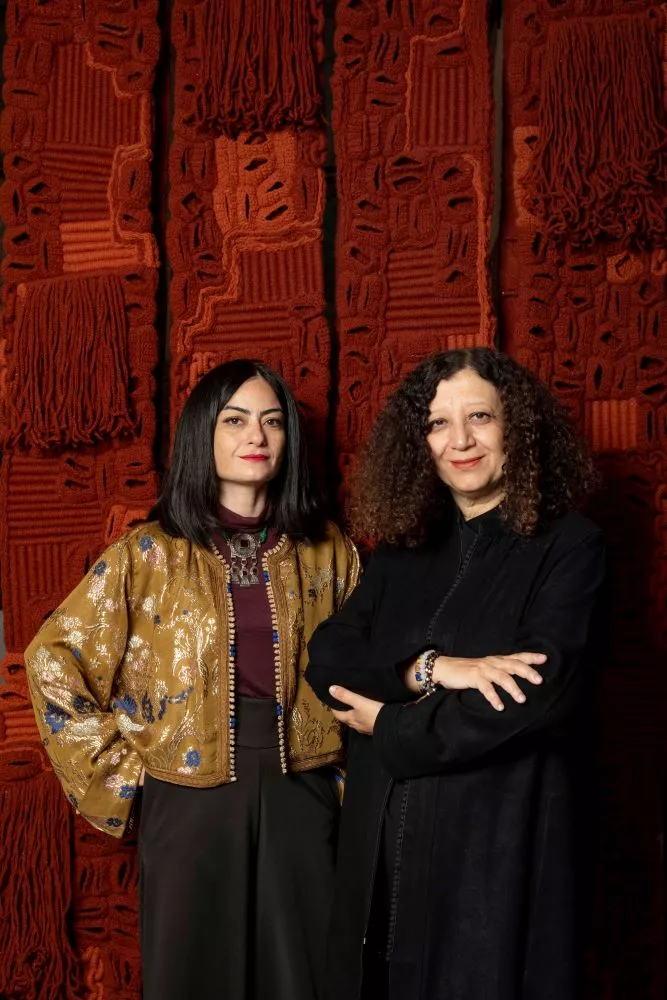
Curator Meriem Berrada, left, and Agueznay pose at the biennale. Courtesy of the Ministry of Youth, Culture and Communication of the Kingdom of Morocco © Matteo Losurdo
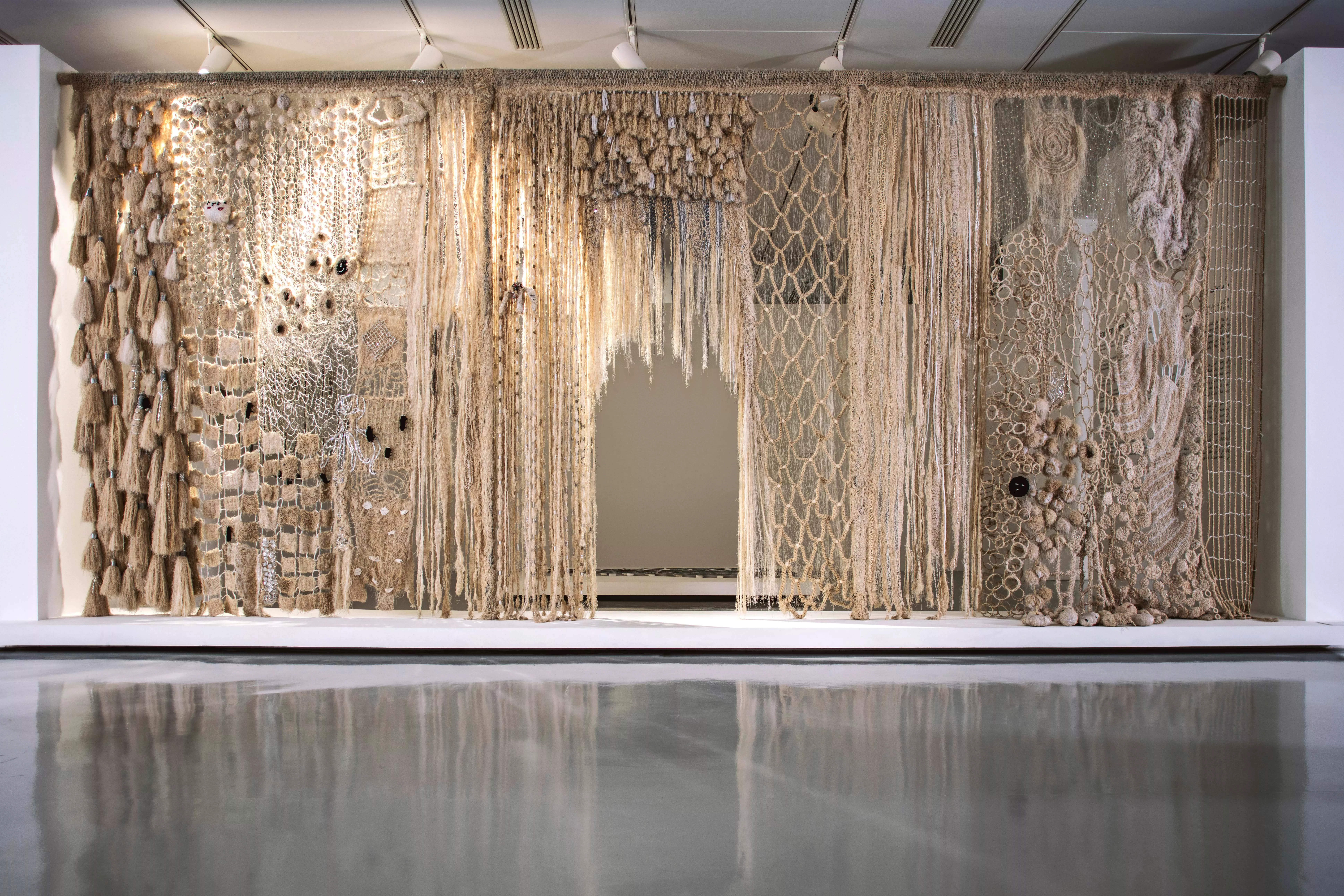
Twenty-five craftswomen used the techniques of crochet, knitting, weaving, macramé, braiding, rope- and pompom making, embroidery (including Randa, traditional Moroccan embroidery), beading and sewing to produce Skin, 2011. It consists of recycled fishing nets, viscose and nylon threads, cotton threads, sisal rope, stainless steel wire, plastic sequins, glass and plastic beads, paper and stainless steel. © Khalil Nemmaoui. With the support of Bank al Maghrib and CultureInterface
The pavilion is infused with ritual. The works reflect a connection to the Moroccan landscape, gestures, traditions and voices that shape and sustain Morocco’s artisanal traditions. “In Amina’s work everything is linked,” says Berrada. “A symbol from an earlier piece might find itself in a newer work or one of her jewelry pieces, textiles or baskets.”
Through her work in the field, Agueznay has observed an increasing need for cultural transmission in Morocco.
“It became clear to me in recent workshops that some of our tangible heritage is disappearing,” explains Agueznay. “Some of the artisans don’t know the names of certain symbols anymore, so they can’t create them. But they are still willing to experiment with me. If there’s a dialogue, an exchange between me and the artisans, in there is a transmission. Some repeat ancestral gestures, and some innovate them.
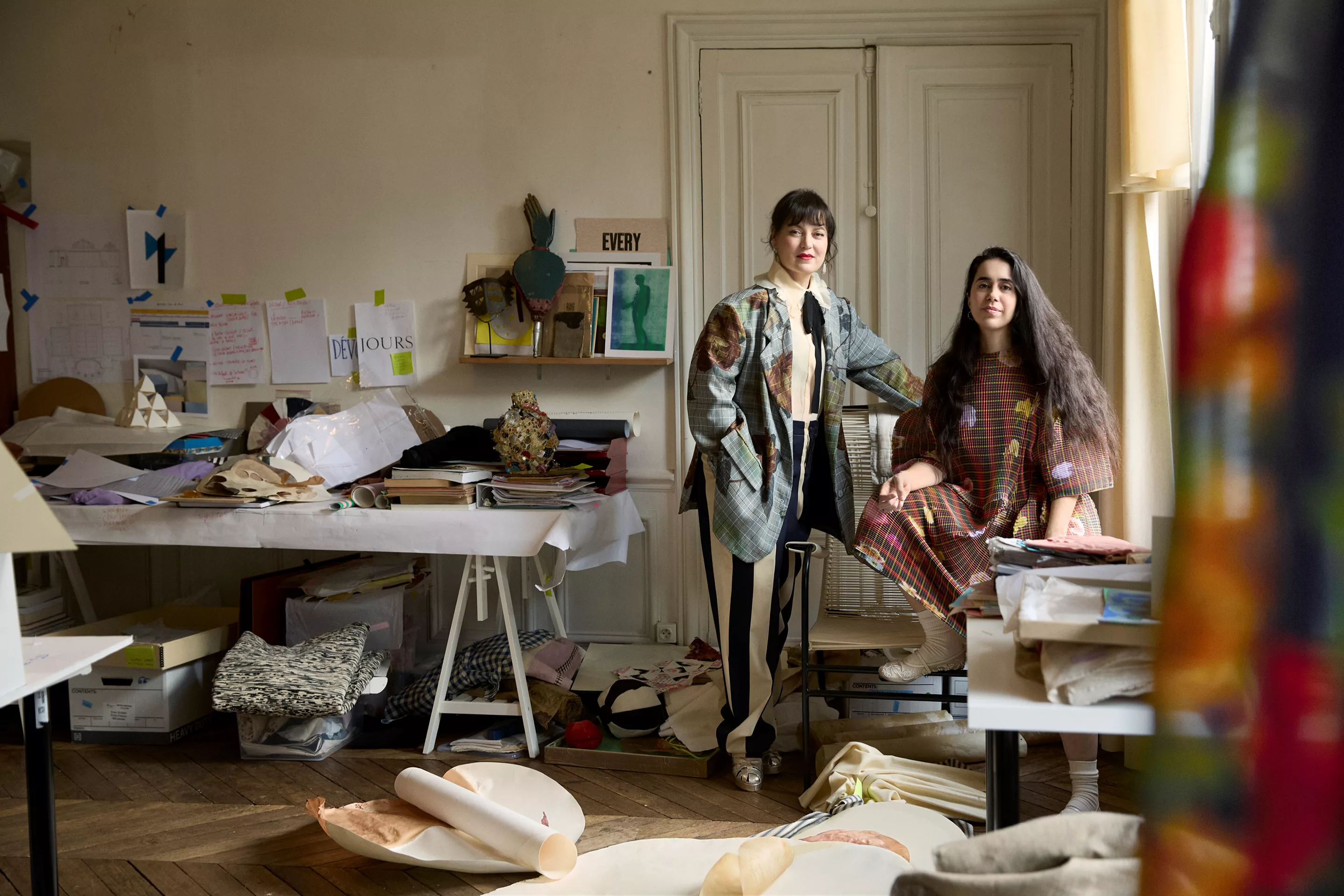
Artist Yto Barrada poses with French Pavilion curator Myriam Ben Salah. Courtesy of Institut Français - Benoit Peverelli
The French Pavilion: Poetic Tools for Survival
Born in France and raised in Morocco, Yto Barrada explores intertwined histories of beauty and destruction in “Comme Saturne (Like Saturn),” her exhibition for the French Pavilion. Exploring the intersection of history, labor and cultural phenomena through the lens of largely textile-based works, Barrada reactivates the dual nature of the ancient figure of Saturn to explore historical cycles of abundance, exploitation and renewal.
Visitors move through interconnected spaces draped in wool and filled with a selection of textiles, sculptures, films, typographic prints and transformed objects.
At the heart of the exhibition is dévoré, meaning “devoured” or in this context, “burnout,” an 18th-century textile technique in which parts of a blended fabric are chemically dissolved to create semi-transparent patterns. For Barrada, the process becomes both material and metaphor: Beauty emerges through erasure.
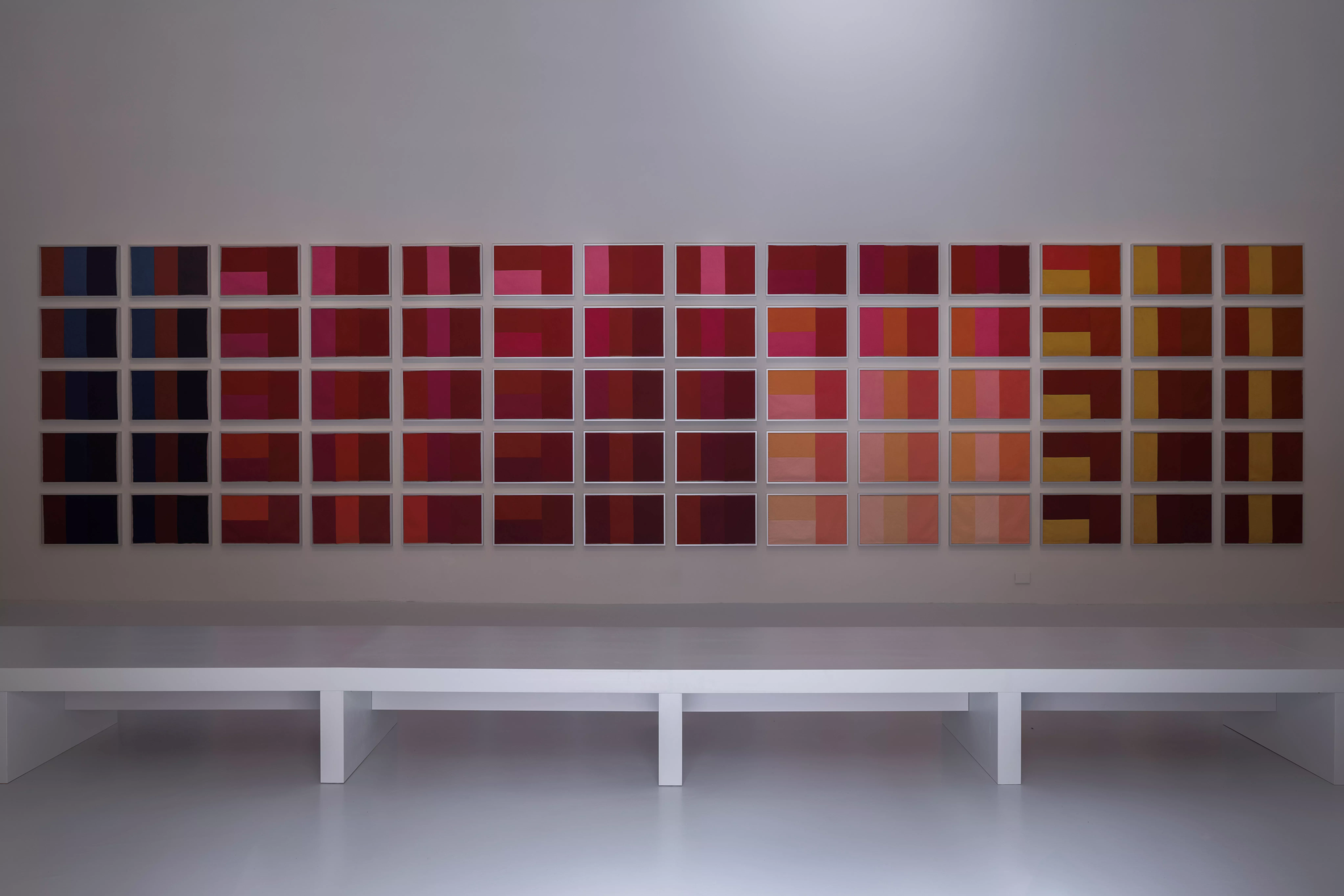
Barrada’s “For a New Color Theory” grew out of years of experimentation. Courtesy of Institut Français - Jacopo La Forgia
In one room white and black wool curtains line the wall, endowing a sense of safety and warmth, while in another space called “The Study,” a captivating series of textiles assembled in triptychlike planes in diverse shades of red, pink and cream form “For a New Color Theory,” a work that grew from years of experimenting at Barrada’s The Mothership, an eco-campus, experimental garden and residency project she runs in Tangier, Morocco.
There, she works closely with local women’s communities to explore color theory through the cultivation and extraction of natural pigments from local plants. The project acts as a site of collective mentorship, empowering artisans and generations of women who have sustained indigenous techniques for dye production. “The project is a good reminder that innovation usually doesn't come from throwing tradition out but rather from staying in constant conversation with it,” states curator Myriam ben Saleh. “Yto isn't trying to freeze tradition in stone; what she's really after is how knowledge survives by changing.”
“The whole show is built around transmission in pretty much every sense of the word, and dévoré is a great example of that because it's destructive and generative at the same time: You get the pattern by deliberately eating away the material,” explains Saleh. “That kind of paradox shows up again and again in the show.”
In the pavilion’s Melancholy Room, officially the Salle du Dévoré, framed textiles using the dévoré technique hang along the walls. One features strips of fabric in varying shades of magenta and cream with sporadic speckles of white and red; despite the frayed nature of the fabric, the piece exudes a sense of light and harmony.
“Instead of presenting knowledge as fixed or authoritative, the show treats it as something that's always being translated, reshaped, reinterpreted,” says Saleh. “A lot of the techniques, materials and even vocabulary in the pavilion carry whole histories of labor, farming, extraction, passing things down. They're a reminder that cultural knowledge isn't some abstract thing; it lives in gestures, in materials, in how people relate to their environment.”
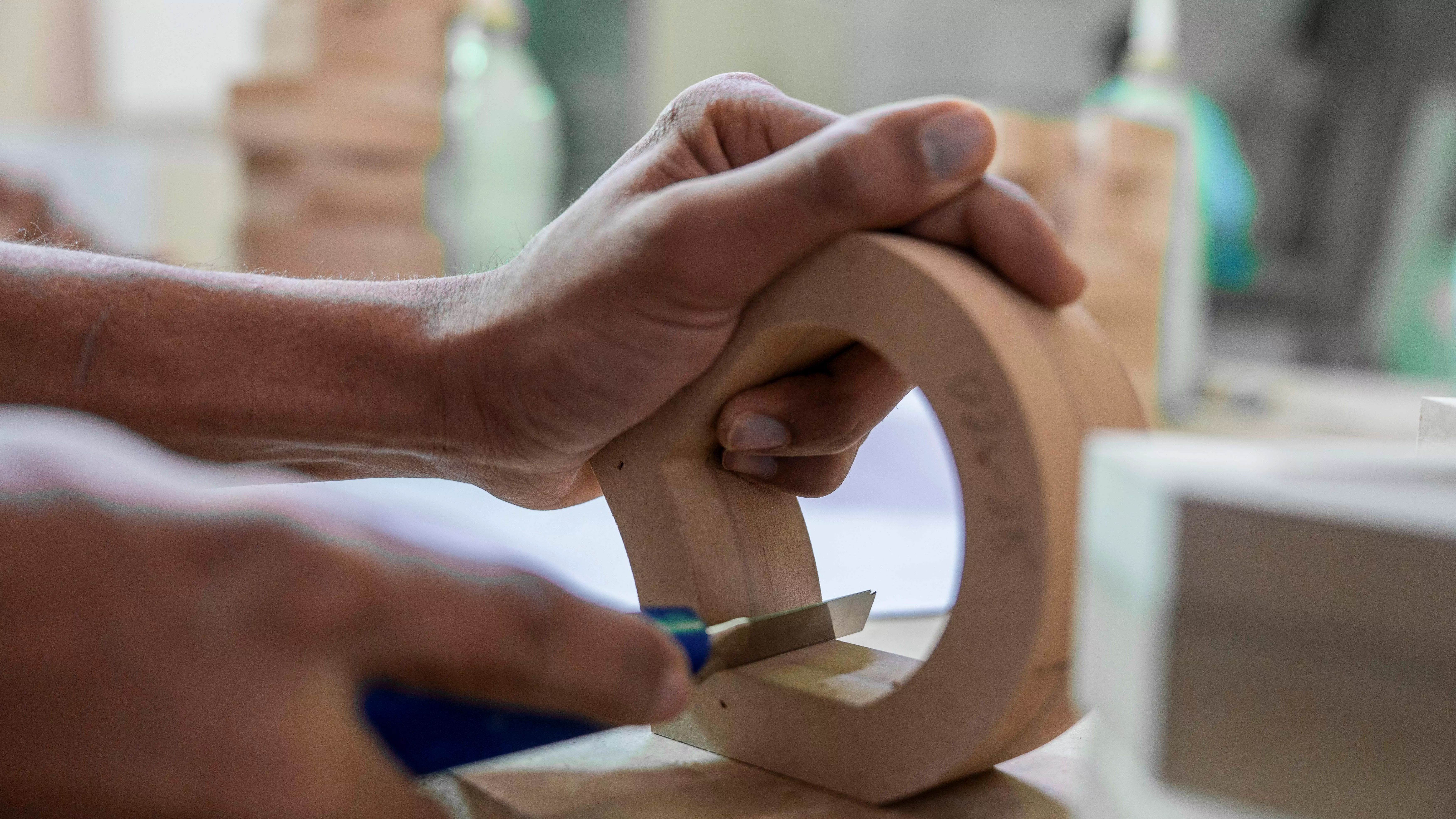
Bricks incorporate four distinct natural clay colors sourced from different areas of Saudi Arabia. Riyadh Production Images
The Saudi Pavilion: Safeguarding Cultural Heritage
Can an artwork preserve the memory of places that no longer exist? Saudi Palestinian artist Dana Awartani’s installation for the Saudi Pavilion suggests it can. Rather than preserving living traditions, “May Your Tears Never Dry, Those Who Weep Over Stone”—curated by Antonia Carver, director of Art Jameel, and assistant curator Hafsa Alkhudairi—honors cultural heritage damaged or destroyed by conflict and environmental degradation.
The massive, site-specific installation transforms the pavilion into an archeological landscape of 29,221 handmade, sunbaked clay bricks meticulously arranged in geometric, floral and faunal patterns inspired by artistic traditions from across the eastern Mediterranean. Together, the motifs evoke shared cultural histories spanning three millennia.
They also reference 23 historically significant damaged or destroyed sites, asking how art might carry memory when architecture itself has disappeared.
To create the work, Awartani collaborated with 32 master craftspeople at a studio outside Riyadh. The bricks incorporate four distinct natural clay colors sourced from different areas of Saudi Arabia.
“The mosaics are the point of connection,” explains Awartani, noting how the earliest known mosaics originated in Mesopotamia and were then adopted and refined across the Mediterranean under the Roman Empire. “I wanted to create a connection between the East and the West to remind viewers that the history between us is shared.”
“For me, the heritage sites [that] the work references are not just bricks and mortar; they embody the people that were there,” says Awartani. “They’re built by our artisans and our ancestors, and they should not be second to people living now—to human life.”
The bricks were deliberately created without chemical binding agents, allowing them to crack naturally over the course of the exhibition. The gradual deterioration becomes a physical metaphor for the fragility of cultural heritage and the lasting impact of its loss.
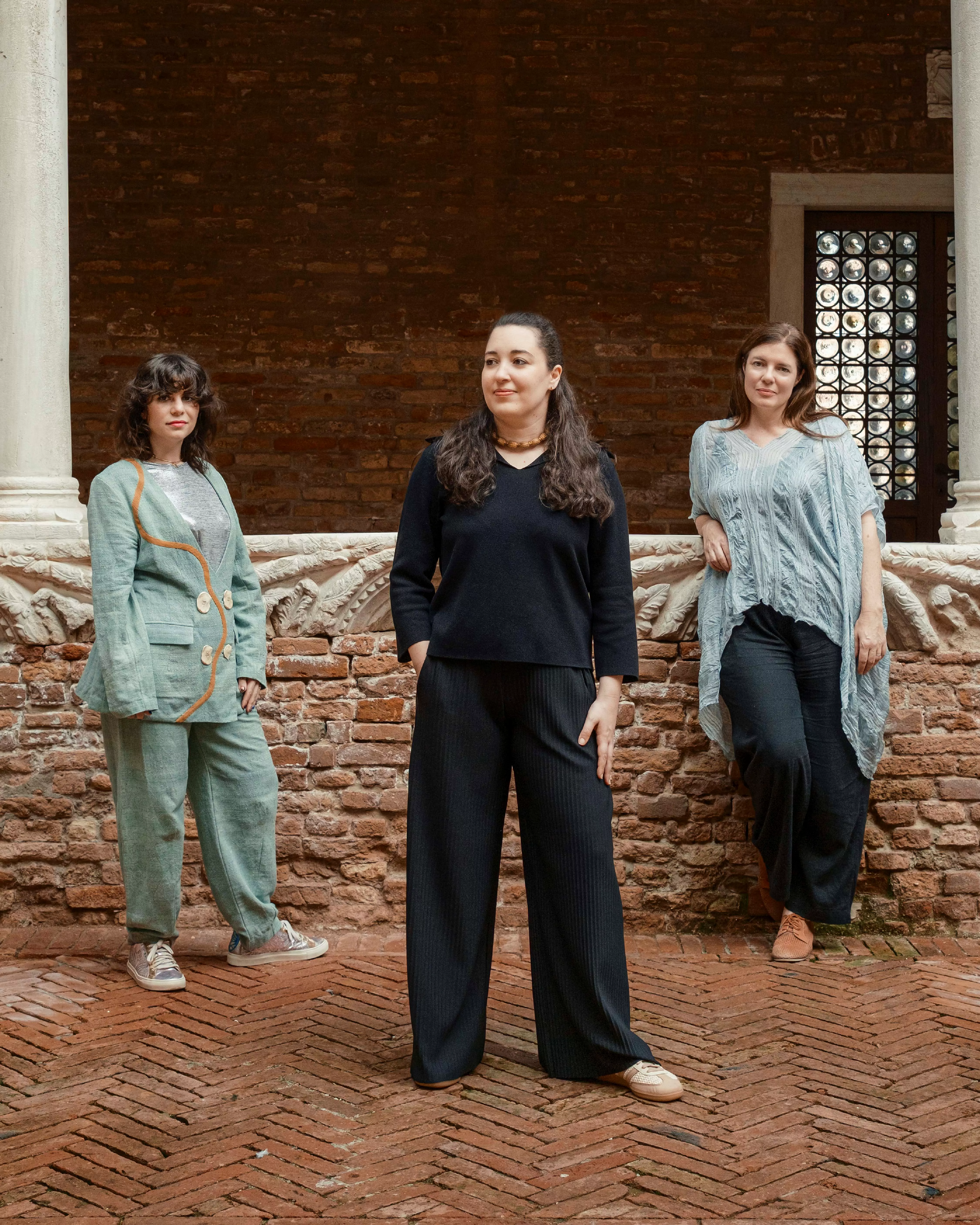
Curators Hafsa Alkhudairi, left, and Antonia Carver flank artist Dana Awartani, who worked with 32 master craftspeople on the mosaics. Alvise Busetto, Courtesy of Visual Arts Commission, Commissioner for the National Pavilion of Saudi Arabia
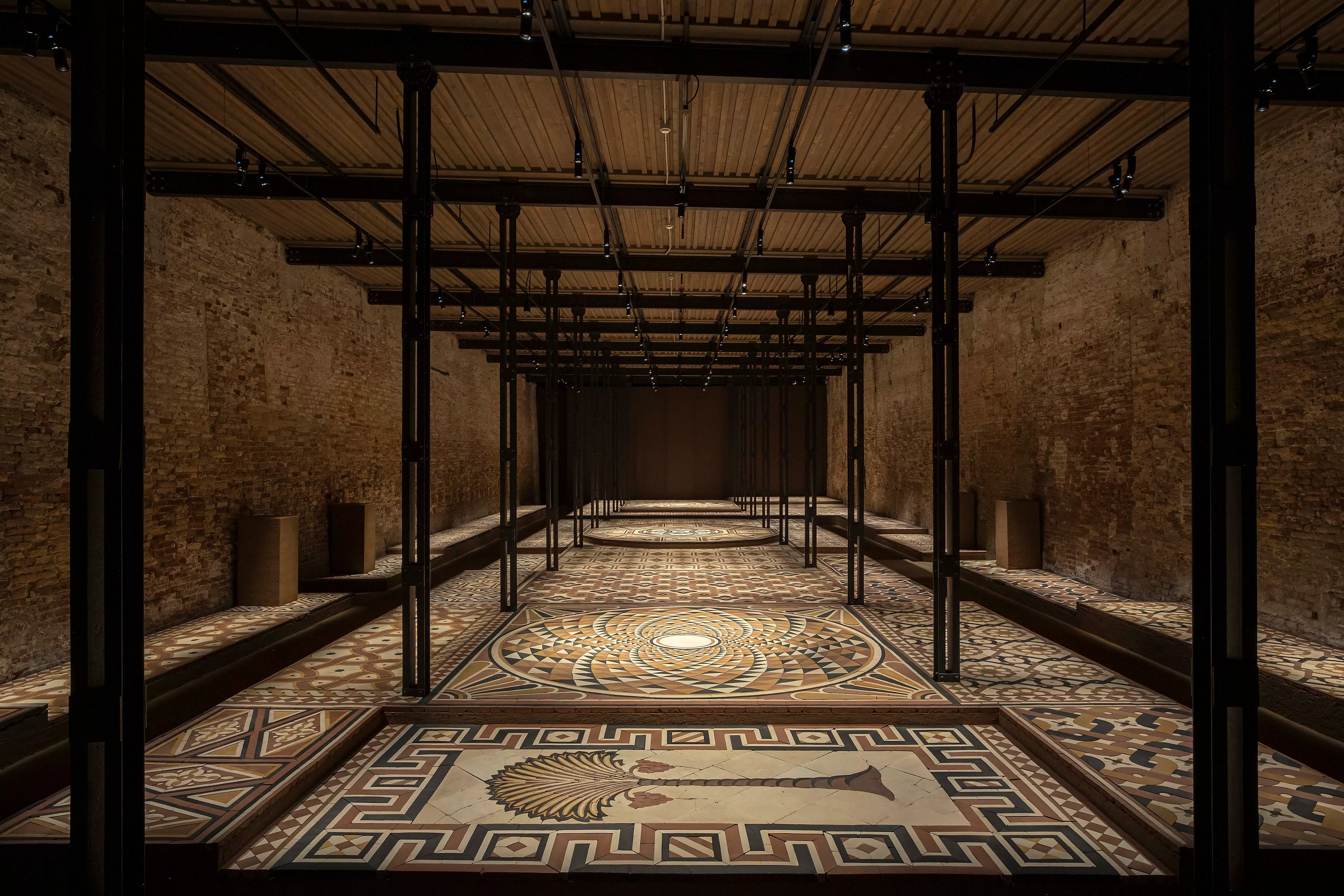
The site-specific installation “May Your Tears Never Dry, Those Who Weep Over Stone” transforms the Saudi Pavilion into an archeological landscape of handmade, sunbaked clay bricks in geometric, floral and faunal patterns. Alvise Busetto, Courtesy of the Visual Arts Commission, Ministry of Culture

The pavilion, in the same manner as the French and Moroccan pavilions, reflects the quiet sense of resistance to the uncertainty of the present that Kouoh intended for “In Minor Keys.”
“This idea of finding beauty within tragedy, of slowing down, of pausing, of taking time to reflect—I feel that it's very much a shared synergy with the main show, but not by design,” says Carver.
Like the sites the work references, Awartani’s installation itself is vulnerable to time, suggesting that knowledge ultimately survives through memories, stories and artworks like hers. Awartani says, “I want people to walk away with awareness and empathy.”

You may also be interested in...
Ottoman-Era Hijaz Railway’s Legacy Endures, Chugging Toward Revival
History
The legacy of an Ottoman-era project to connect Damascus, Syria, to the holy site of Madinah in modern Saudi Arabia and beyond is breathing new life into today’s vision for rail in the region.
Conversation With Karim Wasfi, Chief Conductor of Iraqi Orchestra
Arts
Through his leadership of the Iraqi National Symphony Orchestra, cellist-turned-conductor Karim Wasfi has broadened the range of musical compositions that audiences hear.
Spotlight on Photography: Beneath the Cherry Blossoms in Japan
Arts
Japanese culture reveres the springtime blooms as a symbol of renewal.