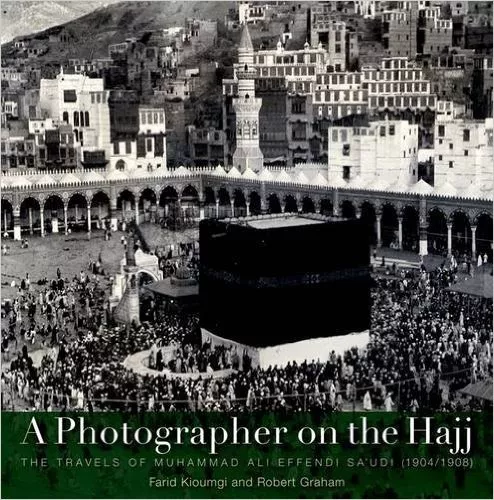
A Photographer on the Hajj: The Travels of Mohammed Ali Effendi Sa‘oudi (1904–1908)
Farid Kioumgi and Robert Graham
2009, American University in Cairo Press, 978-9-774- 16290-1, $34.95 hb.
Students of the history of Makkah and the hajj know the name of Mohammed Ali Sa‘oudi, if at all, only as one of t Muslim photographers whose pictures appeared in Ibrahim Rif‘at’s important book Mirat al-Haramain (View of the Two Sanctuaries), published in Arabic in Cairo in 1925. Gen. Rif‘at, who led the Egyptian hajj several times in the early 20th century, was accompanied in 1904 and 1907–1908 by this young Egyptian civil servant. Sa‘oudi’s original photographs and diaries came to light only recently and, thanks to this publication—essentially a condensed version of them—he emerges as a personality in his own right. He traveled at a time when the advance of the Hijaz Railway threatened to upset the the old pattern of pilgrimage, and he is a scathing observer of Ottoman and Sharifian governance of the Hijaz, the chaos and frustrations of daily life and the neglect of pilgrims’ welfare and security, not to mention the ever-present dangers of taking photographs. And it is the photographs that are the real glory of this book. Sharp and detailed, reproduced with care on high-quality paper, they provide an exceptionally vivid picture of old Makkah and Madinah which may surprise those who are familiar only with the modern cities.
You may also be interested in...

Cookbook Food for Sharing by Ashia Ismail-Singer—Our Book Review
In her third cookbook, Food for Sharing, Ashia Ismail-Singer groups recipes by the social occasions they accompany—presenting food as a means of connecting with cultures around the table.
Archaeology and Geology of Ancient Egyptian Stones—Book Review
In categorizing the stones the ancient Egyptians used, author James A. Harrell unites geology, archeology and cultural history in one monumental reference.