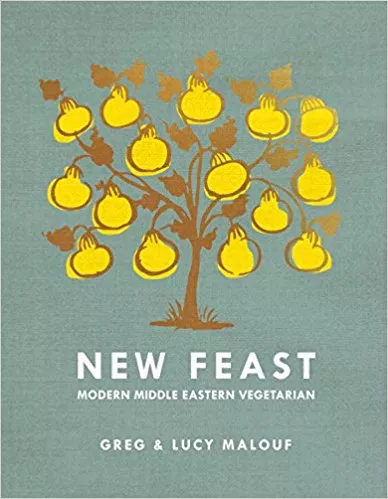
New Feast: Modern Middle Eastern Vegetarian
Tom Verde
Greg and Lucy Malouf
2014, Hardie Grant, 978-1-74270-842-3, $45 hb.
A vegetarian Middle Eastern cookbook is almost a tautology as so much of the region’s classic fare is vegetarian (think hummus, falafil, etc.). Few but the Maloufs, however, could add modern twists to traditional cuisine with such flair. Diced into somewhat finer sections than most cookbooks (“Butters and Preserves,” “Fritters” and “Ices,” for instance), this upscale tour through the humble Middle Eastern diet takes the pursuit to new levels with such offerings as preserved lemon uacamole, za‘tar biscuits and chocolate muhallabeya (boiled milk thickened with corn starch, traditionally made without chocolate) with Turkish coffee granita. There is even an eggplant version of bisteeya, a North African savory pie usually made with chicken. While this is not a book for novice cooks, it still features a good number of recipes—flavored butters, dips and various soups—for the uninitiated to try before they dare attempt bouquets of fruity, flower-shaped meringues or tightly rolled baklava cigars in orange syrup.
You may also be interested in...
Ali Humayan Akhtar's Italy and the Islamic World—Our Book Review
By situating Italy within its Mediterranean and Islamic contexts, Ali Humayan Akhtar powerfully reshapes how we see its past.
Essays on Nile Delta, From Ancient Egypt to Today—Our Book Review
Editor and ancient historian Katherine Blouin asks 18 scholars to address why this crucial region is less visited and studied compared to the rest of Egypt.