Spice Migrations: Ginger
Native to lands across Southeast Asia, ginger has long been used there and across the Middle East and North Africa in savory dishes, while Europeans and Americans have more recently popularized it in sweets. In Detroit, Michigan, chef Warda Bouguettaya does both.
When Warda Bouguettaya, chef and owner of Warda Pâtisserie in Detroit, Michigan, was growing up on the Mediterranean coast of Algeria, her mother would prepare a handful of favorite dishes: harira, a hearty, vegetable-laden soup; m’hammar bel batata, a slow-cooked lamb stew with potatoes; and tajine hlou, a sweet dish of prunes and dried apricots stewed in an aromatic syrup that was served toward the end of the meal.
Bouguettaya turned to this comforting trio when she moved to Detroit in 2004 after graduating from university. Interested in cuisine but not yet an expert, Bouguettaya recalls learning that key to all three was ground ginger. “Ginger is one of the backbones of Algerian cooking,” she says.
Sharp, penetrating and fiery with a sweet aftertaste, ginger—whether fresh or dried—mixes well into almost any food. It is rare, though, that one form can be substituted for the other in a recipe.
But in 2010 at the Ann Arbor Farmer’s Market, ginger just wasn’t a spice Bouguettaya naturally reached for when she started making and selling her own traditional Algerian pastries, such as date-filled makrouts and crescent-shaped “gazelle horns” that use almond paste scented with orange blossom. While in North America and Europe dried and ground ginger is common in sweets like gingerbread, cakes, biscuits and cookies, to the Algerian palate, ginger was exclusively reserved for savory dishes, with tajine hlou a lone, fruit-based exception.
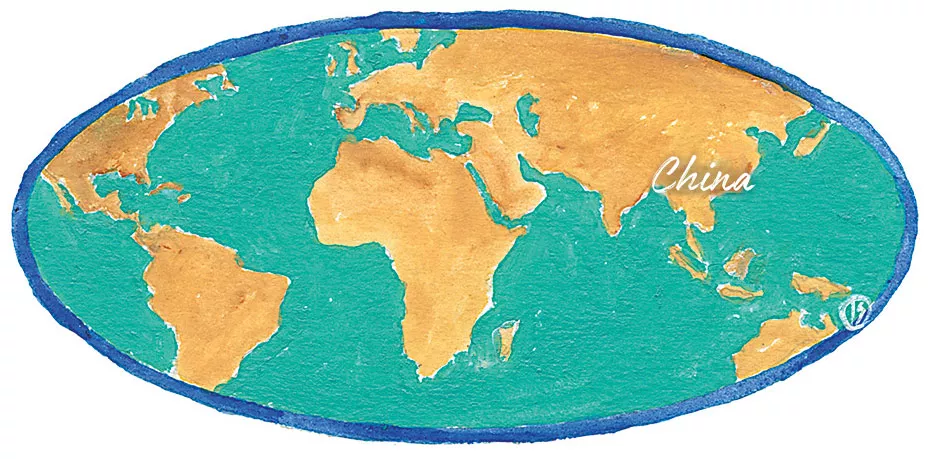
It was two years later, when her husband’s employer relocated the couple to Shanghai, that for the first time Bouguettaya came face to face with great heaps of fresh ginger, jiāng in Mandarin, in the markets. There she found that China has long consumed ginger in countless ways.
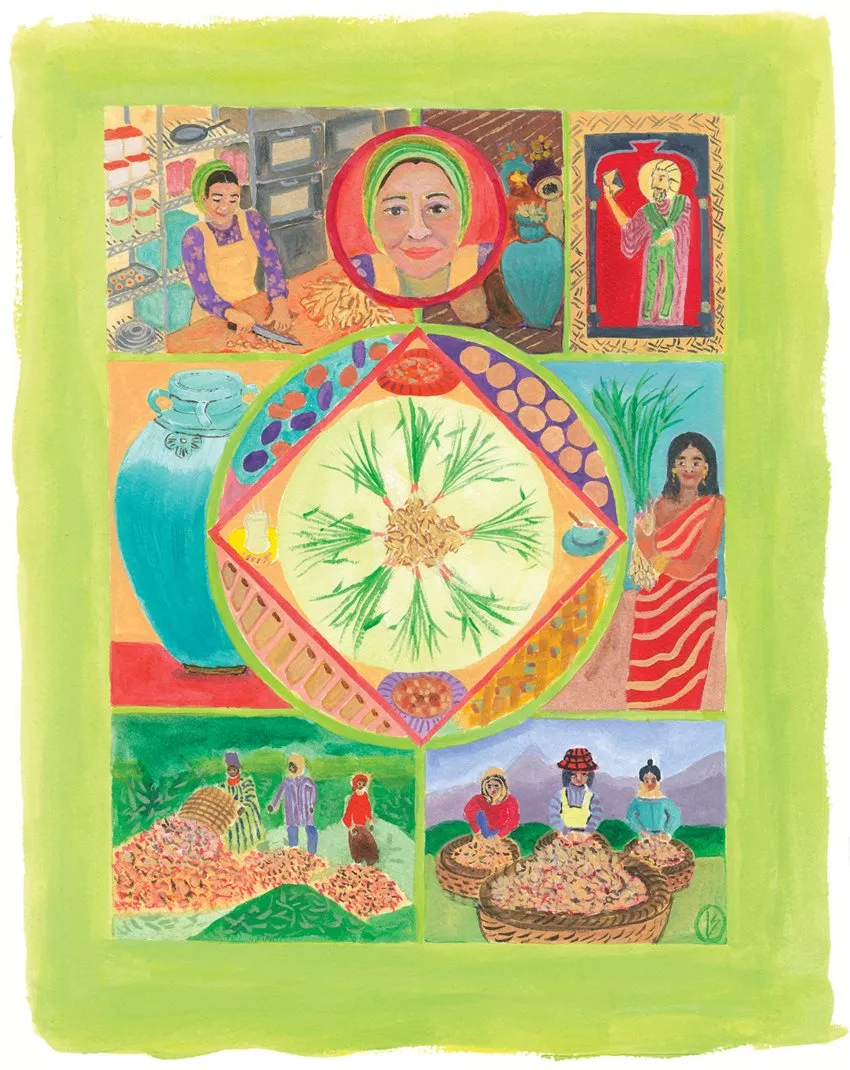
One of the first written Chinese records on ginger is connected with the sixth-century-BCE philosopher Confucius, who noted in his Analects that he “was never without ginger when he ate,” says Mathieu Torck, a postdoctoral research fellow at Katholieke Universiteit (KU) Leuven in Belgium. Similarly, he points out that Master Lü’s Spring and Autumn Annals, written around 249 BCE by Chinese statesman Lü Buwei and universally accepted by Chinese historians, contains references to ginger as a prized ingredient used by the 16th-century-BCE Master Chef Yi Yin of the Shang Dynasty.
As a plant, ginger is a perennial shrub, and it looks like short bamboo. But unlike bamboo, it isn’t the shoots that are of greatest interest. It’s ginger’s underground stem—properly called the rhizome and commonly referred to as the root. This gives ginger (Zingiber officinale) its name in most languages. “The earliest source is the Sanskrit word singabera, meaning ‘horny shape,’” says Torck, “which looks a bit like antlers.”
Ginger, he explains, does not propagate by seed. Rather, the root must be split and planted. It has several tropical areas of origin: southern China, Southeast Asia and India. From all of these regions it has been gradually carried and transplanted around the world.
“The Arabs played an important role in spreading ginger throughout the Indian Ocean,” he says, noting that the name zanjabil was used in Arabic. Later, Europeans carried ginger farther, notably to the West African coast and the Caribbean.
Masala Chai
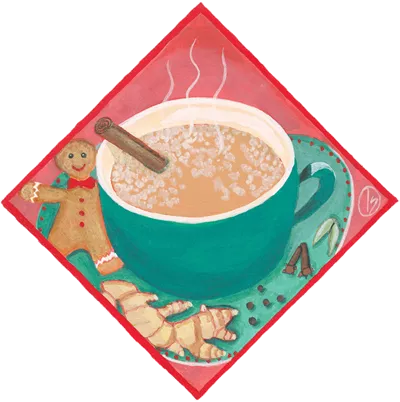
Indian spiced tea—properly called masala chai—can include any number of spices, though ginger, cardamom pods, cloves, black peppercorns and a piece of cinnamon stick are the most common. This version highlights the ginger flavor, and it is adapted from the author’s 2015 Darjeeling: A History of the World’s Greatest Tea.
(Serves 4)
4 cardamom pods
2 cloves
4 whole black peppercorns
1 small piece cinnamon stick or cinnamon bark
2 cups whole milk
2 cups water
1 piece fresh ginger, 2½ centimeters / 1 inch, grated or chopped
3 tablespoons sugar, or more to taste
2 tablespoons loose, strong black tea leaves, preferably Indian, or 2 tea bags
In a mortar, crush the cardamom, cloves, peppercorns and cinnamon stick.
In a heavy-bottomed saucepan, add the milk and water, the crushed spices, and the ginger. Bring to a boil, reduce the heat to low and allow the foam to subside. Stir in the sugar and tea and simmer for 3 to 5 minutes depending on desired strength for tea, stirring from time to time and watching that it does not boil over.
Strain into 4 tea glasses and serve very hot.
While it grows in many tropical places today, India is the world’s largest producer, harvesting some 1.8 million metric tons a year, about a third of the global total, and other large producers include Nigeria, China, Indonesia and Nepal. In the state of Kerala and along India’s west coast, planting takes place in early May with the premonsoon showers, while in Assam and the northeast, it is slightly earlier, in April. Harvesting ginger that will be sold fresh begins about six months after planting, and rhizomes that will be dried and sent for grinding are dug up at about 8 months of age, when they have reached full maturity.
Historically, like many other spices, ginger has been appreciated for its medicinal values. For that, Carlos González Balderas, a researcher at KU Leuven, refers to the first-century-CE Greek physician Dioscorides’ five-volume encyclopedia De Materia Medica. Writing between 50 and 70 CE, Dioscorides characterized the taste and smell of ginger’s root as well as “what parts to use—the stems and root—and advice on administering,” González Balderas adds. “Warming and digestive,” Dioscorides prescribed, ginger roots “soften the intestines gently, and are good for the stomach.” When “mixed with antidotes … in a general way it resembles pepper in its strength.”
For centuries, Dioscorides served as the authoritative source in the West. “The first translation into Spanish was in the 15th century,” says González Balderas. “And then the Spanish pharmacopeia followed it as a standard reference. From it they learned to use ginger,” he says, adding that the Spanish used the spice during their periods of Atlantic and Pacific colonization.
González Balderas discovered references to ginger in 18th-century shipboard boticas (pharmacies) of galleons while collaborating with Torck on research into trans-Pacific trade from the mid-16th to the early 19th century. “It was prescribed for stomach problems and to relieve body pains. It was made into an infusion, and you had to drink the tea three or four times a day for the stomach,” he says. For aches and pains, a ginger ointment was prepared and spread topically.
One of Bouguettaya’s first signature dishes was a rhubarb tart—with ginger.
The idea wasn’t new. For centuries, sailors in Asian waters may have kept ginger on board, Torck says. Ibn Battuta, the 14th-century Moroccan traveler and scholar, observed this about Chinese junks: “The sailors have their children living on board ship, and they cultivate green stuffs, vegetables and ginger in wooden tanks.” Considering the salty air and the preciousness of both space and fresh water, the value of the ginger must have been extremely high. He also recounted that before setting sail on one of his voyages in the region, ginger was among the provisions he was given, which included “two elephant loads of rice, two buffalo cows, ten sheep, four pounds of julep (a syrupy paste with rose water) and four martabans, which are big (glazed, ceramic) vessels filled with ginger, pepper, citrus fruit (lemons) and mangoes, all salted with what is used in preparing for sea voyages.” Here ginger served something of a double purpose, Torck says, serving as both a condiment and a modest source of the vitamin C that prevented scurvy.
For chefs, ginger has offered countless flavoring possibilities—as Bouguettaya learned during what became three years in China. On its Shanghai campus, she enrolled at the noted French cooking school Institut Paul Bocuse, where she ultimately focused on pastry. While the training shaped her career, she credits her experiences in China and her travels around Southeast Asia as deeply formative in developing her taste.
When she returned to Detroit in 2015, she resumed selling pastries at the farmers’s market. But Asia had opened her palate, and she wanted to move beyond traditional Algerian items. She drew on her experiences in China as well as those in the US, France and North Africa to make what she now calls “pastries without borders.” One of her first signature dishes was a rhubarb tart—with ginger.
“The acidity of rhubarb, the tartness of it, with the zingyness of fresh ginger,” she says, “now seemed an obvious and perfect pairing.” Another is her take on the classic French strawberry Fraisier cake, which uses ginger-infused syrup.
Her creations drew such a dedicated following that she opened Warda Pâtisserie in an artist-run space in the heart of Detroit’s historic Eastern Market district. (Fittingly, the building was a former spice-processing warehouse.) Her sweet and savory delicacies, with ginger among her many and often original ingredients, have earned her city-wide accolades. The online food site The Eater named Warda Pâtisserie Detroit’s 2019 bakery of the year. In 2020 the Detroit Free Press, the city’s largest newspaper, hailed her “Chef of the Year.” In June Warda Pâtisserie moved to its own building in Midtown Detroit, where even the pandemic hasn’t thwarted success. One bite of her rhubarb tart or Fraisier cake makes it clear why.
About the Author

Jeff Koehler
Jeff Koehler is an American writer and photographer based in Barcelona. His most recent book is Where the Wild Coffee Grows (Bloomsbury, 2017), an “Editor’s Choice” in The New York Times. His previous book, Darjeeling: A History of the World’s Greatest Tea (Bloomsbury, 2016), won the 2016 IACP award for literary food writing. His writing has appeared in the Washington Post, the Wall Street Journal, Saveur, Food & Wine and NPR.org. Follow him on Twitter @koehlercooks and Instagram @jeff_koehler.
Linda Dalal Sawaya
Linda Dalal Sawaya (www.lindasawaya.com; @lindasawayaART) is a Lebanese American artist, illustrator, ceramicist, writer, teacher, gardener and cook in Portland, Oregon. Her 1997 cover story, “Memories of a Lebanese Garden,” highlighted her illustrated cookbook tribute to her mother, Alice's Kitchen: Traditional Lebanese Cooking. She exhibits regularly throughout the US, and she is listed in the Encyclopedia of Arab American Artists.
You may also be interested in...
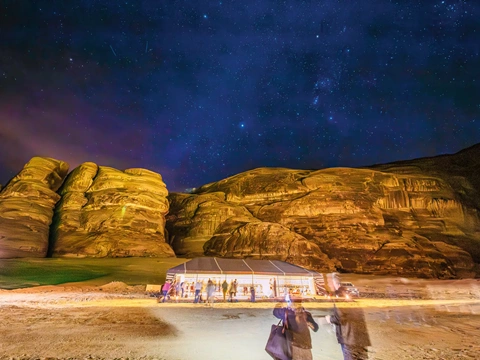
Spotlight on Photography: Long Exposure Grabs AlUla's Starry Night
Arts
Photographer Waleed Dashash gets away from urban light pollution, adjusts his aperture and shutter speed—and catches the majesty of AlUla at night.
America at 250: The Eastern Foods the Nation Has Always Loved
Food
History
As the United States marks the 250th anniversary of its independence from Great Britain on July 4, the foods that filled the tables of the Founding Fathers—the late-18th-century statesmen who were most influential in the new country’s creation—are a reminder that elite households relied on ingredients carried through trade routes connecting the Mediterranean, Africa, Asia and regions now known as the Middle East.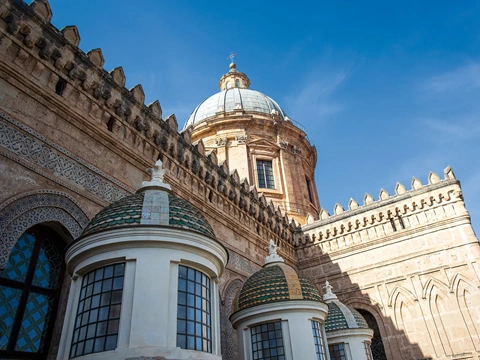
A Conversation With Islamesque Architecture Book Author Diane Darke
Arts
Culture
In Islamesque Diana Darke argues that Europe’s most celebrated architecture, including the Palermo Cathedral in Sicily, owes its sophistication to cultural exchanges with forgotten Muslim craftsmen.