A Conversation With the Keeper of Malaysia’s Peranakan Memory
Malaysian hotelier Chris Ong has amassed an impressive Peranakan heritage collection of at least 10,000 artifacts.
Two things have shaped Chris Ong like no other: his grandmother’s stories and the interior of a home filled with objects of the Peranakan Chinese, descendants of early Chinese settlers of the Malay Peninsula and Indonesian archipelago whose mixed ancestry forms a distinctive hybrid culture.
Growing up in 1970s George Town, capital of the Malaysian state of Penang, as a fifth-generation Malay Chinese teenager, Ong was captivated by the material culture of a Peranakan household—dishes, cups, spoons, fans, cooking vessels, almirahs (wardrobes), cabinets and more. Each object drew him in, sparking a curiosity that would last far beyond his teenage years.
Ong traces his ancestry to 1840, when his maternal great-grandfather Khaw Boo Aun arrive in Malaya, then a British territory, from China. His paternal grandfather, Ong Khong Oon, was a later migrant from China’s Fujian province.
In adulthood, his ever-growing passion for cultural inheritance compelled him to leave a prosperous investment banking career to become a heritage hotelier and full-time collector dedicated to preserving Malay Chinese traditions, also known as Straits Chinese, Peranakan or Baba Nyonya culture.
Historically, the Peranakan intermarried with local communities along the Straits of Malacca, creating a culture shaped by Chinese, Malay, British, Indian and Arab influences. Much of these are reflected in the distinct esthetics of Ong’s heritage hotels. The Jawi Peranakan Mansion, for example, is a restored former residence of a wealthy Tamil Muslim merchant whose façade bears Mughal design elements and whose interior doors, windows, textiles and other items were acquired in India to lend the property an Indian Muslim feel.
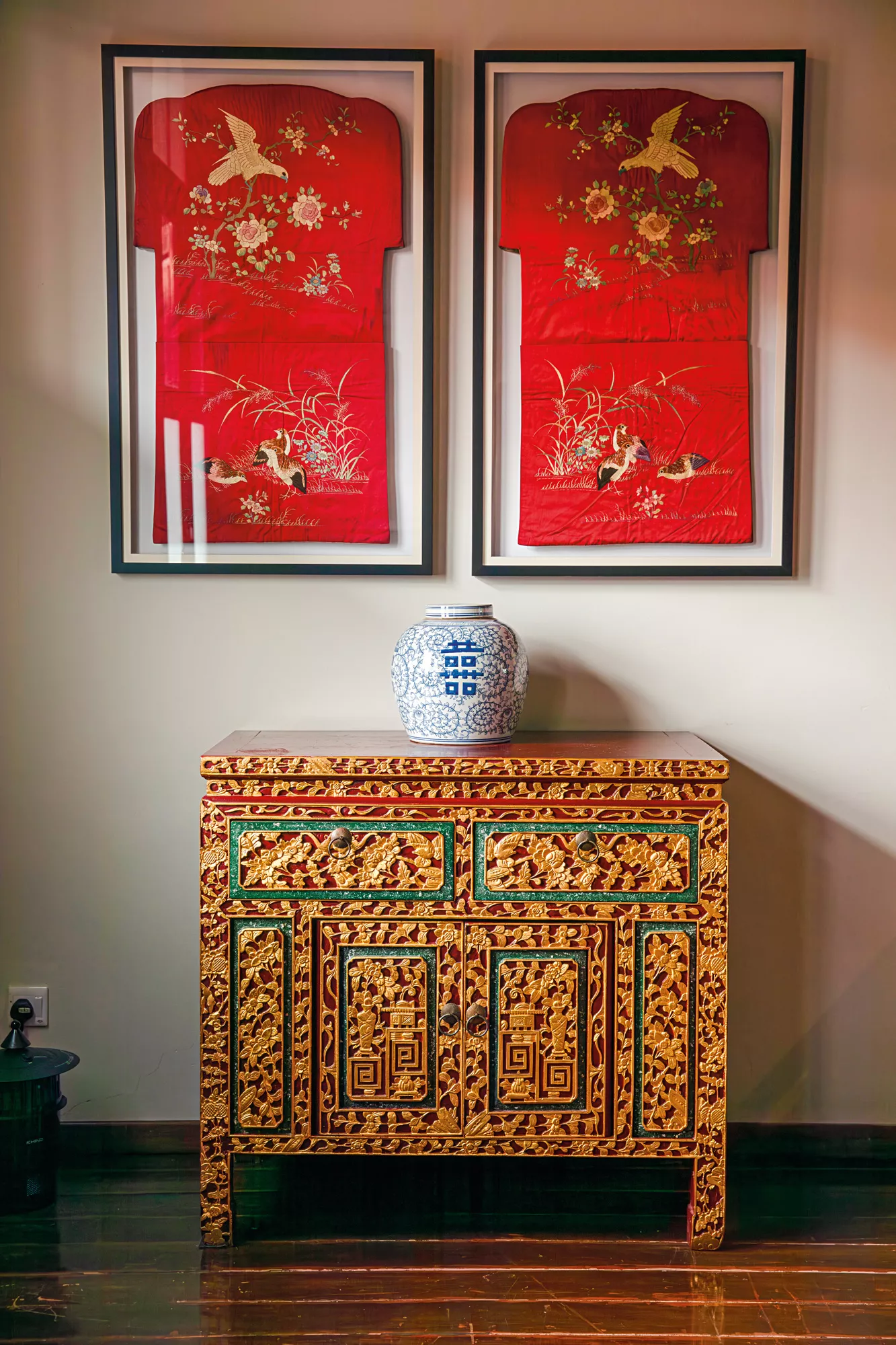
But it is mostly his Peranakan Chinese heritage on display. Today his collection encompasses at least 10,000 artifacts, including kam cheng (covered jars), tingkat (stackable tiffin carriers, like multitiered lunchboxes used to transport home-cooked meals), Peranakan porcelain, Penang wedding beds, mother-of-pearl furniture and rare textiles. A portion of the collection can be viewed at Seven Terraces Hotel in George Town, where the items form part of the hotel’s furnishings and a dedicated gallery.
From his sprawling residence, which resembles a Peranakan home from the late 1850s to the 1950s and serves as a private museum, Ong spoke with AramcoWorld about how his collection has evolved from “just gathering stuff” to a meaningful return to his ancestral and cultural roots.
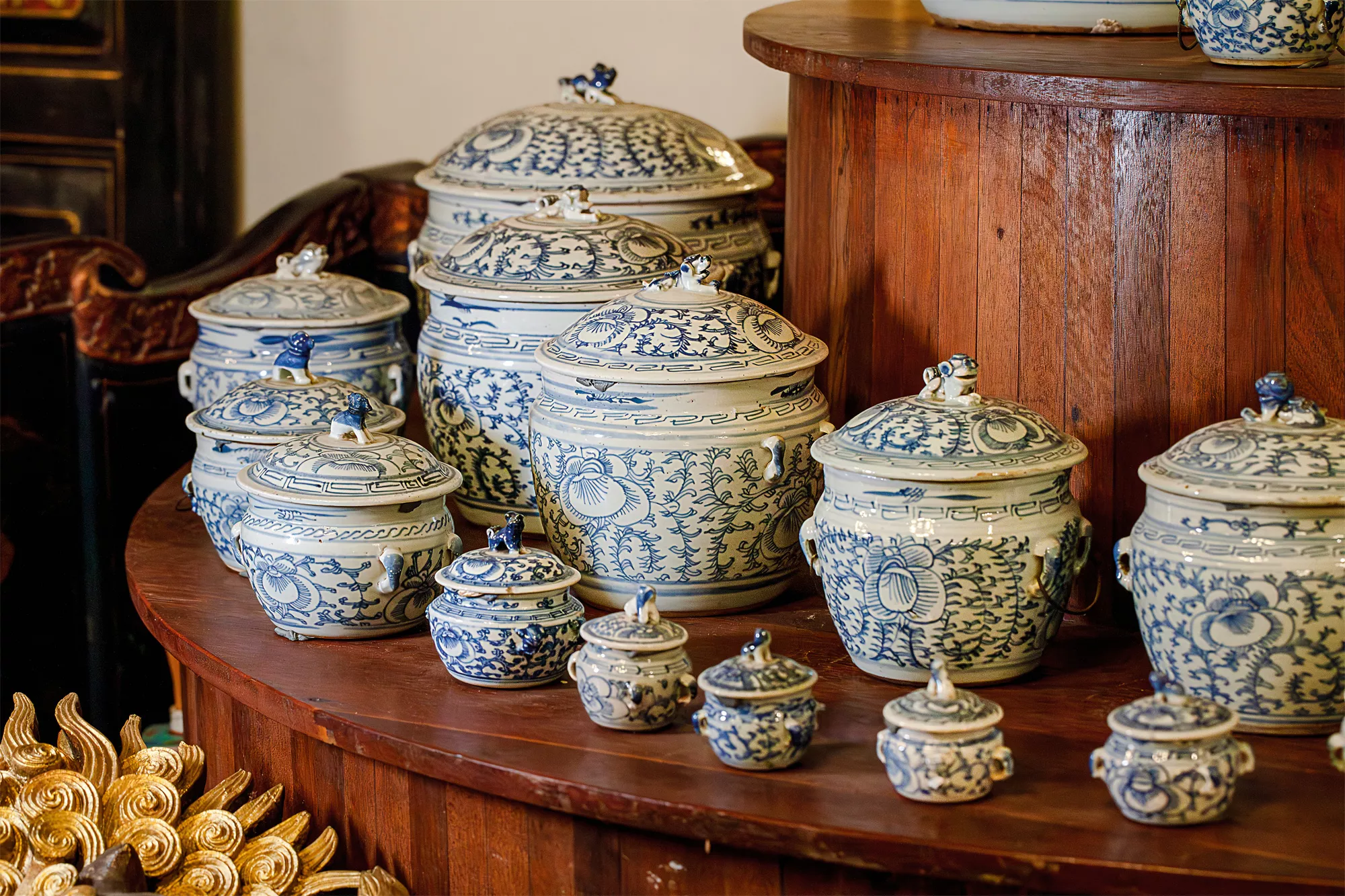
Above and Top Ong displays parts of his 10,000-plus-object collection at his Seven Terraces Hotel in George Town, Penang, Malaysia. They include several pieces of Peranakan porcelain and cabinetry.
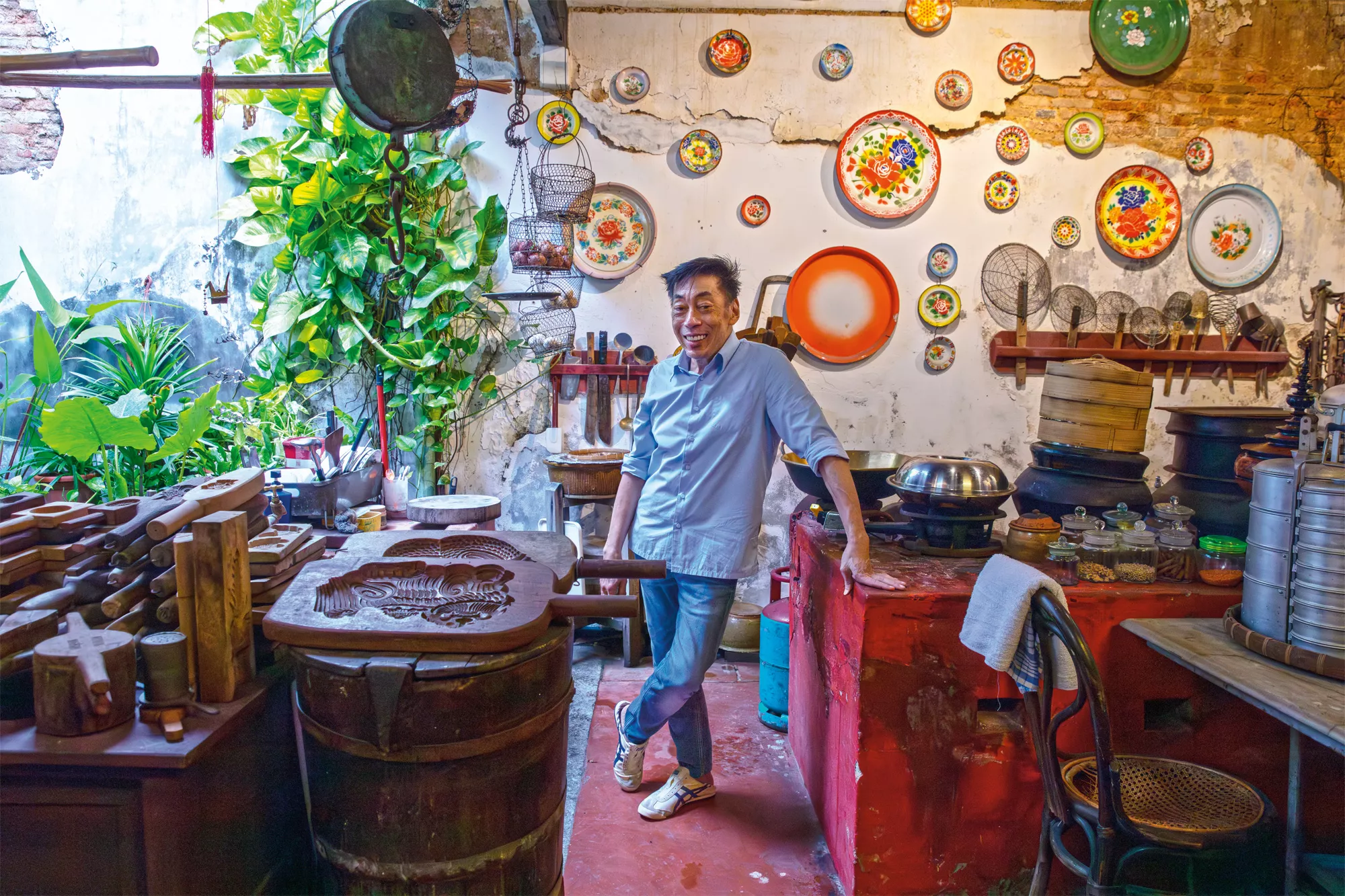
Chris Ong collects objects reflecting Malaysia’s mix of cultures.
From investment banker to private collector, you’ve been on a long journey. Where did it all begin?
In the 1960s, when I was 4 or 5, my widowed grandmother came to live with us. She molded my upbringing with her stories. I would be lost in her conversations, instead of watching the Muppets or [other] television. My head would be filled with her stories as a Nyonya in the gilded age of the 1920s.
…The most heartbreaking [stories] were about the disposal of her entire contents from her Straits Chinese home by my mother because they were deemed too old fashioned in the 1960s. Those memories remained embedded in me. Soon a 13-year-old, I was buying little antiques as if to refill my grandma’s life.
[Many] influences and knowledge got channeled into my passion as I retired from banking in my 40s, returning to my hometown after being away for 30 years, to pursue my passion in Straits Chinese heritage. Around the same time, George Town was inscribed as a [UNESCO World Heritage Site in 2008], and my financial strength and interest in Straits Chinese culture and heritage came together, as I ventured into the world of hospitality.
How has your role as a collector changed over the years?
Recently, I have started archiving and recording intangible heritage too.
Starting my collection of Straits Chinese antiques at a relatively late stage, and furnishing my terrace house and hotels at the same time, meant I was acquiring a lot of pieces every day. I have collected all on my own terms, acquiring them from the open market. These collections are my vessels of remembrance. They remind me of my heritage and background. The only problem—no one had told me when to stop!
Do you plan to convert your collection into a private museum?
The collection at my home and the hotels is essentially the genesis of a private-public museum. We have been putting together annual exhibitions of parts of my collection to instill the discipline of curation and creating a narrative for each exhibition. So far, we have had nine exhibitions.
What is the future of your heritage work?
The future of my heritage work is about passing on this knowledge, educating younger generations about our history, its relevance and adaptability in this new age.
Archiving and creating a legacy is a priority right now. I am doing this through the publication of books [2024’s The Chris Ong Collection, written by Ong and photographed by Nick Almasy, was published by group brand George Town Heritage Hotels] and giving talks to students and special interest groups.
Until [my last breath], I will take an active interest in collecting, for the pursuit of beauty and perfection is a never-ending process with immense joy and satisfaction.
This interview has been lightly edited for length, clarity and flow.
About the Author
Nilosree Biswas
Based in Philadelphia and Mumbai, Nilosree Biswas is an author, filmmaker and columnist who writes about Asian history, art, culture, food and cinema. Her work regularly appears in national and international media.
Suzanne Lee
Suzanne Lee is a Malaysia-based documentary photographer and filmmaker with over two decades of professional experience covering Asia through visual stories rooted in culture and heritage. She is also a photography educator and co-founder of altstudio.asia, where she leads workshops on visual storytelling.
You may also be interested in...
Chef Shane Delia’s Rosewater Sutlaç With Pistachio Crumble
Food
Chef and restaurateur Shane Delia re-creates a rice-and-milk pudding he discovered along Türkiye’s Black Sea coast, one of many sutlaç found on menus in the region; this recipe gets additional texture from a pistachio crumble.
When India Sailed to Makkah: A 350-Year-Old Hajj Chronicle
The 17th-century Anīs al-Ḥujjāj, a Hajj travelogue newly translated into English, shows the forgotten maritime world that bound Mughal India to Islam's holiest city.
How a US Filmmaker Reclaimed a Forgotten Syrian Lebanese Legacy
Josh Chitwood belongs to a small group of American descendants trying to document and preserve their Syrian Lebanese history before it disappears. What compels people like him to recover what remains?