
Othman Almulla Embodies Arab World’s Dream of a Golf Championship
The journey of Saudi Arabia's first professional golfer parallels that of the region from humble beginnings to leaderboard for the global game.
The manicured greens and stately grounds might lead the average spectator to assume they have landed at an upscale golf course in Phoenix, Arizona, or Pebble Beach, California-if not for the Arabic signage.
This is Riyadh, not necessarily associated with a game that originated in medieval Scotland. And this is no ordinary golf tournament. This is the annual PIF (Public Investment Fund) Saudi International golf tournament, the final stop in the 2025 International Series tour, the most prized pathway in professional golf today.
As players warm up on the driving range ahead of the first round of the tournament at the Riyadh Golf Club, one figure stands out-not for his world ranking but for what he represents. Othman Almulla's footsteps on the fairways echo a deeper story. He is Saudi Arabia's first professional golfer.
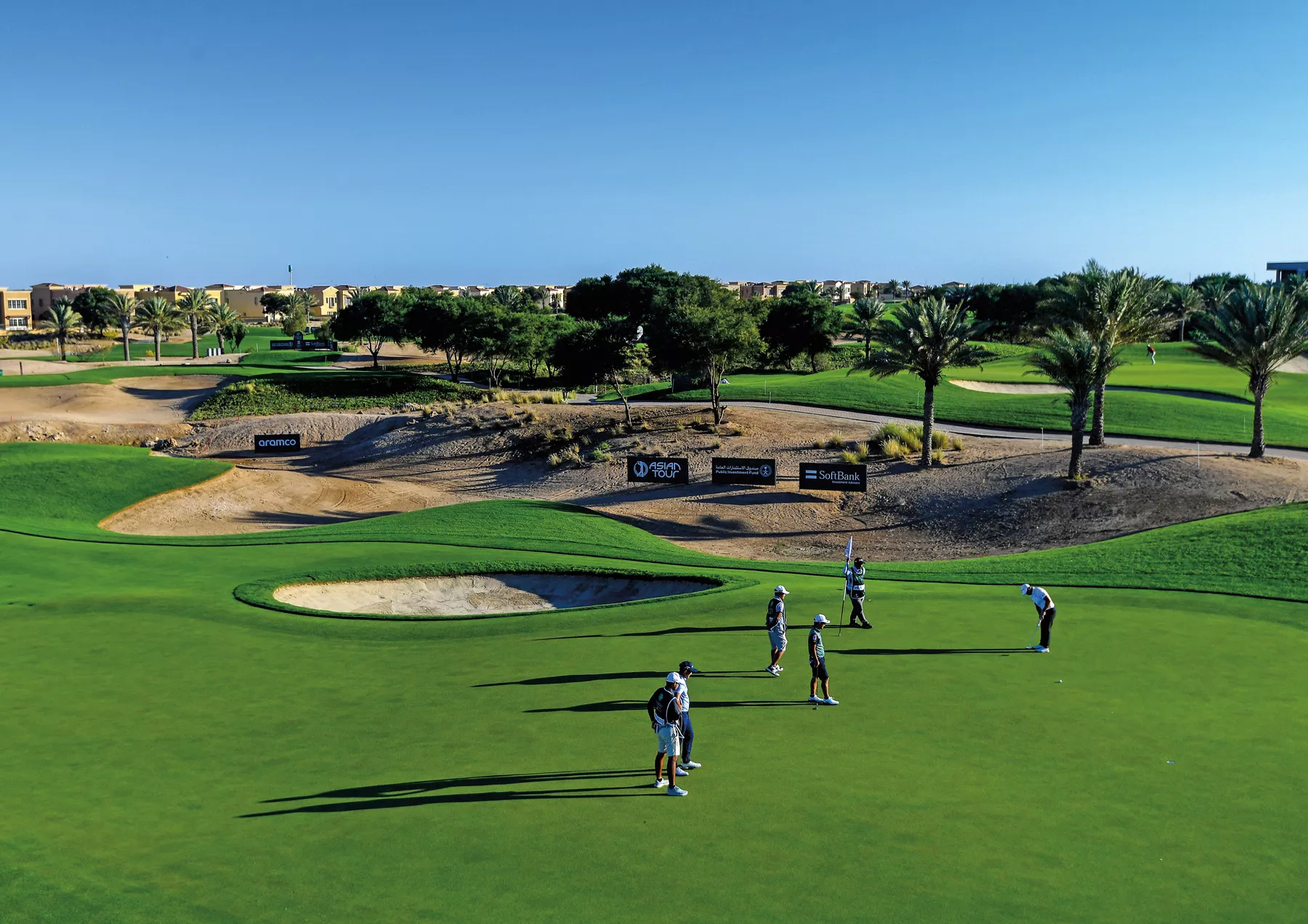
The PIF Saudi International, shown in 2023 at Royal Greens Golf and Country Club in King Abdullah Economic City, Saudi Arabia, is one of the premier sporting events in the Arab world. Top Othman Almulla, Saudi Arabia's first professional golfer, competes in the Omega Dubai Desert Classic in 2020 in the United Arab Emirates.
Tom Dulat/Getty Images
From a summer in Dhahran, in eastern Saudi Arabia, to teeing off alongside the game's biggest names on this day, Almulla signals with his presence not just how far Arab golf has come-but how far it's aiming to go.
The Arabian Gulf region now hosts more than 10 internationally sanctioned professional golf tournaments.
"We want to create an Arab major champion by 2035, male or female," says Mohammed Attallah of the Arab Golf Federation, which represents 17 member nations. "In order to do that, we are facilitating the growth of a sustainable golf industry and ecosystem across the Arab world."
Today to the average spectator, golf in the Middle East appears to serve primarily as a magnet for tourism and investment, which may be true to some degree. But the history of the sport in the Arab world is much richer and more nuanced.
History of Golf in the Arab World
The origins of modern golf can be traced to 15th-century Scotland. At first, the game was banned by King James II, who feared it distracted young men from practicing the archery needed for military defense during conflicts with England. Yet the game continued to gain popularity. The ban was eventually lifted in 1502 as the strife eased, and the game has been gaining popularity around the world ever since.
Foreign interests in North Africa introduced golf in the late 19th century, with Egypt and Morocco leading the way. In Morocco, the Tangiers Golf Club was established in 1897 to cater to the diplomatic community. While in Egypt, The Mena House Hotel opened its own course in 1899, offering visitors the surreal sight of tee boxes aligned with the pyramids.
Less than two decades later, Cairo's exclusive Khedivial Sporting Club, founded in 1882 and later renamed the Gezira Sporting Club, added a 12-hole course. In Beirut, the Golf Club of Lebanon was founded 1923, also primarily catering to non-Lebanese members.
David Lesch, a professor of history at Trinity University in San Antonio, Texas, who has written numerous historical books on the Arab world, characterizes the impetus of golf in the region as exclusive. "It was aimed toward expats in various countries, diplomats, businesspeople and then of course to try to draw tourism mostly from the West," he explains.
The roots of the game had been laid, but it was not until the oil-exploration boom in the Gulf region in the 1930s that golf in the Arab world would get its next boost.
The Awali Golf Club in Bahrain-the oldest in the Arabian Gulf-was founded in 1937 to cater mostly to employees of the Bahrain Petroleum Company. This course, like the others that followed in the area, was carved not from verdant parkland but from parched desert.
Sand courses started to appear in Kuwait, Qatar and, perhaps most famously, the Aramco Rolling Hills Golf Club in Dhahran. Today, the Rolling Hills Golf Club remains a central venue for regional tournaments, including key events on the Asian Development Tour.

“The vision is clear: to see a player from the Arab world lift a Major championship trophy by 2035.”
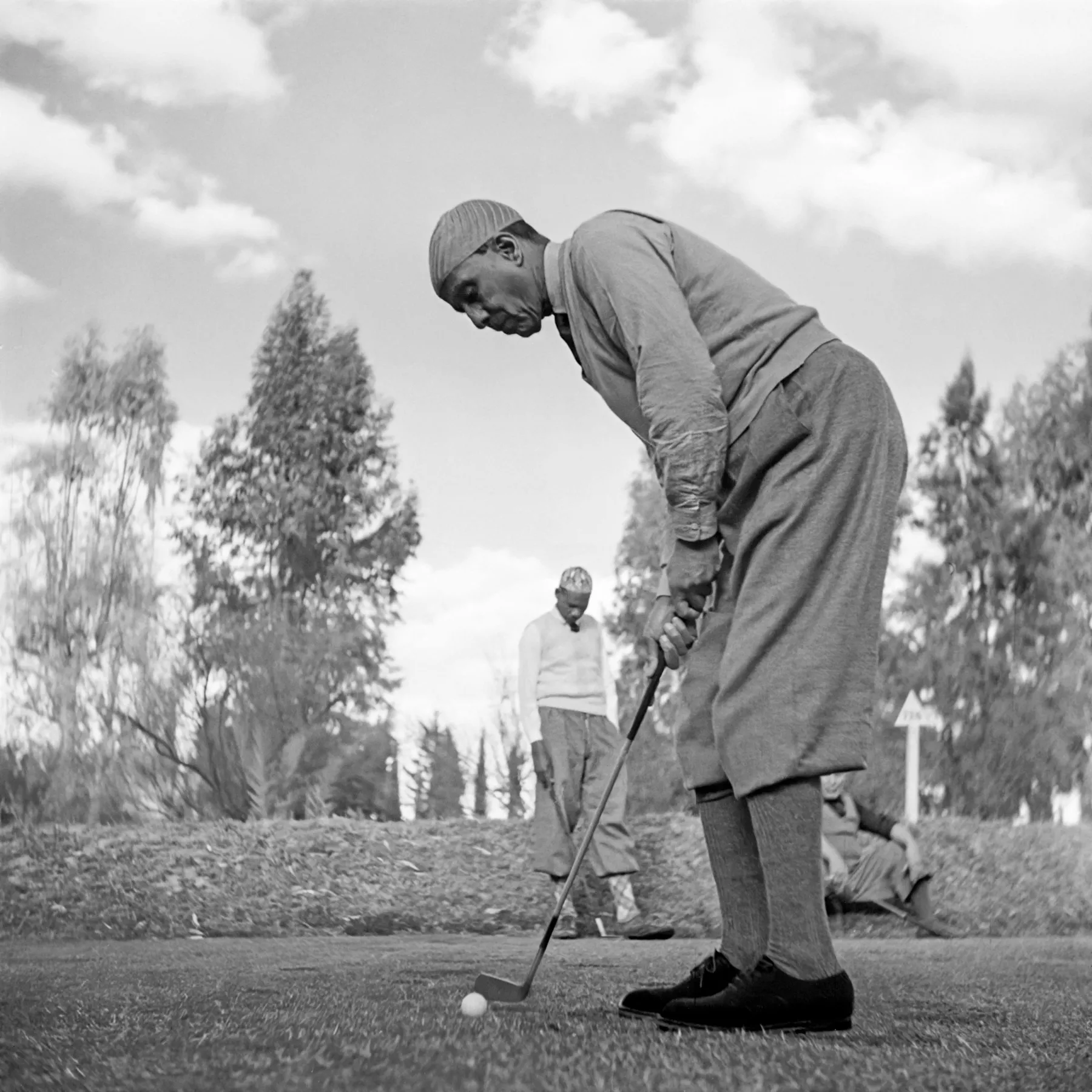
The pasha of Marrakech, Morocco, Thami El Glaoui, plays golf in April 1946.
AFP via Getty Images
While the first half of the 20th century was a key driver for golf in the region, the game itself remained a pastime for foreigners. There was one man, however, who wanted to change that.
In North Africa, King Hassan II of Morocco, who reigned from 1961 to 1999, was an avid golfer and student of 1948 Masters champion Claude Harmon's son, according to an interview with his son Butch Harmon in 2015.
In 1971, the monarch inaugurated the Royal Golf Dar Es Salam, a majestic complex nestled among the cork forests of Rabat and designed by renowned British American golf course architect Robert Trent Jones. His goal was to make golf a part of Moroccan tradition.
The course became the home of the Hassan II Trophy. Winners didn't hoist cups-they were awarded jeweled daggers, a nod to the fusion of tradition and prestige that defined Moroccan golf.
That tournament is now a stop on the PGA Tour Champions, a men's professional senior golf tour. But its origins trace back to a monarch's personal obsession and the belief that Morocco, and by extension the Arab world, could not just play golf-they could host it.
"The Arab world has a rich history in golf," Attallah says. "Last year we celebrated the 50th anniversary of the Arab Golf Federation. This year we're going to be celebrating the 50th anniversary of the Hassan II Trophy...we do have a history, and now we are building on that heritage for future Arab golfers."
In 1974, the Arab Golf Federation was established with the core mission to strengthen governance of the game across the region and support overall player development.
In the 1980s, as countries in the Gulf continued to develop, the region started to see more investment in traditional green first-class golf facilities, largely driven by real estate development and tourism.
The apex was in 1988. The Emirates Golf Club in Dubai was opened as the first all-grass championship golf course in the Middle East. Lesch sees that opening as a culmination of overall development in the region.
And it is around this time that Almulla's story begins...

The original clubhouse at the Golf Club of Lebanon in Beirut, which opened in 1923.
Courtesy of Golf Club of Lebanon
From Pitch to Greens: Othman Almulla's Journey to Professional Golf
In many ways, Othman's story mirrors that of Arab golf itself: humble beginnings shaped by limitations and circumstance.
Growing up in Dhahran, Almulla was introduced to the game in the mid-1990s. But golf wasn't his first love. In fact, it was football. As a boy, he dreamed of representing Saudi Arabia in the World Cup.
"Football was the most important sport in Saudi Arabia, and I excelled at that. I loved it," he recalls. But when Almulla was on the verge of signing with a Saudi football club, his school report card-missing just one "A"-upended everything.
His mother's rule was simple: "No straight A's, no football." With nothing to do that summer, he tried golf at a friend's invitation. The dusty sand course wasn't what he expected-nor was getting beaten by kids he used to crush in football. "I hated that," he says. "The next day I told my friend, 'Let's go again.' "
And so, the obsession began.
From 2003 to 2013, Almulla won titles across the region and spots in several European Tour qualifiers. But a professional career seemed out of reach as his love of golf took hold at a time when accessibility to the sport in the Kingdom was limited.
In his early 20s, Almulla slowed down. He continued to play for the Saudi national team, which competes in both amateur and professional tournaments, but with much less commitment and lower expectations. That was, until a tournament in 2014.
Competing at the GCC Championship in Kuwait, he was on pace to win. But on the final hole, a disastrous triple bogey dropped him out of the lead. He was devastated but realized how much he still cared. He signed his scorecard and told his father he needed a few minutes.
"I went and bawled my eyes [out] in the bathroom," Almulla recalled. "I looked in the mirror, and I said, 'I have a decision to make here. I can go back to my job, or I can push on from here...' I decided to push on."
In 2016, Othman, along with fellow Saudi golfers Khaled Attiyah, Ali Al Sakha and Saud Al Sharif, led Saudi Arabia to its first Pan Arab Championship win in Oman. "It was one of the most pivotal moments of my life. To hear the national anthem, it was awesome," he recalls.
Around 2018, Othman reached out to Golf Saudi just as the organization was starting to ramp up its plans to grow the game in the Kingdom. Trying to figure out his next move, he put together a full business proposal on why the group should support his turning pro. He set up a meeting to pitch it, but before he could even get started, the representatives asked, "How do you feel about turning professional?" He laughs remembering the moment: "Nice. I guess I don't need my business proposal."
At age 33, Othman Almulla had become Saudi Arabia's first professional golfer.
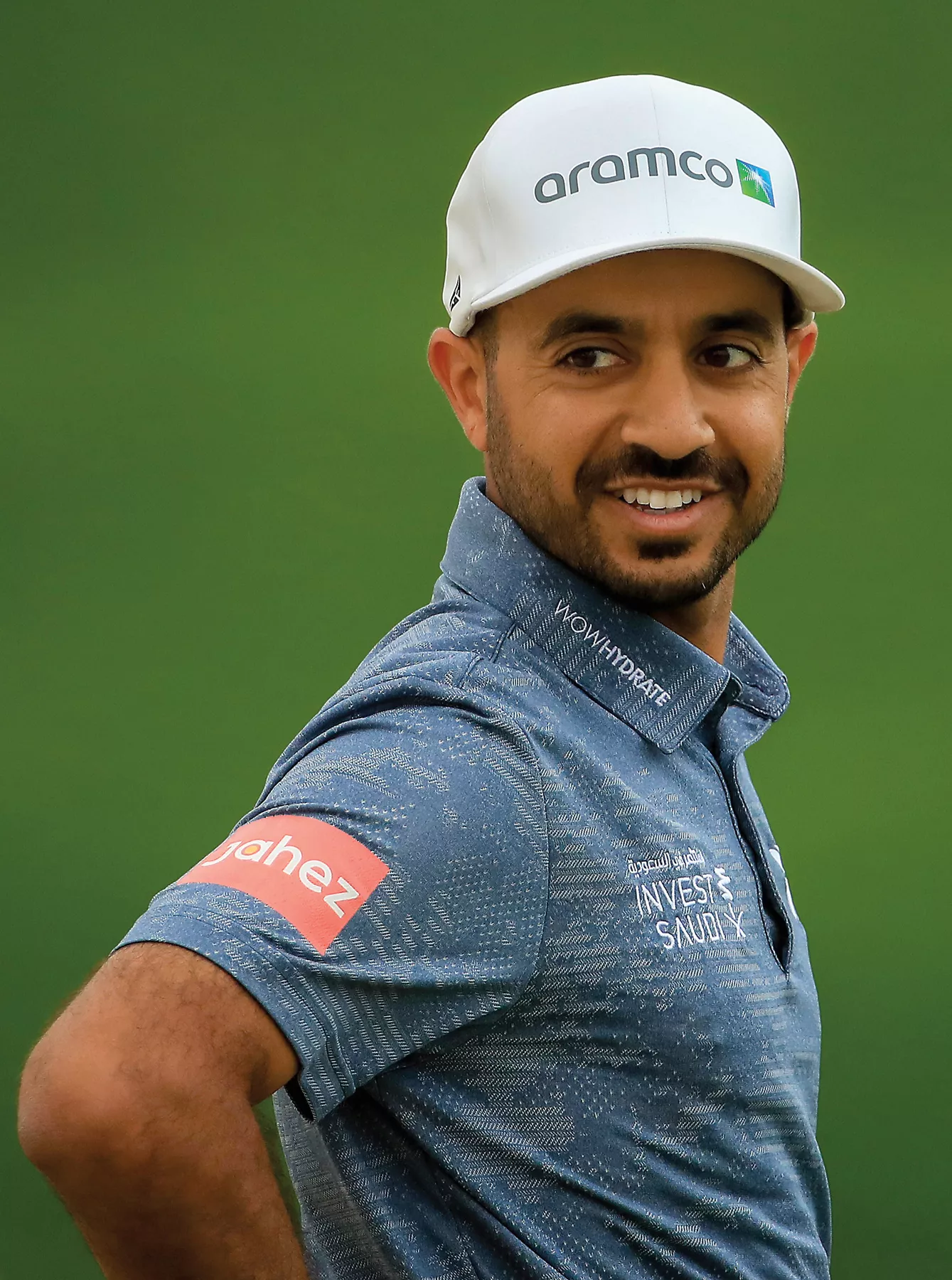
Evidence of golf's growing accessibility and future potential in the region includes increased former players' participation in key roles of national federations, as Almulla notes.
Ross Kinnaird / Getty Images

“With efforts to establish a homegrown golf presence where Arabs themselves are playing golf to the point where they can get on the professional tours and compete, I think it has a bright future.”
Crossroads at the PIF Tournament
Almulla's journey from amateur to pro runs parallel with the region's ambitions to take the game of golf to the highest level. The two stories merge at the crossroads of the PIF Saudi International, one of the premier sporting events in the Arab world.
Essential to the transformation of golf in the region is the Arab Golf Federation, supported by voices like Attallah, who speaks plainly about the challenge ahead.
"Now, we want to build the ecosystem to get us there. We're not just talking about one champion, we're talking about making it sustainable, learning from the trials of pioneers like Othman Almulla, whose path was often lonely and undefined, to create pathways for the next generation. ... The vision is clear: to see a player from the Arab world lift a Major championship trophy by 2035."
At the heart of that goal is a new generation of programs and partnerships designed to identify, nurture and retain Arab talent-especially youth. These initiatives include scholarship programs for top junior Arab golfers to train abroad.
"Participation is beginning to resonate across all demographics," says Attallah, emphasizing that the three-pronged strategy of raising awareness, opportunity and investment is bearing fruit.
But there is still work to be done. While countries like Morocco, Saudi Arabia and the United Arab Emirates have established world-class facilities and deep tournament calendars, other countries are catching up. Even in places with significant investment, there is more to be done to cultivate local talent, Attallah says.
In addition, Almulla highlights the increased participation of former players in key roles of national golf federations as a positive development.
"I think you're starting to see a lot more athletes go into management of federations now, and I think that will be transformational."
Attallah agrees, reiterating the retention of golf professionals in the industry as a key to success.
He says that's where the legacy of pioneers like Almulla becomes instructive. "He made us aware that we should always look to the people who took the risk and had the pressure. ... Their reputation was on the line first."
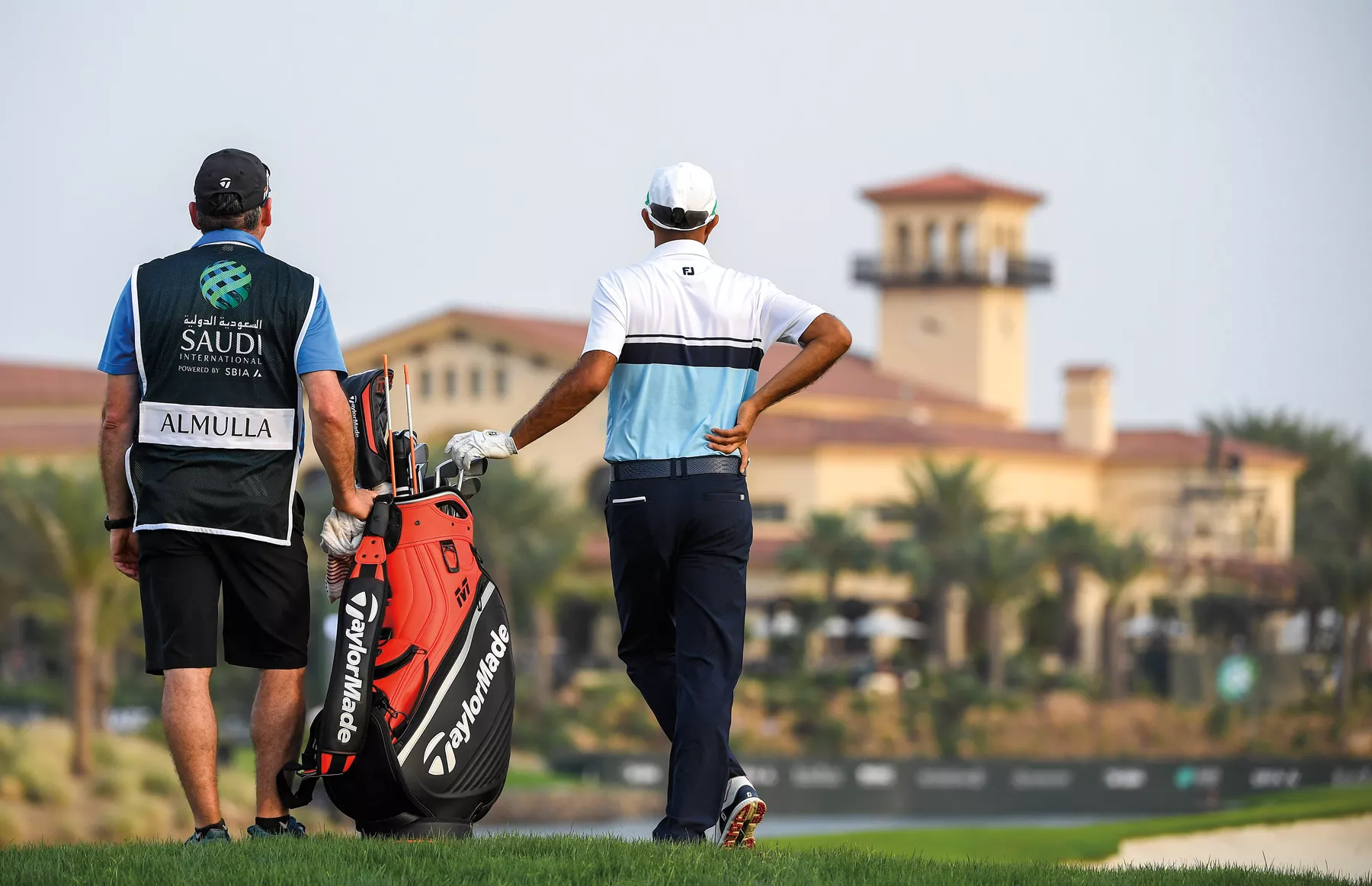
A caddy and Almulla assess the 18th fairway during the first round of the PIF Saudi International in 2019.
Ross Kinnaird/Getty Images
Almulla's story is only one of many when it comes to rising professional Arab golfers: Shergo Al Kurdi from Jordan, Issa Abouelela from Egypt, Elyes Barhoumi from Tunisia, Azzan Al Rumhy from Oman. Arab women, such as Maha Haddioui and Inès Laklalech from Morocco, are also making a splash.
As for the big picture, Lesch believes this evolution is an overall positive development for the region. "With efforts to establish a homegrown golf presence where Arabs themselves are playing golf to the point where they can get on the professional tours and compete, I think it has a bright future," Lesch concludes.
According to a 2024 report from R&A, a leading body that monitors golf participation around the globe, the Middle East has seen a 238% rise in golfers across the region between 2012-2024, and the results are tangible to professionals like Almulla. "To see busloads of kids come in and try golf and have fun playing the sport, I would say that's an emotional moment for me."

You may also be interested in...

From Leather to Labs: The Science of Football Design
Culture
The ball's continually refined materials and construction affect its behavior, quietly reshaping how the game is played.
A Quiet Path Through Recipes: A Conversation With Jeff Koehler
Arts
Culture
Jeff Koehler approaches food as a vessel for storytelling, for geography and cultural identity.
Threads of Memory at the Venice Biennale
Arts
History
Culture
At the Venice Biennale, which runs through November 22, 2026, the Moroccan, French and Saudi national pavilions show how craft and shared memory can resist cultural erasure.