An Alchemist's Quest To Re-create Medieval Healing Foods
Food historian and Arabic scholar Daniel Newman spent decades studying and re-creating centuries-old recipes, revealing the reasoning and alchemy behind food as medicine.
6 min
Written by Indlieb Farazi Saber, Photographs courtesy of Daniel Newman
Editor's note: Daniel Newman, the scholar whose work and voice shape this article, passed away shortly before its publication. It stands as a tribute to his pioneering research and passion for bringing the culinary traditions of the medieval Islamic world to life.
What do the bile of sperm whales, the glandular secretions of deer and the bitter resin of the mastic tree have in common? All are prized for their scent and, astonishingly, were also once known for their purported healing powers.
In the royal kitchens of the medieval Middle East, these coveted substances scented the dishes of caliphs and sultans, turning every banquet into a feast for the senses.
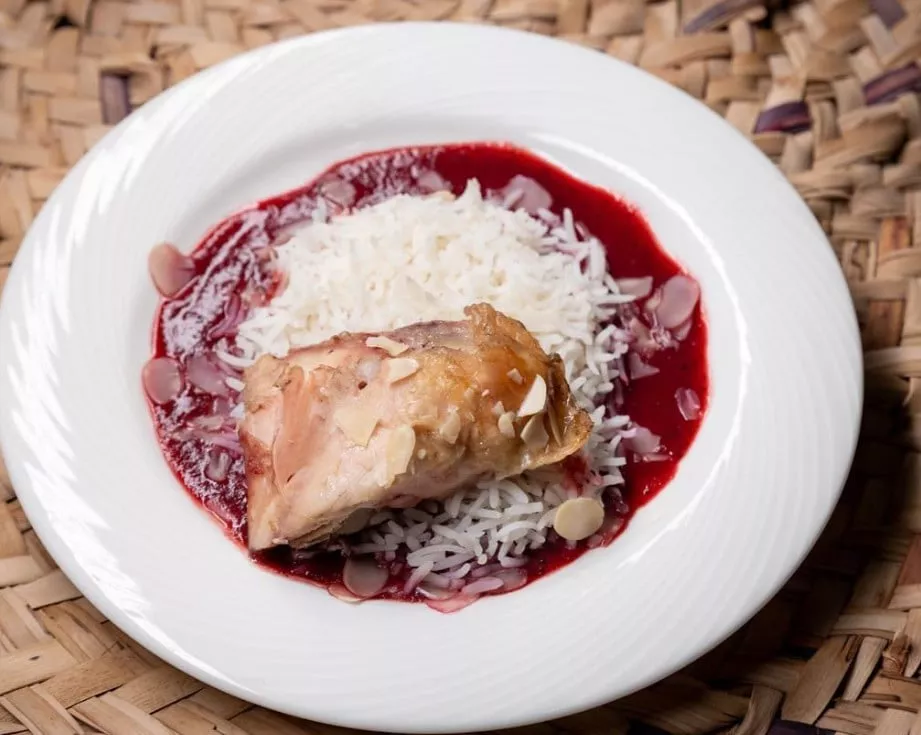
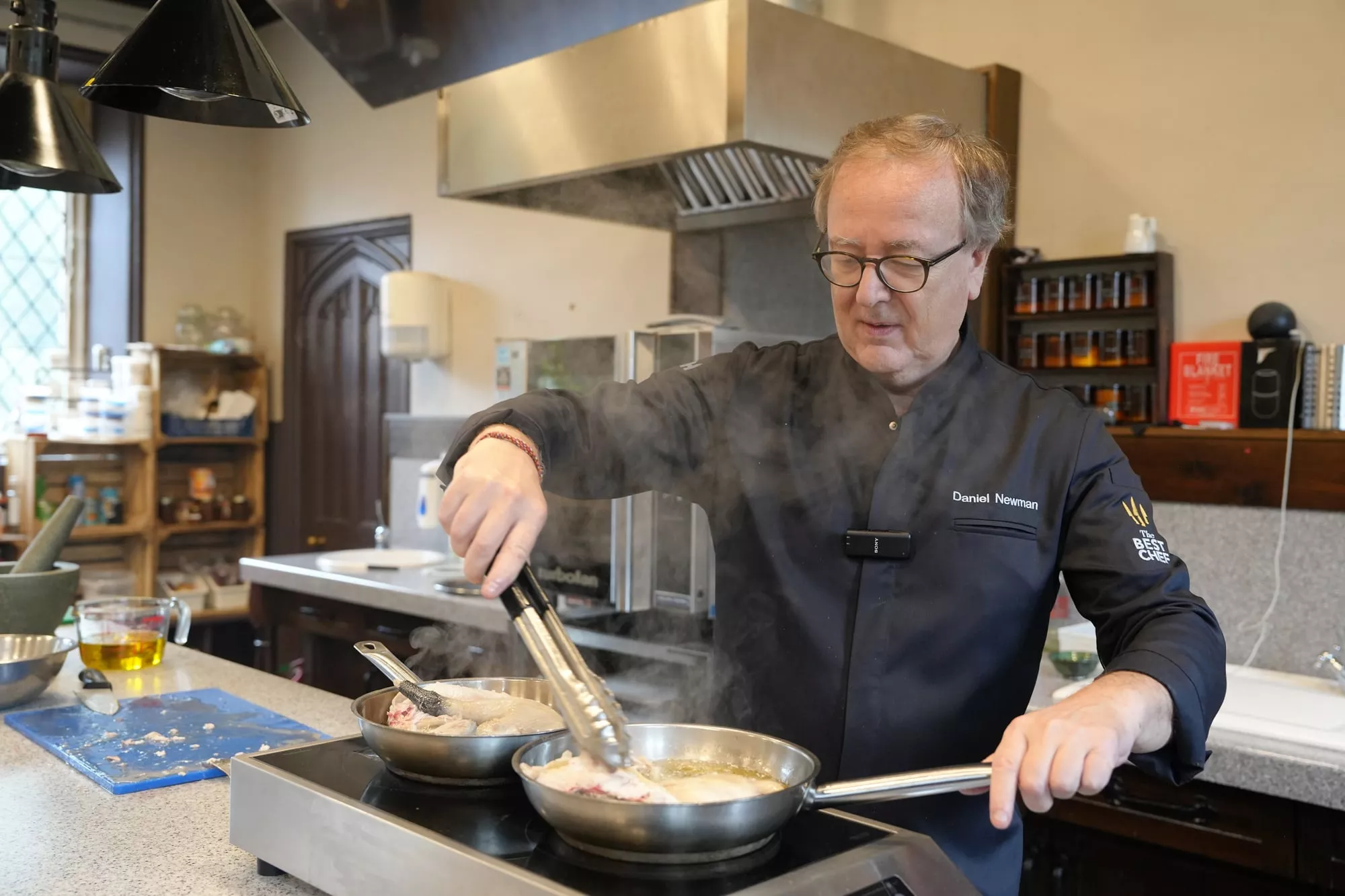
Cherry chicken reflects the refined sweet-and-sour tastes of Mamluk Egypt. Top: Daniel Newman prepares parsley chicken from Mamluk Egypt (15th century) at the cookery school kitchen within Blackfriars Restaurant in Newcastle, England.
Top: Photograph by Whitney Stanton, Courtesy of Daniel Newman
Aromatic as it was, food was not merely fragrant sustenance: It often also was a form of medicine. Daniel Newman, food historian and Arabic scholar at England's Durham University, spent decades studying centuries-old recipes and, in recent years, revealing the reasoning and alchemy behind them.
"People are always shocked when they realize ambergris [the waxy secretion of a sperm whale] or musk were once also eaten," Newman says, smiling. "But to the medieval mind, these were firstly medicines—tonics to fortify the heart, sharpen the senses and balance the body."
Ambergris perfumed bowls before food was served; its musky sweetness signaled luxury and potency, believed to strengthen the heart and arouse desire. Mastic resin, equally prized, lent dishes a piney freshness while aiding breath and digestion.
Newman spent years decoding the manuscripts that describe such foods, translating hundreds of recipes from ancient Arabic texts that blur the lines between cookbooks and medical treatises, as was common at the time.
His The Sultan's Feast: A Fifteenth-Century Egyptian Cookbook (Saqi Books, 2020), a translation of more than 200 recipes from Zahr al-Hadiqa fi-al-Atʿima al-Aniqa (Garden Flowers in Elegant Food) by 15th-century Egyptian author Shihāb al-Dīn Aḥmad Ibn Mubārak Shāh, opened a rare window into the kitchens of Mamluk Cairo.
Newman later turned westward with The Exile's Cookbook: Medieval Gastronomic Treasures From al-Andalus and North Africa (Saqi Books, 2023), his translation of the 13th-century Andalusian scholar Ibn Razīn al-Tujībī's culinary treatise—a work that in 480 recipes preserves the flavors and memories of Muslim Spain and North Africa that prevailed during the seven-century Muslim rule of medieval Iberia.
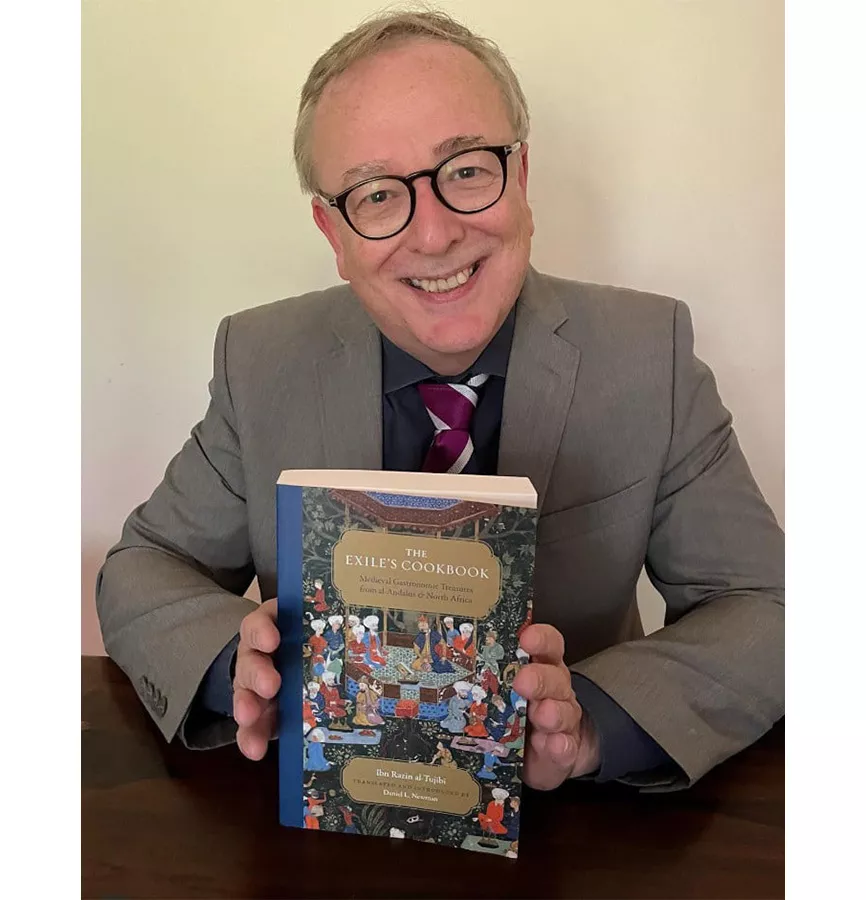
Newman poses with The Exile's Cookbook, his translation of a 13th-century Andalusian culinary work.
'For the table of princes'
But it was Newman's translation of Mubārak Shāh in The Sultan's Feast that first revealed how deeply medicine and cuisine intertwined. Shāh was no chef but rather a poet and anthologist who documented the dishes he loved, from rich chicken stews to honeyed sweets—all steeped in medical theory.
"So many of these recipes began as pharmacological notes," Newman says. "They were copied from medical encyclopedias into cookbooks, then adapted by chefs for the table of princes."
In its pages, a chicken stew with pomegranate, quince and apple appears beside a syrup of violet flowers for cooling fevers, and a honeyed pudding is prescribed to "cheer the spirit." The text is part medical compendium, part royal menu—a manual for living well and eating wisely.
"These weren't separate worlds," says Newman. "The doctor and the chef shared the same vocabulary of balance."
He later discovered Tasnif al-At'ima ("The Categories of Foods"), an anonymous Maghrebi manuscript from the Wellcome Collection in London. Though catalogued as a pharmacopeia, Newman realized it concealed an early recipe collection—one he now believes pre-dates even the 10th-century Abbasid cookbooks. "It may be the missing link," he says, "showing how recipes evolved from medicine to gastronomy."
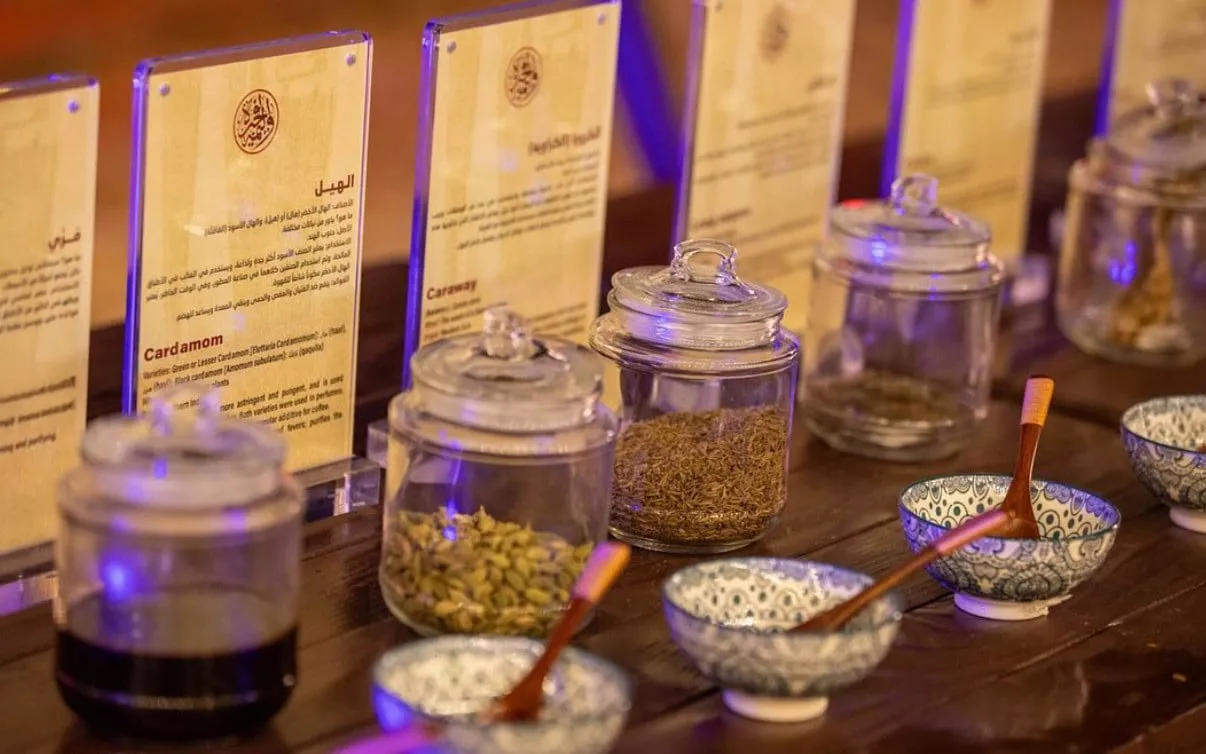
Spices were central to both flavor and medicine in the medieval Arab kitchen.
The crossover is most visible in dishes like sikbaj, a beef stew simmered in vinegar and aromatic herbs. "The first time I made it, I didn't like it. It was far too sour," Newman laughs. "But once I adjusted the vinegar, it was exquisite. It's a perfect example of balance: acidity to stimulate digestion, spices to warm the stomach."
Newman moves through the scholarly world with the gleeful curiosity of a modern alchemist. He is equally at home puttering around in the library as he is in his Durham kitchen, where cupboards overflow with spices gathered from his travels. It is part laboratory, part family dining room. He tests and shares centuries-old recipes with his wife, his ever-patient taste tester.
"Our kitchen often smells of caraway or vinegar," he acknowledges. "[But] you can't understand these texts until you cook them."
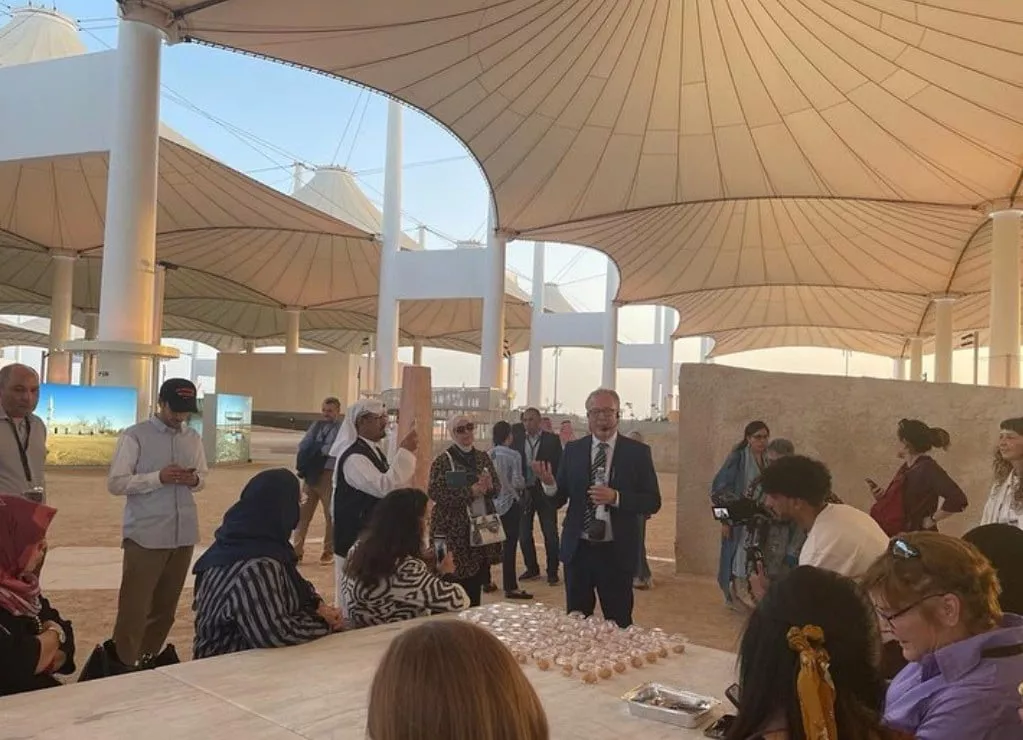
At Jeddah, Saudi Arabia's Islamic Arts Biennale in April 2025, medieval recipes were brought to life
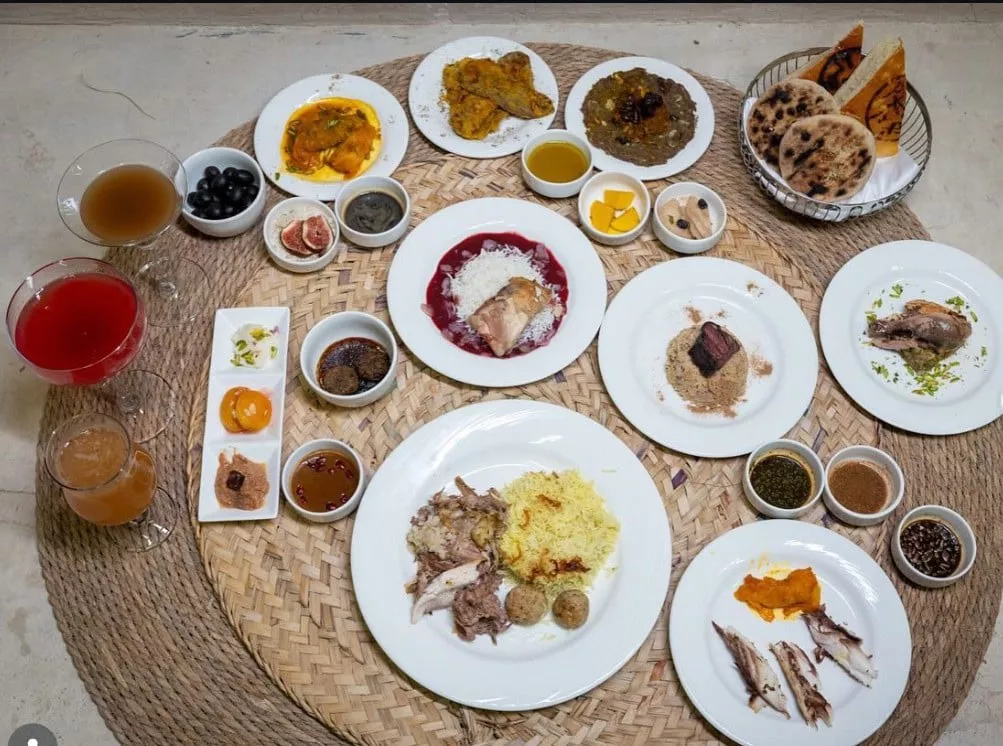
Newman re-created a full-scale medieval kitchen in December 2023 at the United Arab Emirates's Fujairah Fort.
His experiments, documented on his blog Eat Like a Sultan, include collaborations on heritage projects and culinary reconstructions. They have taken him from Durham to Doha, including stops at Qatar's Museum of Islamic Art and Saudi Arabia's Islamic Arts Biennale in Jeddah, as well as to Bahrain and across the United Arab Emirates., collaborating on heritage projects and culinary reconstructions.
Most recently, in May 2025, Newman completed the re-creation of a full-scale medieval kitchen at the UAE's Fujairah Fort, complete with brass pots, clay tandoors, brick stoves and open-fire hearths. A year earlier, he had curated a series of banquets there for 150 diners.
The 20-dish menu spanned the medieval Muslim world, including a whole oven-roasted camel stuffed with smaller animals—including a lamb, a goat and several chickens—along with a precursor to modern-day hummus: a coarse 13th-century Aleppan chickpea mash blended with vinegar, nuts and sesame paste.
Chickpeas, he explains, were prized for being both nutritious and aphrodisiac. The dishes were paired with medieval beverages such as a tamarind drink from al-Andalus, said to cure jaundice, quench thirst and whet the appetite.
"Food was medicine, and medicine was food," he says.
The science of the senses
Newman's interest in reviving medieval Arabian recipes began through his interest in translating ancient texts. The pharmacological writings of 10th- and 11th-century physicians such as Ibn Jazla, al-Razi (Rhazes) and Ibn Sina (Avicenna) proved a particular draw.
These scholars in Baghdad's Bayt al-Hikma—the House of Wisdom—rendered Greek medical texts by Galen and Dioscorides into Arabic, shaping a culinary tradition both scientific and sensual. "A physician must also be a good cook," Galen had written. And medieval scholars took him at his word.
"When you study Arabic medicine," Newman explains, "you realize that food lies at its heart …. Eating the right food maintains equilibrium; eating the wrong one disturbs it."
The theory held that the human body mirrored the cosmos, governed by four humors—blood, phlegm, yellow bile and black bile—each aligned with one of the elements, seasons and temperaments. A balanced temperament meant health; an imbalance meant disease.
"If you had a 'cold' temperament,'" Newman explains, "you might be prescribed warming foods—cinnamon, ginger, meat roasted over a fire. If you were overheated, you'd eat cooling foods like cucumber, lettuce or violet syrup." Lamb and honey were warming; pomegranates cooling.
The skill of the cook—indeed, of the physician—lay in crafting dishes that restored balance. "If you were melancholic," Newman says, "you'd eat something warming and moist to counteract the cold dryness of your disposition. If your liver was sluggish, a chard-and-mustard stew might 'open' it."
Over four centuries, Arab culinary scribes compiled more than 4,000 recipes—no other civilization produced such a vast written corpus on food. Newman emphasizes the logic behind them. "Taste was not frivolous," he says. "If medicine were unpleasant, patients wouldn't take it."
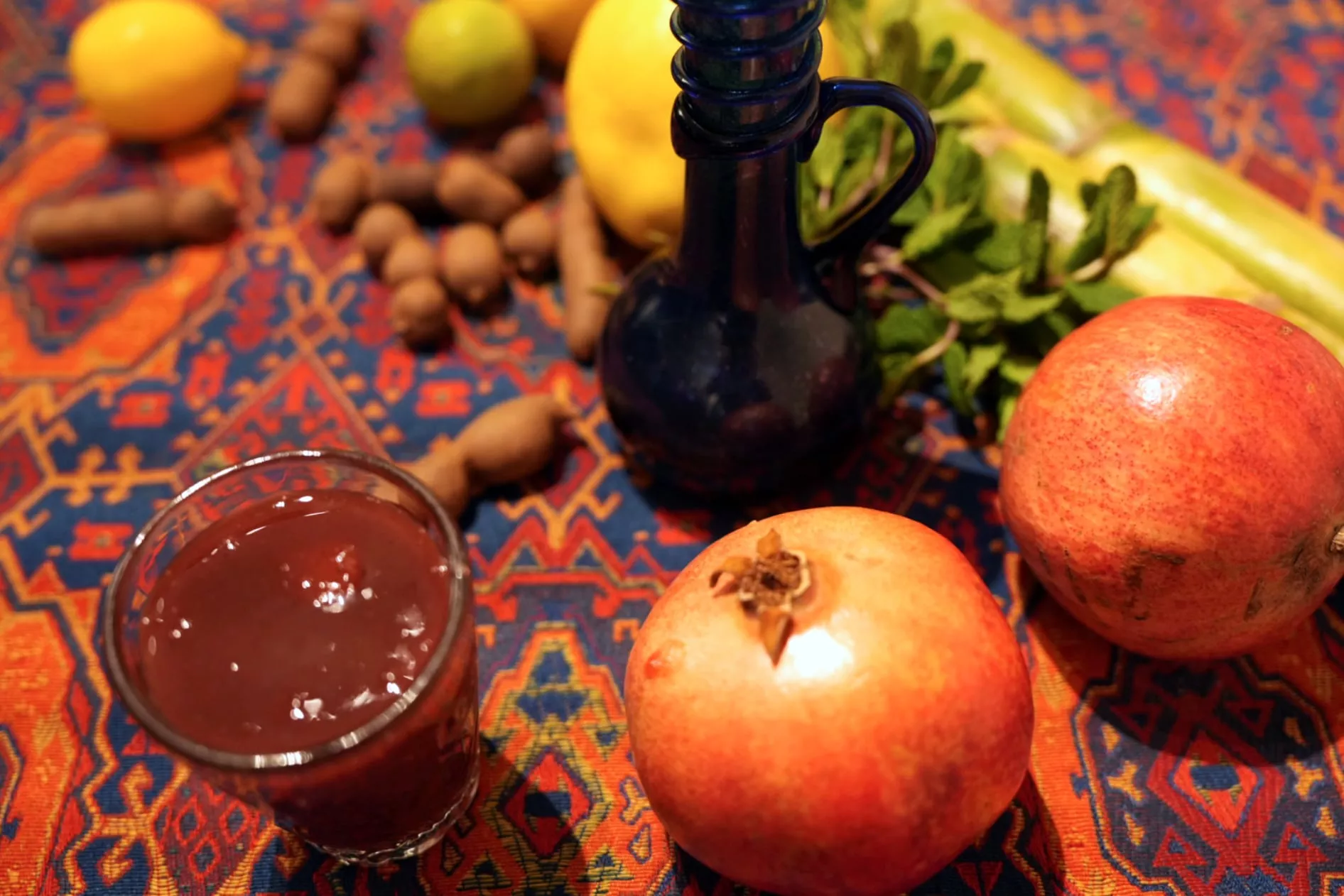
A Mamluk anti-nausea drink of pomegranate, quince and mint.
A favorite blend of Newman's is a cloudy mixture of fresh pomegranate juice, lemon, quince and mint. He calls it a "Mamluk anti-nausea drink,"a medieval Egyptian remedy once prescribed for queasy stomachs. The drink, spiced with atraf al-tib—a delicate blend including cinnamon, cloves, nutmeg and mastic—was intended to calm the humors and refresh the spirit. "It's extraordinary," Newman smiles, "how something devised to cure nausea can also taste so utterly luxurious."
By the 13th century, royal kitchens across Cairo; Damascus, Syria; and Baghdad functioned as extensions of the apothecary. Recipes aimed to lift the mood, improve complexion or restore vitality after illness. "The air around the banquet was as important as the meal itself," Newman notes. "A dish perfumed with rosewater or mastic was a statement that the diner possessed both good taste and good health."
At the royal table, every dish was a statement. A stew of quince, pomegranate and apple might fortify the blood and cool the humors; a pudding of bread and milk could soothe the stomach; sweets were perfumed with rosewater and musk to "open the pores of the soul." To dine well was to demonstrate mastery over nature—and over one's own temperament.
But re-creating some of these dishes today requires detective work. "The manuscripts rarely give quantities," Newman explains. "You get lines like, 'Take some sugar and boil until done'—done by whose standard?"
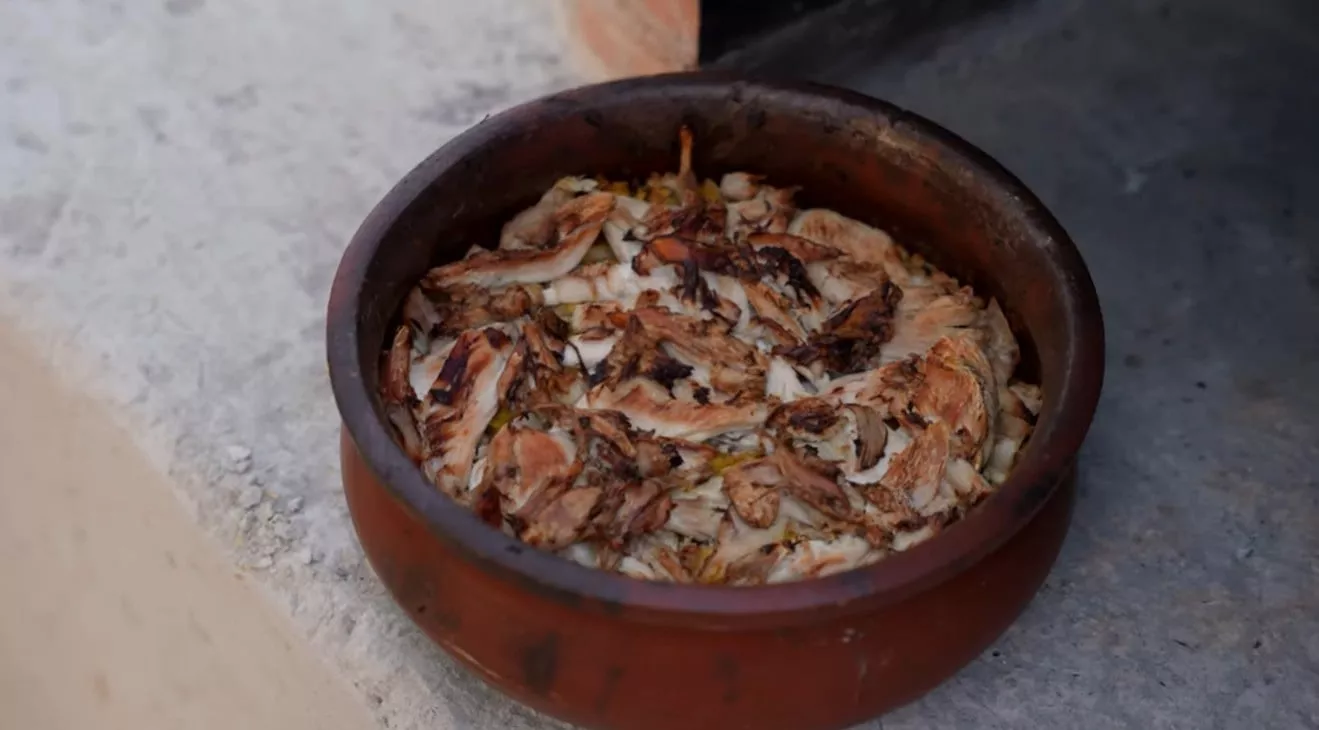
Judhaba is a medieval bread pudding enriched with chicken juices.
A favorite dish Newman re-creates in his kitchen is judhaba, a bread pudding layered with chicken juices. "The Abbasid gastronome-caliph Ibrāhīm ibn al-Mahdī [779–839 CE] devised his own variant," Newman says, "while the physician al-Razi praised its nourishing properties but recommended 'a nap afterwards to aid digestion.'"
Revival and resonance
As global food culture swings toward wellness, the principles of humoral balance have returned—disguised as modern trends.
"When I see turmeric lattes and adaptogenic smoothies, I can't help smiling," Newman says. "It's medieval wisdom dressed in millennial branding." The notion that food can warm, cool or rebalance the body would have been instantly recognizable to a 10th-century physician.
Even the rediscovery of Middle Eastern spices follows an old pattern. "A celebrity chef recently claimed he had 'discovered' sumac," Newman laughs. "I wanted to send him a 13th-century recipe book."
While modern gastronomy often separates indulgence from health, the medieval Arab kitchen united them. Every ingredient served multiple ends: to nourish, to heal, to delight, to signify rank. "The ideal dish," Newman says, "was one that pleased the senses, sustained the body and affirmed your place in the world."
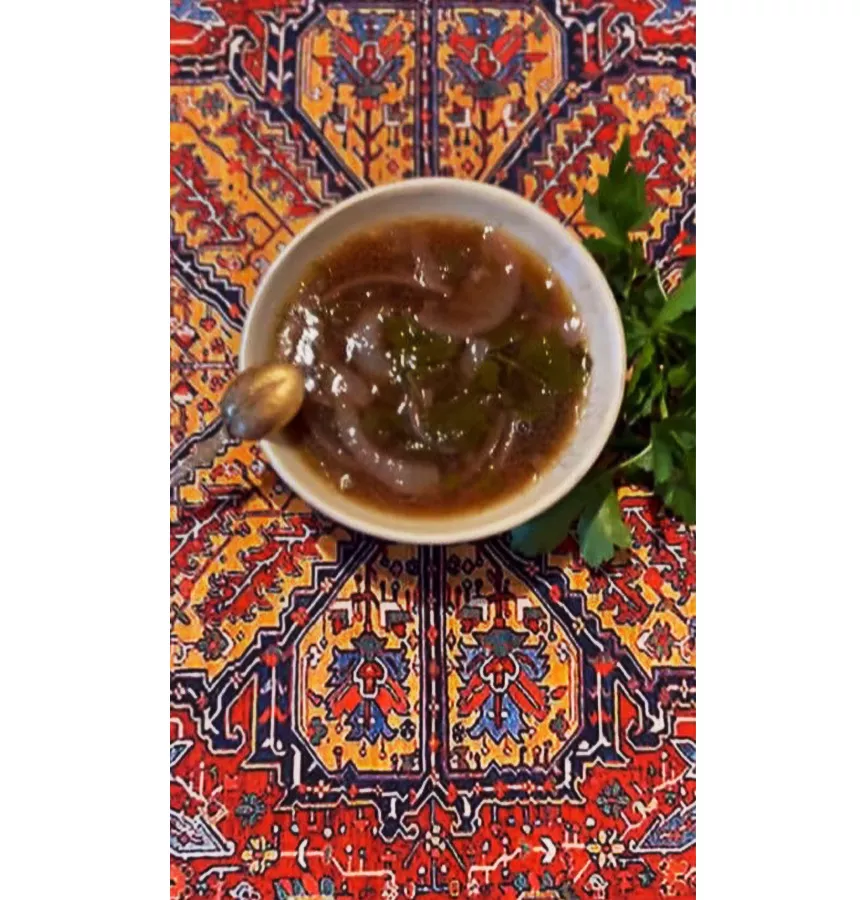
An Abbasid cough mixture reflects the close ties between food and medicine.
Across his travels in the Arabian Gulf and North Africa, Newman finds local chefs reclaiming ancient recipes, reinterpreting them with modern finesse. "They're rediscovering their culinary ancestry," he says. "And that ancestry is scientific, cosmopolitan, deeply rooted in cross-cultural exchange."
The very foundations of European cooking owe much to this legacy. Arabic manuscripts carried into Sicily and Spain were translated into Latin in the 11th century, then into Italian and German, shaping Renaissance cuisine. "The Mediterranean was never divided," Newman reflects. "It was a single conversation, conducted through food."
It's that alchemical spirit—half scholarly, half culinary—that defines his work, reminding us that the boundary between kitchen and clinic is fluid, and the search for balance has long defined how we eat.
Note: Newman shared his ongoing culinary reconstructions and historical experiments on Instagram and YouTube.

You may also be interested in...
How a US Filmmaker Reclaimed a Forgotten Syrian Lebanese Legacy
Josh Chitwood belongs to a small group of American descendants trying to document and preserve their Syrian Lebanese history before it disappears. What compels people like him to recover what remains?
Momma’s Maqluba: From Damascus to My Alabama Table
Food
This is how a Damascus dish became my Alabama family story, one generation at a time.
Football's Other Score: World Cup Music Unites Fans Around the World
Culture
The collaborative nature of World Cup songs reflects the global scale of the tournament itself.