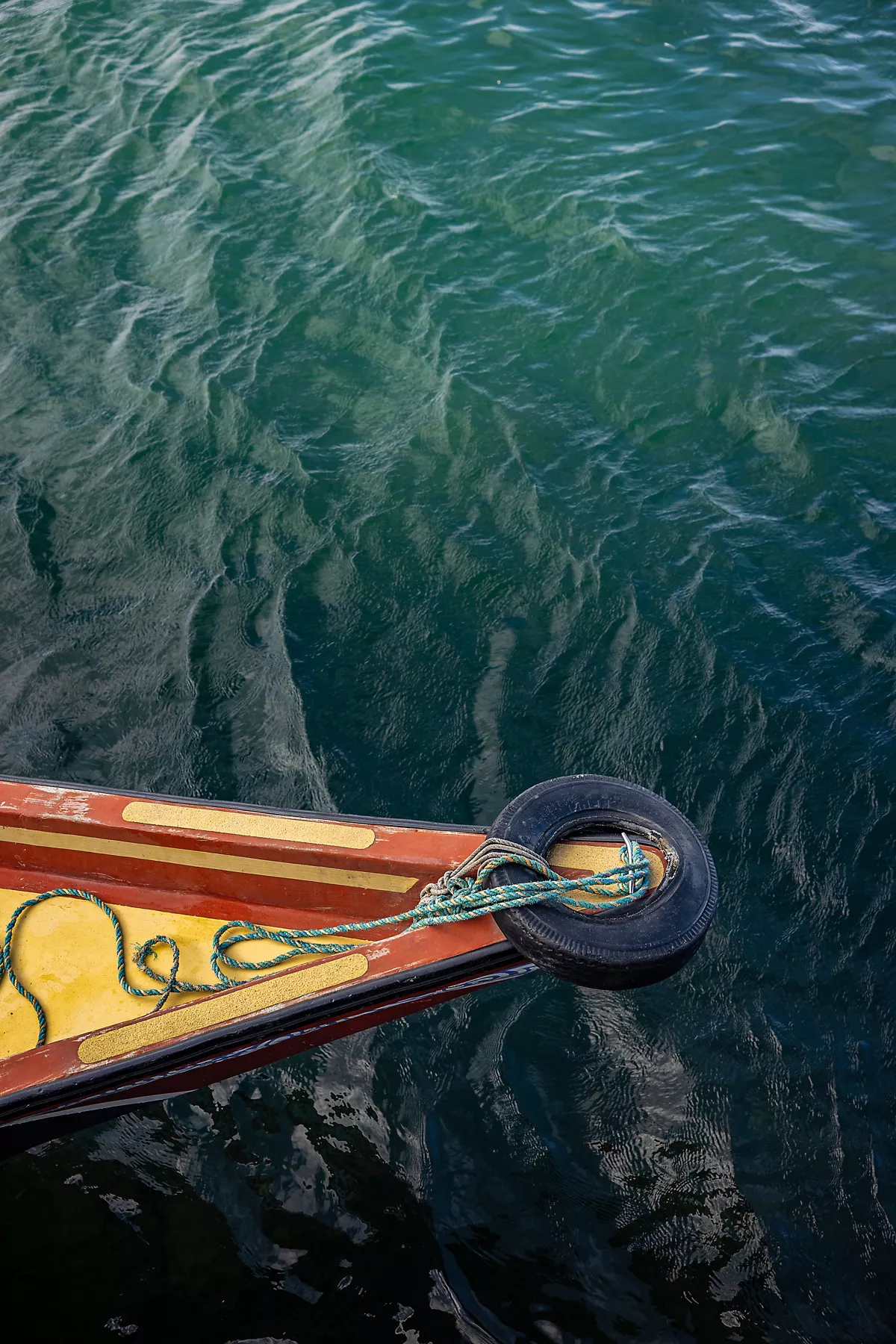
Lamu's Last Dhow Builders and the Craft That Refuses To Vanish
On Lamu, off the northern Kenyan coast, builders of traditional wooden vessels that carried sailors who made their living from the sea for more than a millennium today steer them toward a different economic horizon: tourism.
Written and photographed by Samantha Reinders
Boatbuilding has defined the island of Lamu, Kenya, for centuries.
The sail of the Amina catches what remains of the afternoon’s intermittent wind, flutters and then goes slack. Catches it, flutters and then goes slack again. On the horizon, the sun is doing what it does here every evening with theatrical reliability, sinking into the Indian Ocean in long ribbons of amber and copper. From somewhere deep in the mangroves we drift past, cicadas provide a soundtrack.
There is no engine. No hull-slap of a speedboat, no crackle of a radio. Just the occasional creak of the wooden mast, and the breath of a wind that has been crossing this ocean for thousands of years. It is difficult, in a moment like this, not to feel that you are inside something very old.
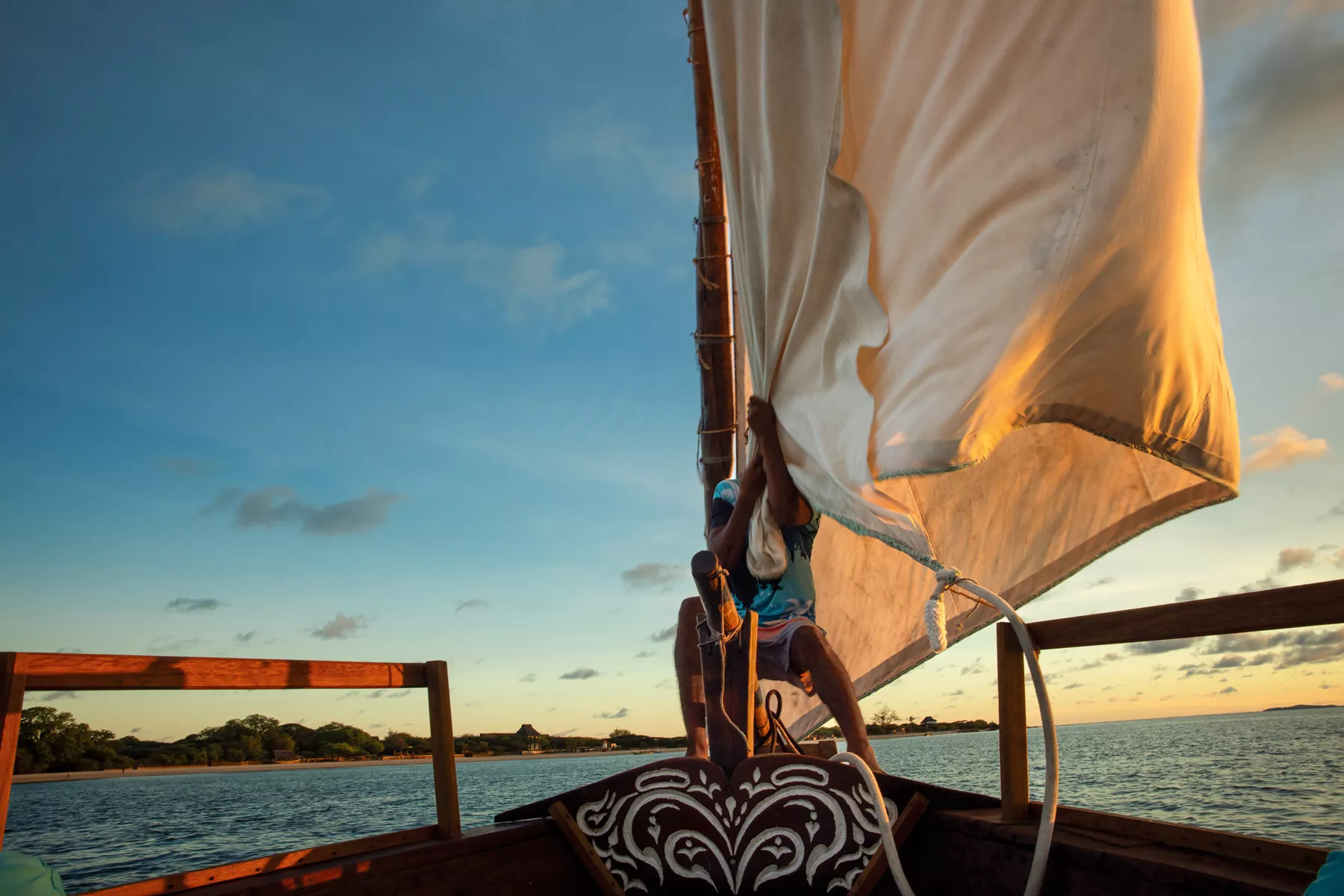
The Amina carries visitors across the Lamu Channel at dusk. Such dhows represent the small coastal craft that have kept Lamu’s boatbuilding tradition alive.
I am. The dhow is the vessel of one of the oldest continuously practiced forms of seafaring on the planet. For more than a millennium, boats like this one connected East Africa to Arabia, Persia and India. They ran on monsoon logic: the socioeconomic philosophy that respects seasonal rains and their associated winds, and accumulated knowledge of wind and tides and boatbuilding techniques. They carried mangrove timber and ivory north, cloth and dates and porcelain south, and in both directions something harder to inventory: language, religion, gene pools and ideas.
That kind of seafaring, in its original form, is gone. But on Lamu—this small, car-free island off the northern Kenyan coast—something of it persists. The question is what, exactly, and for whom.
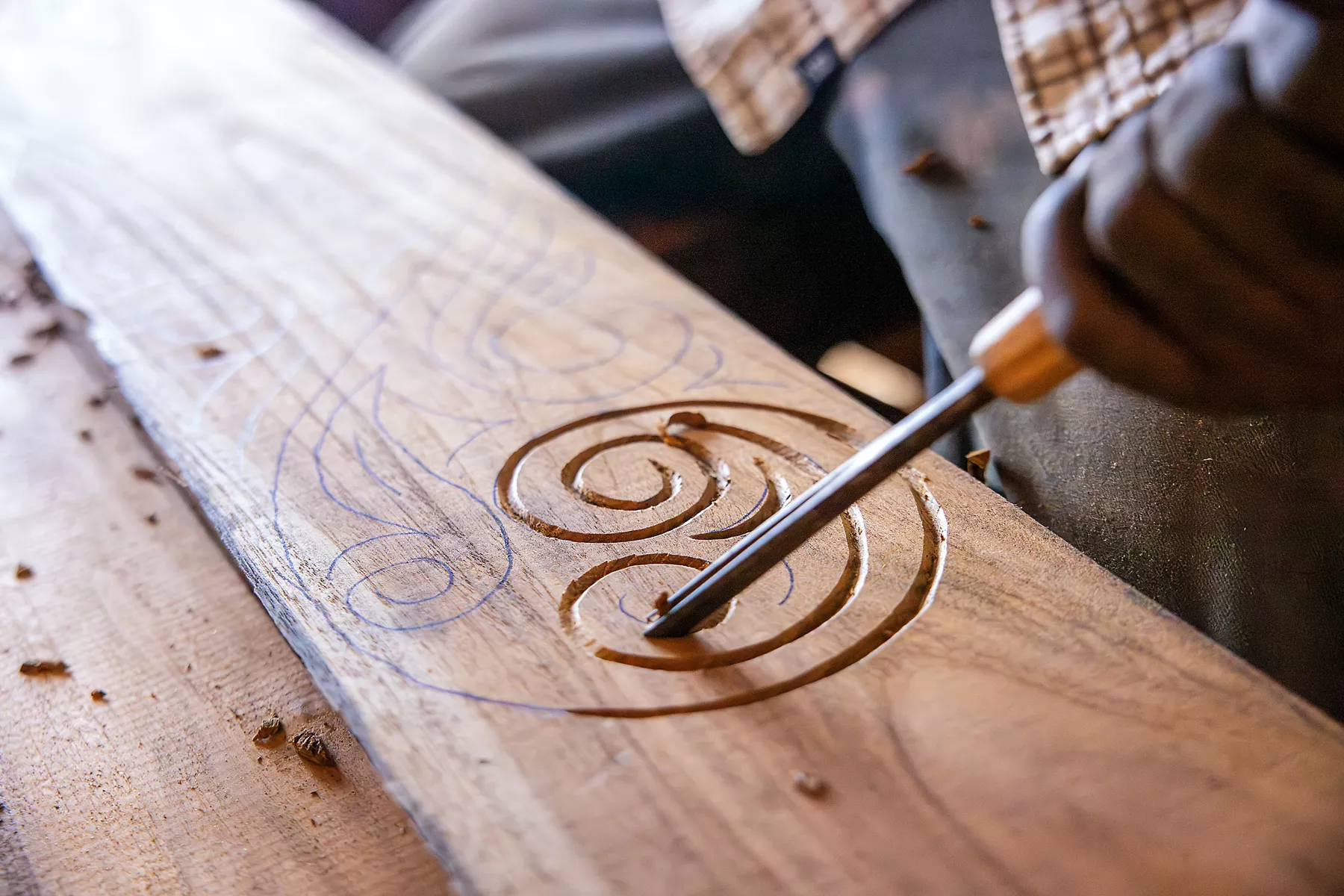
Most wooden dhows are still built by hand and by eye, with traditional designs carved into the imported teak planking that goes over mangrove frames.
The Monsoon Trade
The word “dhow” is, strictly speaking, a European convenience—a catch-all applied by outsiders to dozens of distinct vessel types that Indian Ocean communities had long named precisely.
Maltese-born Dionisius A. Agius—British Academy Fellow and Al Qasimi Professor at the University of Exeter in England and author of several books on dhow traditions—notes that the term’s origin is contested: Earlier scholarship traced it to Arabic or Persian, while more recent research suggests a Swahili root (daw, meaning vessel), reflecting the layered exchanges of the Indian Ocean world. The term entered wider European usage during the colonial period, when British naval authorities in East Africa were regulating and suppressing trade routes across the western Indian Ocean.
Dhows themselves have specific names: jahazis and booms, mtepes and baghlas, the latter with their ornately carved sterns, alongside countless smaller coastal craft whose names shifted across regions and time.
What they shared was a relationship with the monsoon winds so intimate as to amount to a kind of annual conversation: northeast from November to March, carrying sailors down from Arabia; southwest from April to October, pushing them home.
In The Life of the Red Sea Dhow, Agius describes the dhow as “not simply a vessel, but a way of life,” linking ports and peoples in networks of exchange that long pre-date modern political boundaries. Abdul Sheriff, an author and historian based in Zanzibar, expands this beyond trade: “Sailing across the seas involved sharing of knowledge not only of wind systems and navigation but also of boatbuilding.”
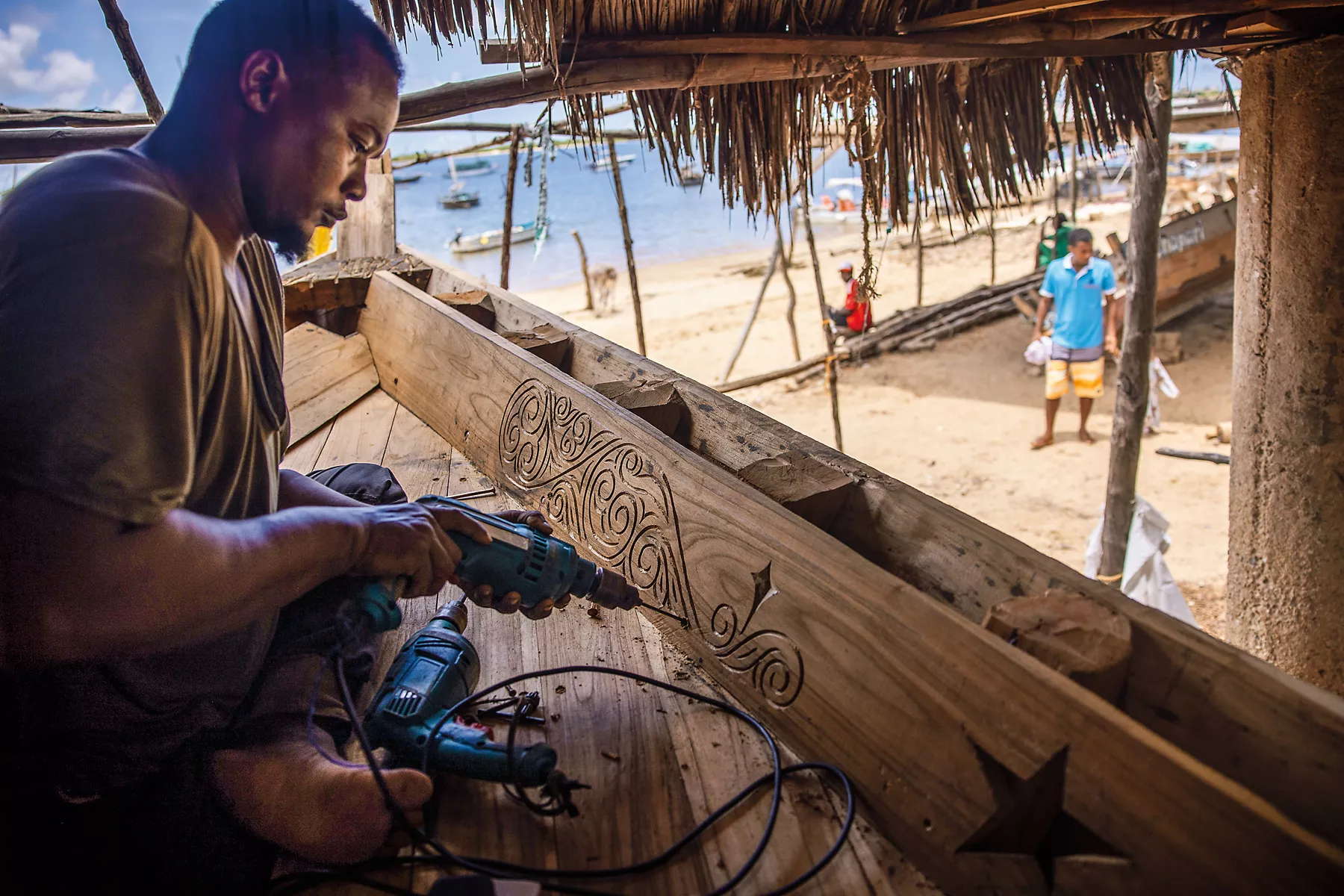
Idris Ali Ahmed works on a Mozambique-style double-ended dhow commissioned for tourist sunset cruises.
“Sailing across the seas involved sharing of knowledge not only of wind systems and navigation but also of boatbuilding.”
Traditional Dhow Builders
I meet Ali Skanda, a master boatbuilder, or fundi (from Arabic fann, meaning skill or craft), in Lamu. Tall and lean, with gray beginning to thread through his long beard, Skanda carries the easy authority of someone long accustomed to being listened to. People greet him constantly as we walk through town.
He traces his lineage on the archipelago back at least 700 years and is somewhat of a cultural figurehead for the tradition of boatbuilding.
Unlike many on the island, Skanda has traveled widely beyond Lamu—abroad and across the continent—and he moves comfortably between worlds: soft-spoken, deliberate, equally at ease discussing monsoon trade routes and modern tourism economies. His clothes are those of a workman, though: a dust-marked T-shirt and worn trousers streaked with paint and sawdust.
After many hours working in his father’s workshop during school vacations, he mastered the art of carpentry and boatbuilding, learning to make dhows the old way—with no blueprint in sight. His most important tools: memory and an inherited understanding of materials and balance.
Skanda is best known as the chief boatbuilder behind the Flipflopi, a campaign against single-use plastic whose flagship project—the world’s first sailing dhow made entirely from recycled plastic waste—brought international attention to Lamu’s boatbuilding traditions. He has even designed a dhow that now resides in the collection at the Mariners’ Museum and Park in the US state of Virginia.
He points me to Matondoni, a village on the sheltered northwest coast of Lamu Island, reachable only by boat. For centuries it was the center of dhow building. At its peak in the 1930s and ’40s, nearly every household was connected to the trade: as craftsman, sailor or supplier of mangrove timber. Then, in the mid-20th century, the world that had made the dhow necessary began to dissolve.
As Skanda tells it, containerization and motorized shipping took the cargo routes. Logging regulations restricted access to timber. The building of the great oceangoing vessels—the jahazis, the mtepes, the long-haul dhows that had knitted continents together—stopped. By the 1960s the largest types had mostly disappeared from East African waters. Agius concurs, adding that the advent of the oil industry in the Middle East ensured that the dhow world could not continue in any recognizable form.
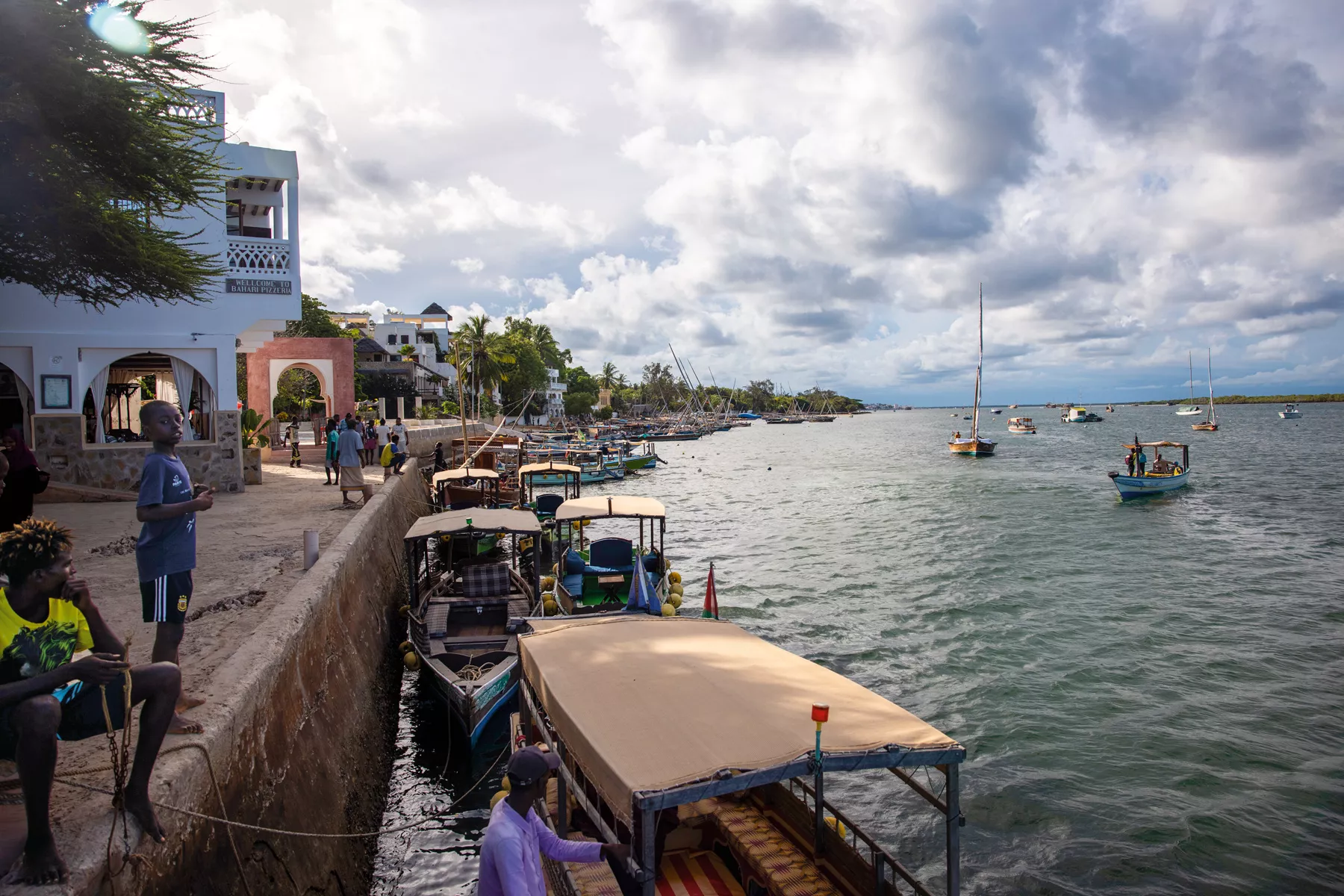
In Shela, a Swahili village on Lamu Island with narrow sandy lanes and no cars, the rhythms of the tide still shape the day.
A Handful of Builders
I arrived at Matondoni on a still morning. The village was quiet, the pace unhurried. Several boats lay marooned in the mud of the low tide, like skeletons in a desert. There were only a handful of wooden dhows; the rest were made from fiberglass. This is not an uncommon sight these days.
Fiberglass boats are cheaper to build and maintain, builders tell me, particularly now that timber is expensive and tightly regulated. In earlier generations, much of the wood could simply be cut locally. Fiberglass hulls also require less fuel when winds fail and engines take over.
But economics is only part of the story. Younger boat owners increasingly see fiberglass boats as modern—cleaner, faster, aspirational in a way wooden dhows no longer are.
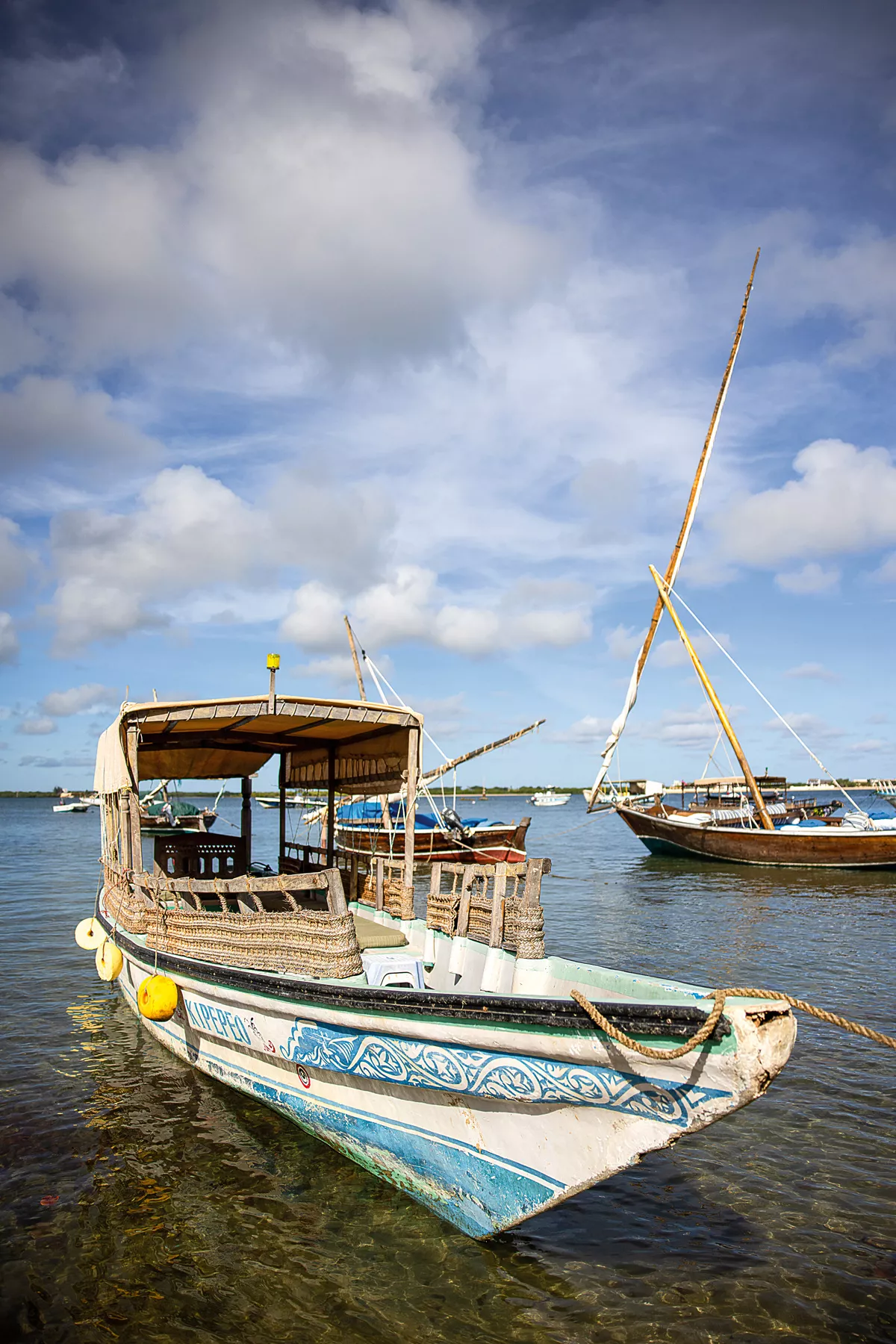
A fiberglass dhow sits moored—cheaper to build, easier to maintain and increasingly common on Lamu Island.
The knowledge of traditional boatbuilding is alive, but the context around that knowledge has changed.
“Today’s generation want to be TikTok stars, not fundis,” says fundi Ali Bakari Bwana, 60. Up close, his eyes appear almost clouded by cataracts, and he carries himself like a man older than his years.
Although he learned the trade from his father and grandfather, Bwana has not taught it to his children. There is little future in it for them, he implies, and little money.
“One day the only dhows left are going to be the ones like Ali and I took to America and are in museums,” he tells me, referring to a vessel he built with Skanda for the Smithsonian Folklife Festival in Washington, D.C.
Retirement seems less like a conscious ending than something toward which he has gradually drifted. He tells me he still has enough work: one boat underway, another commission waiting. But there are fewer dhows passing, he says, pointing to the water, and most new ones are fiberglass.
So, is the craft in decline? It’s complicated. Wooden boats are still being built. The knowledge—how to read the grain of mangrove poles, shape imported teak planking, bend wood with fire and diesel, seal with shark oil, measure a hull by eye—is still alive. But the context around that knowledge has shifted.
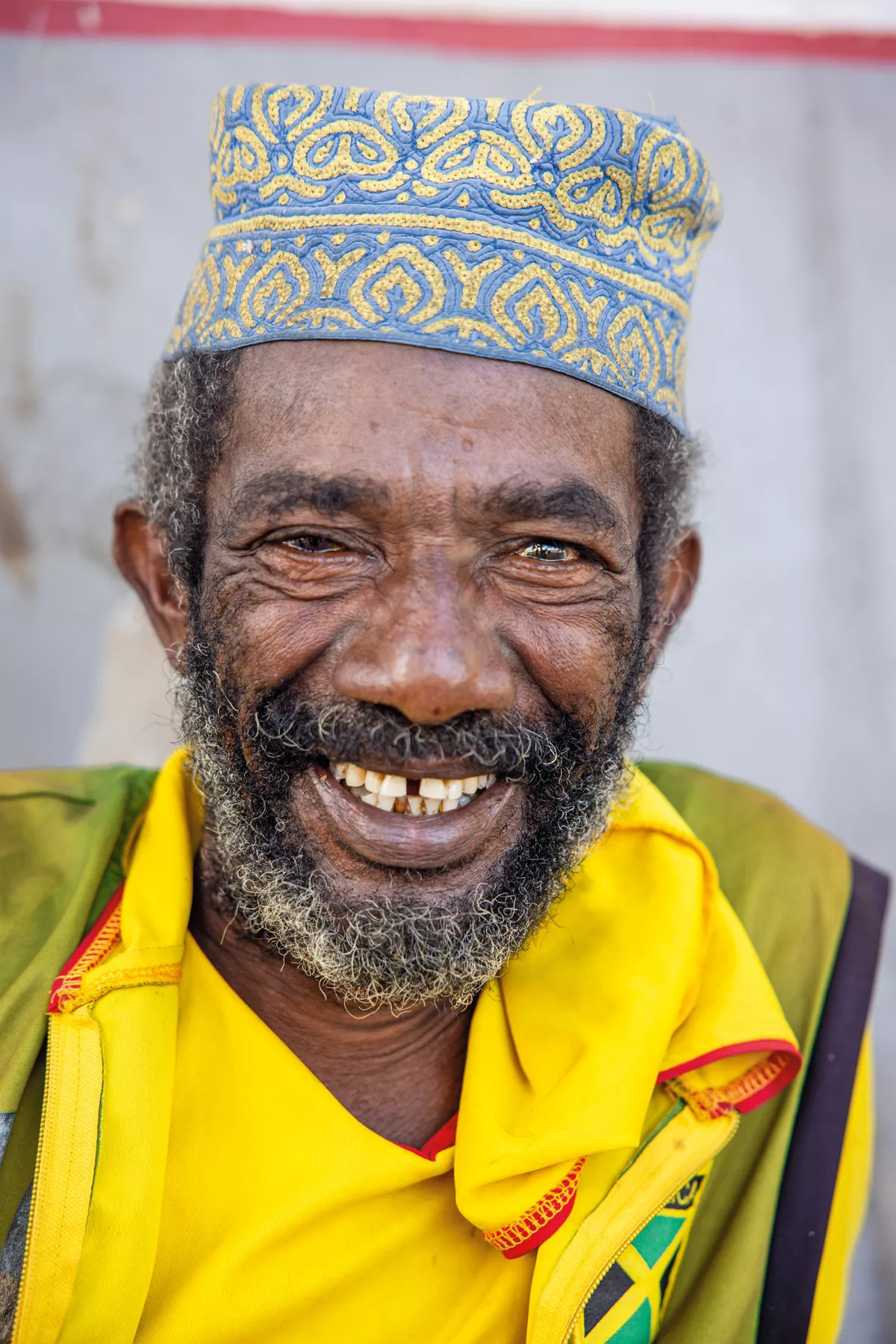
Ali Bakari Bwana, 60, is a master boatbuilder still working in Matondoni, the village where the craft has its deepest roots.
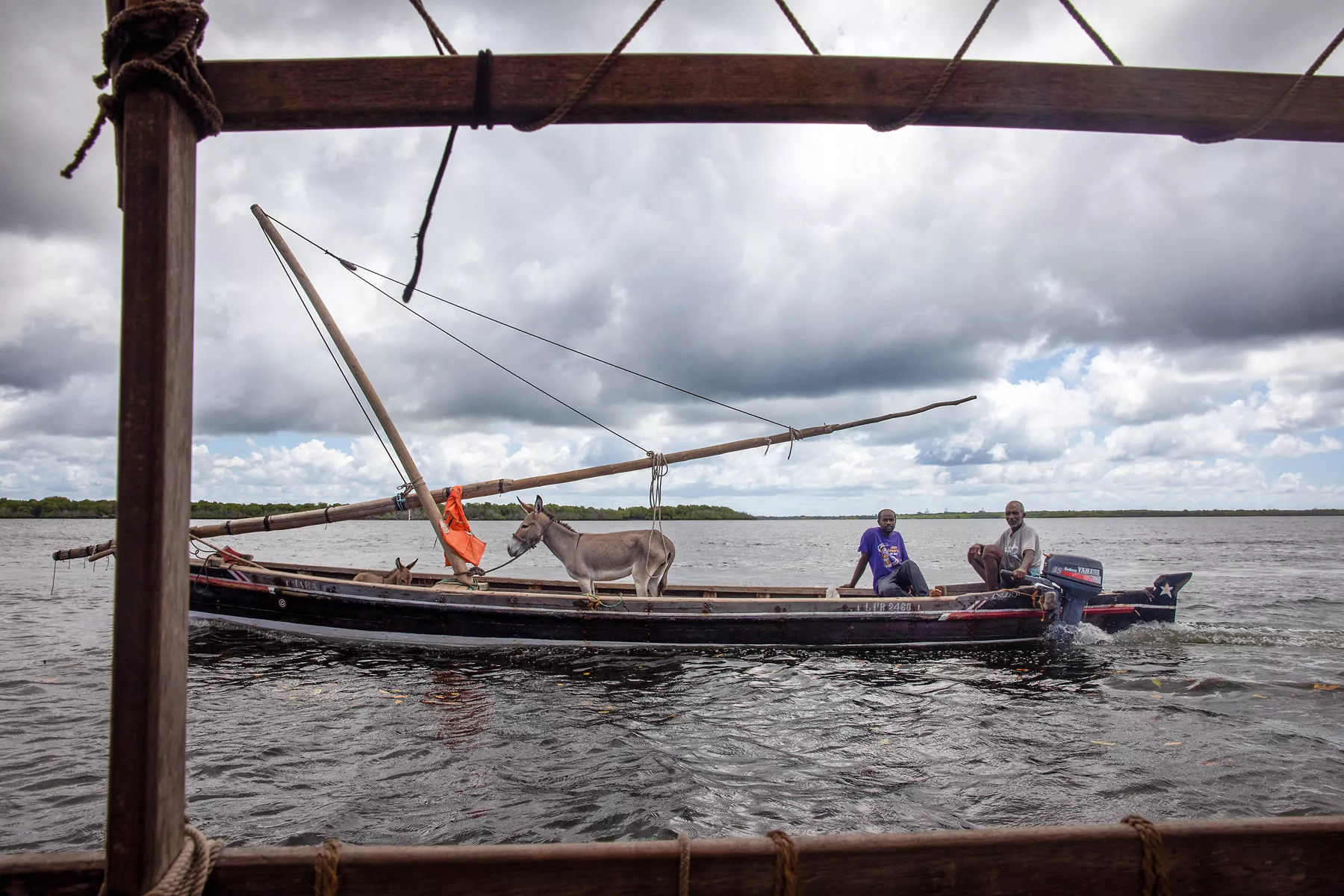
A donkey hitches a ride in Lamu Channel.
Different Boats for a Different World
The boats being built on Lamu today are not the ones that built the island’s reputation. The jahazis—deep hulled, oceangoing, built for heavy loads across open water—are gone from the yards. What remains, and in some ways thrives, is smaller: coastal craft for fishing, transport, tourism and racing.
Among them are boats like the Amina, what builders call the Mozambique style: an elegant double-ender, wider in beam and shallower in draft than older designs, better suited to the calm waters of the Lamu Channel. It is built for stability and comfort. Its customers are guesthouse owners, tourism operators, captains running sunset cruises for visitors, like me, who want to feel, for an hour, that they are inside something very old.
Brothers Idris Ali Ahmed, 33, and Ahmed Ali Ahmed, 49, continue to build boats on Lamu, carrying on what they call “their legacy.” “This is what we inherited from our father,” says Idris. They are a few weeks from completing Eco, a wooden Mozambique-style dhow commissioned for sunset cruises. For the entire time I’m on Lamu, I watch as they chisel, sand and hammer on the hull of the new vessel. It’s just before the rainy season, and it’s incredibly hot. Sweat mixes with sawdust in equal measure.
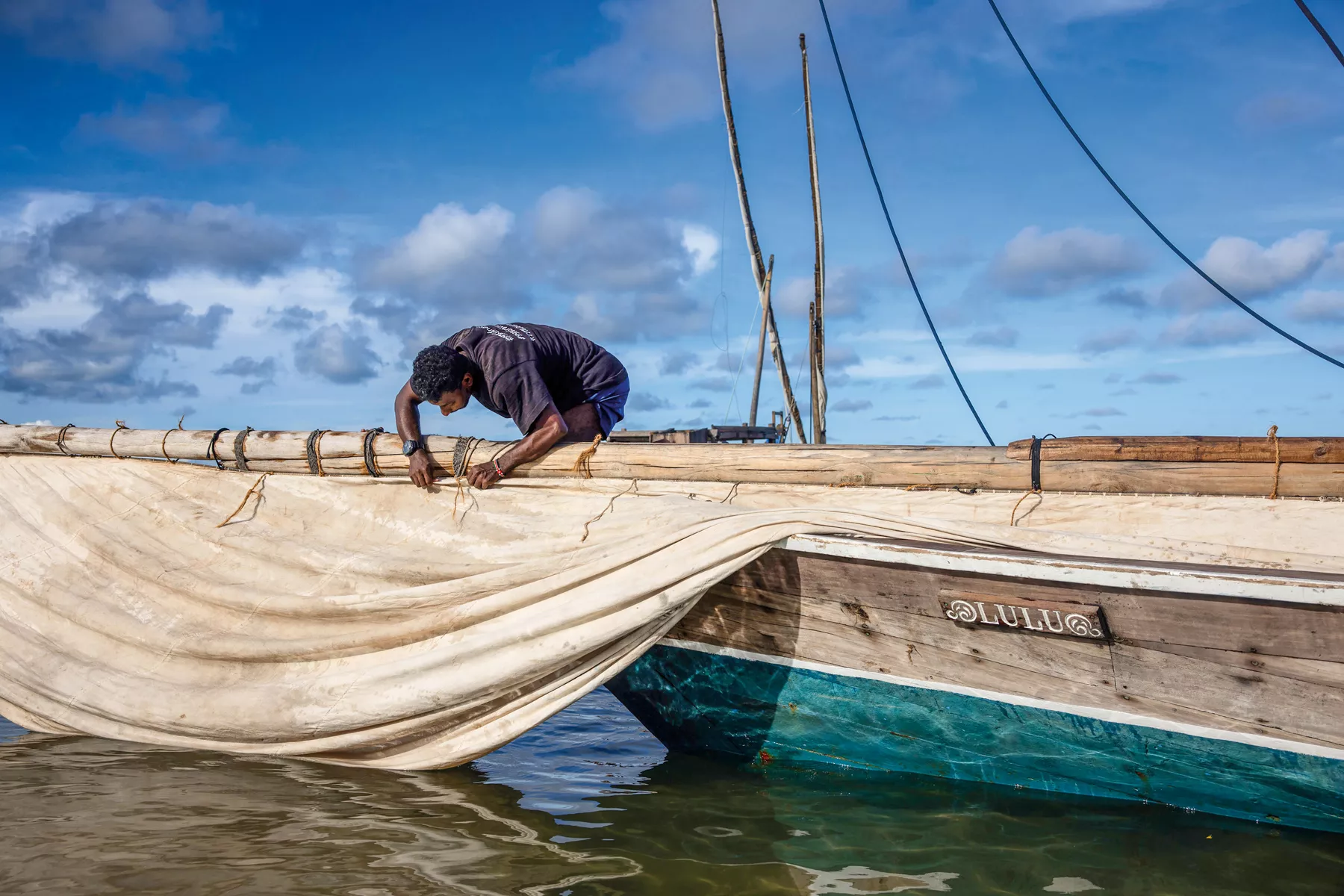
A crew member prepares a dhow for racing. The competitive events are held on New Year’s Day, Eid, Easter and during the annual Lamu Cultural Festival in late November.
This kind of adaptation is not new. Both Agius and Sheriff note that the dhow was never a fixed form but a working vessel that shifted among cargo, pearl diving, warfare and trade as demand required in a monsoon economy, the term for a system in which a region’s livelihood depends on seasonal rainfall and wind. Today that demand is tourism and, increasingly, racing.
Each year, when the trade winds that once powered the monsoon economy fill sails again, the waters off Lamu host a series of dhow races. The races are timed to the wind at its strongest, when the channel shifts from calm to volatile in minutes. The water darkens and chops under sudden gusts, frothing white near the mangroves—a far cry from the flat turquoise of tourist brochures.
On New Year’s Day, Eid, Easter and during the annual Lamu Cultural Festival in late November, up to 15 racing dhows compete on courses marked by buoys, their crews balancing on cantilevered beams, adjusting sail and weight with practiced precision. And it’s not just in Lamu. Agius notes that similar racing cultures are growing in Bahrain, Qatar and the Red Sea.
The races are not staged for tourists, although they come to watch. They are fiercely competitive community events, with prize money and local prestige at stake. They also require boats—new ones built for speed—drawing younger sailors and builders into the tradition.
The winds that once carried cargo now power something else. The monsoon hasn’t disappeared. It has found new work to do.
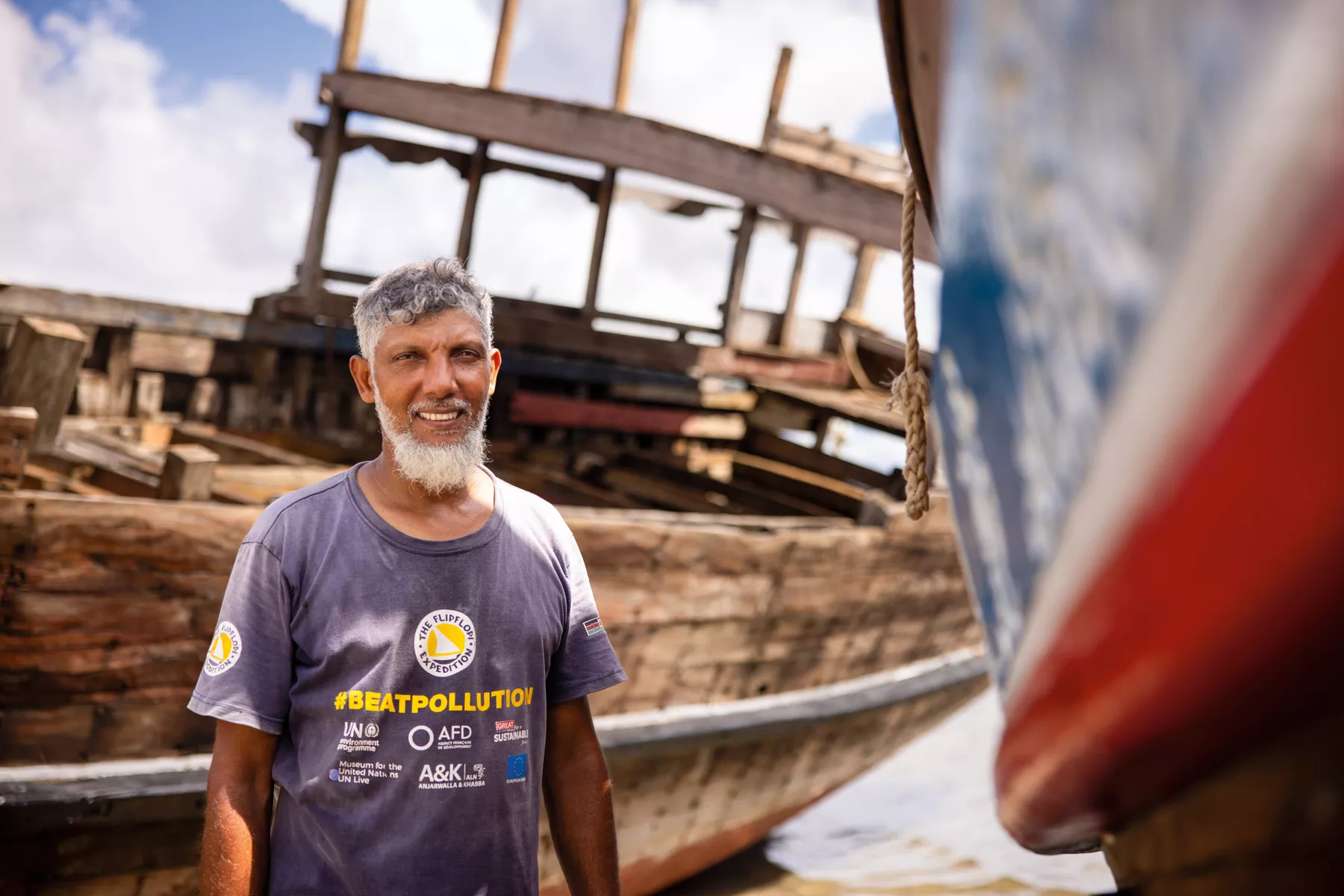
Ali Skanda, master boatbuilder and cultural figurehead of Lamu’s dhow-building tradition, learned the trade in his father’s workshop.
“This is what we inherited from our father.”
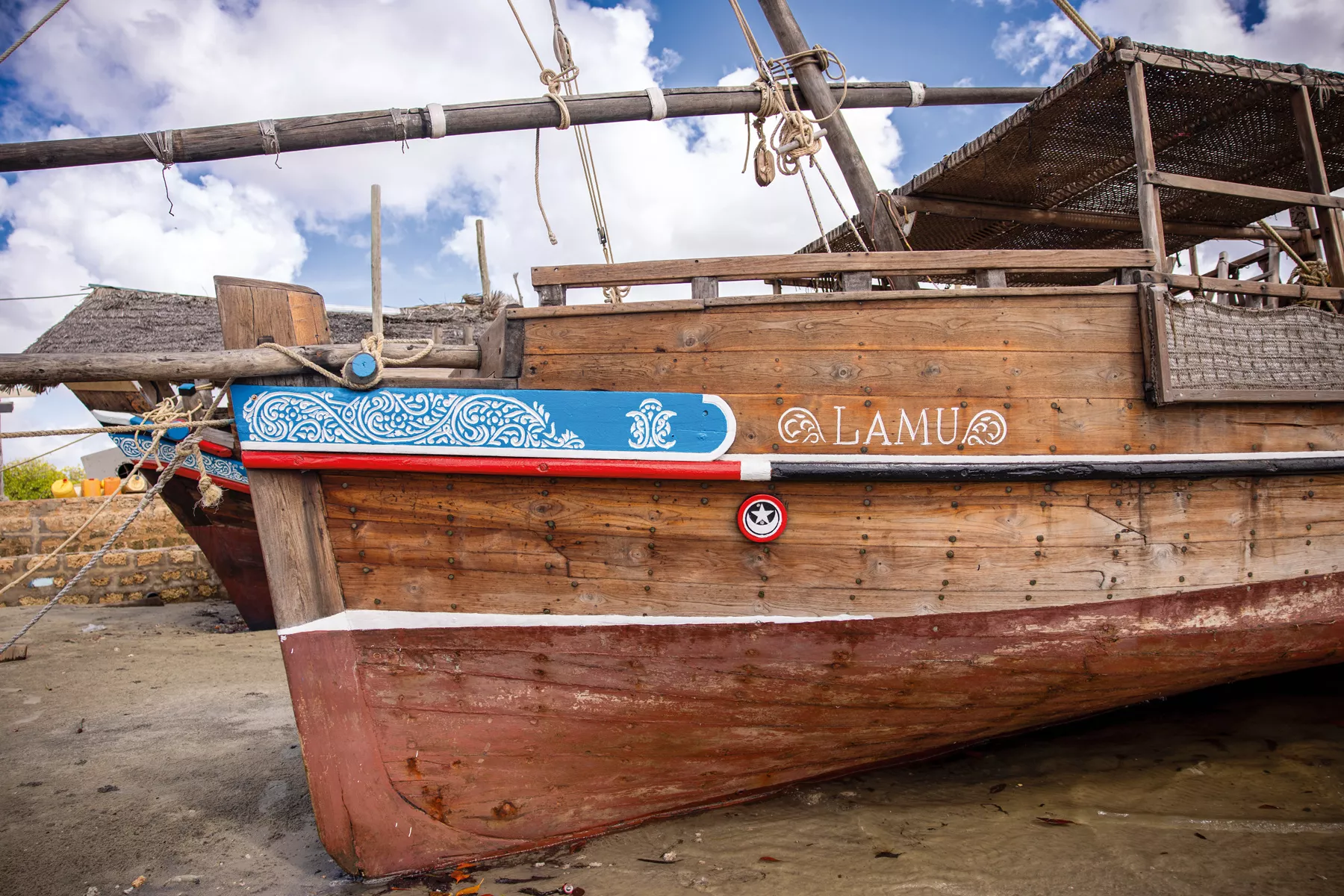
Details reflect the heritage and artistry behind a dhow belonging to Skanda.
Into the Evening
By the time the Amina brings me back to the Lamu waterfront, the last light has gone. The sail comes down with practiced ease, folded with the efficiency that comes from repetition.
The tradition that once carried ivory and mangrove timber across the Indian Ocean now carries visitors across a sheltered channel. The winds that drove the monsoon trade now decide the outcome of a race. The master builder who once supplied cargo fleets now takes commissions from guesthouse owners.
None of this is what it was. But then, it never quite was. The dhow has always been a vessel in motion—not just across water but across time, absorbing what each era required of it and carrying forward what it could. In Lamu, at least, it is still moving.

You may also be interested in...
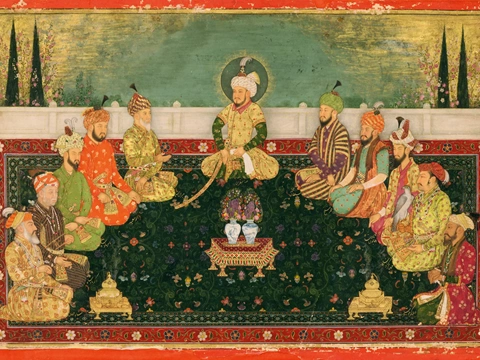
When India Sailed to Makkah: A 350-Year-Old Hajj Chronicle
The 17th-century Anīs al-Ḥujjāj, a Hajj travelogue newly translated into English, shows the forgotten maritime world that bound Mughal India to Islam's holiest city.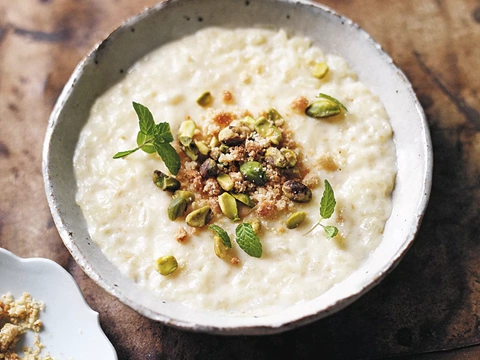
Chef Shane Delia’s Rosewater Sutlaç With Pistachio Crumble
Food
Chef and restaurateur Shane Delia re-creates a rice-and-milk pudding he discovered along Türkiye’s Black Sea coast, one of many sutlaç found on menus in the region; this recipe gets additional texture from a pistachio crumble.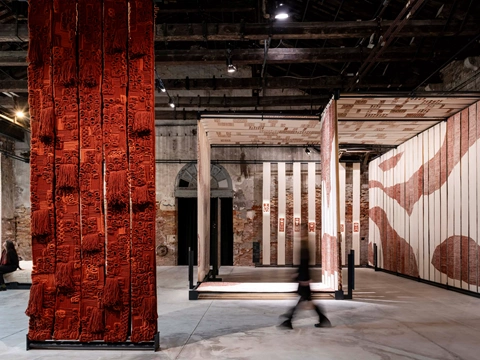
Threads of Memory at the Venice Biennale
Arts
History
Culture
At the Venice Biennale, which runs through November 22, 2026, the Moroccan, French and Saudi national pavilions show how craft and shared memory can resist cultural erasure.