AramcoWorld: 75 Years of Cultural Connections
Since its origins in 1949 as a company newsletter for Aramco, AramcoWorld has evolved to focus on global cultural bridge-building across the Arab and Muslim world and beyond.
A note of thanks
Seventy-five years. More than 500 covers. As we were putting together this special issue to mark the incredible milestone of AramcoWorld's 75th anniversary, we paused to acknowledge all those who helped it come to fruition. Our heartfelt gratitude goes to the many longtime contributors whose creativity and talents have connected with readers. Likewise to supporters at our home office in Dhahran, Saudi Arabia, and around the globe whose insights consistently improve the product. Special thanks also to Richard Doughty, Art Clark, Rob Arndt and Greg Noakes for their expertise in informing the direction of this edition. And finally, to you, our readers: We appreciate your trust in us throughout our journey. For your loyalty and your time, we thank you.
—AramcoWorld editorial team
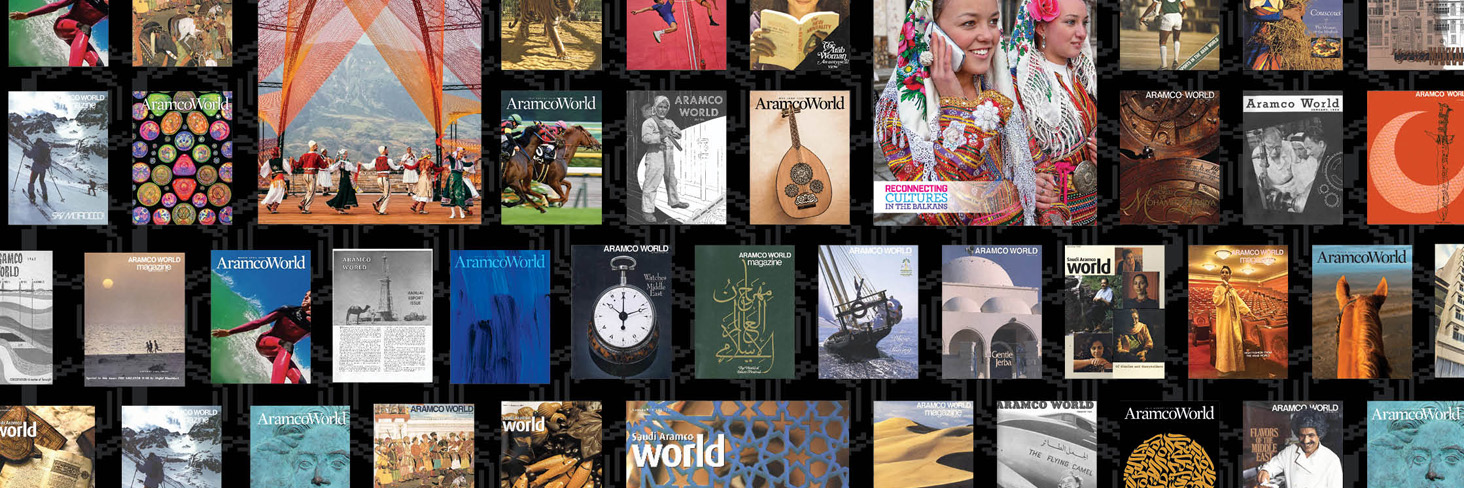
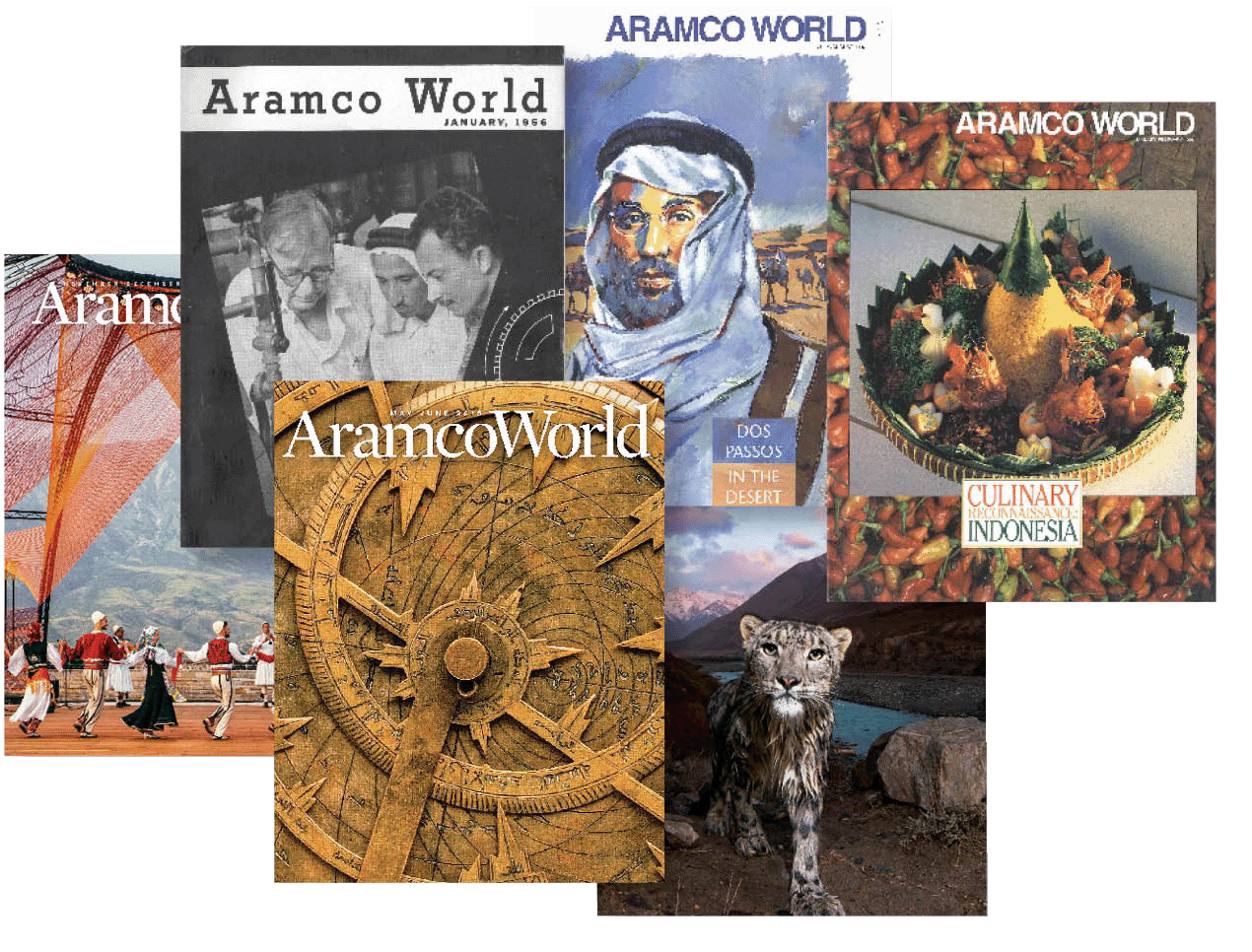
AramcoWorld debunks the maxim, “Don’t judge a book by its cover.”
Indeed, the magazine’s eye-catching covers have long defined its mission to serve as a window for the impactful stories found on its pages. The covers have offered a window into AramcoWorld’s wide range of storytelling across the globe. They reflect its evolution over 75 years from a publication by and for employees of Aramco to one that shares the wonders of the Arab and Muslim worlds with a global audience and emphasizes cross-cultural connections.
The first titled issue of Aramco World (then two words) appeared in January 1950 as a four-page newsletter. It was issue No. 3 of an initially unnamed publication launched the previous November that aimed to put employees of Aramco in the United States in touch with their counterparts in Saudi Arabia and around the world. That connection grew increasingly important in the years after commercial quantities of oil were discovered in Saudi Arabia in the late 1930s. As Aramco expanded, the company moved its headquarters from San Francisco to New York in 1949.
“We wish to break down the walls of isolation so that our people here in America will be helped to see beyond their immediate surroundings…,” W. F. Moore, president of Aramco at the time, said at the top of the initial issue.
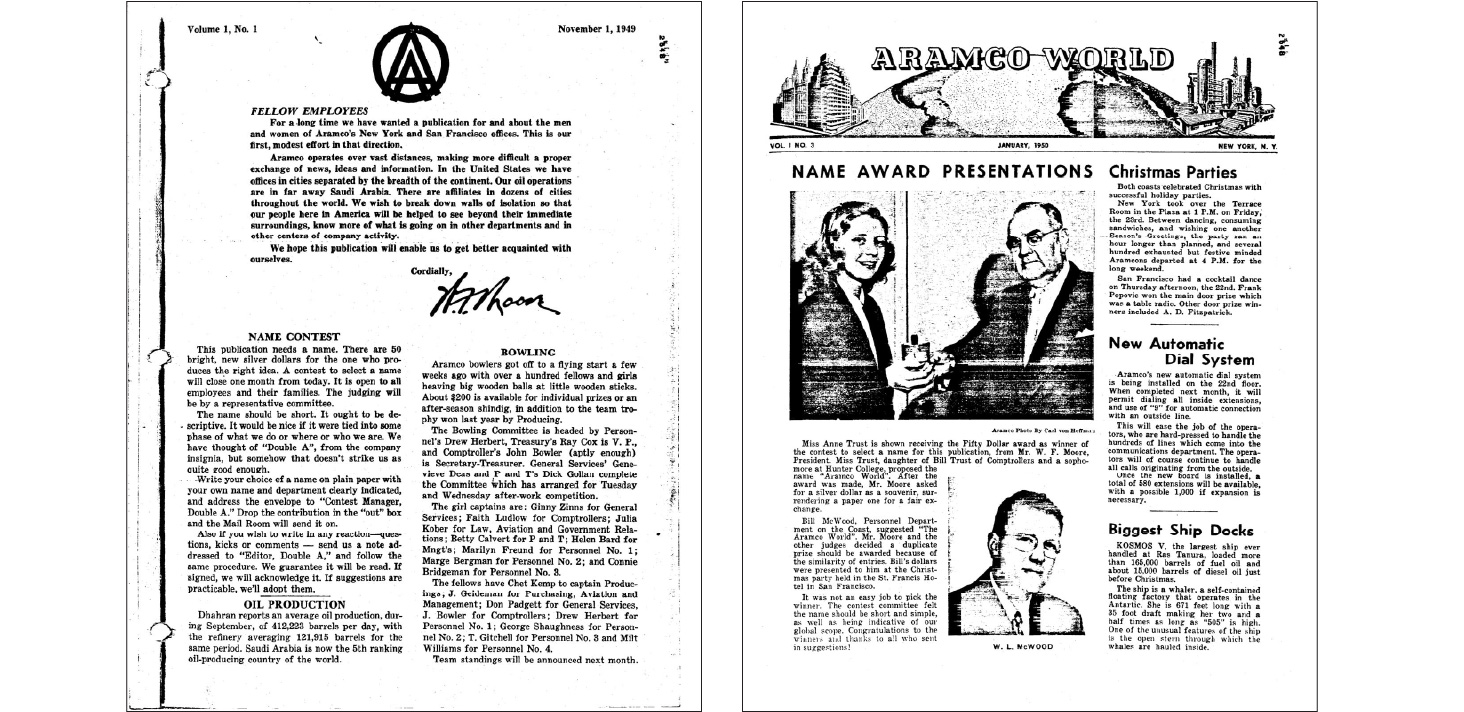
Left: In 1949 Aramco created a company newsletter with the hope to, in the words of then President W. F. Moore,“ get better acquainted with ourselves.” Right: Vol. 1 No. 3 revealed the name of the publication and logo highlighting the connection from New York, US to Dhahran, Saudi Arabia.
“We wish to break down the walls of isolation so that our people here in America will be helped to see beyond their immediate surroundings…,” W. F. Moore, president of Aramco at the time, said at the top of the initial issue.
A front-page story announced a “Name Contest” for the publication. “The name should be short. It ought to be descriptive. It would be nice if it were tied into some phase of what we do or where and who we are,” it read.
Anne Trust, a college sophomore and the daughter of employee Bill Trust, won the contest with her entry of “Aramco World.” She is pictured on Page 1 of the January issue receiving a prize of 50 silver dollars from Moore.
Its nameplate showed Aramco World over a crescent slice of the globe, with the company’s new skyscraper headquarters at 505 Park Avenue in New York on the left and an oil installation in Saudi Arabia on the right.
Stories in that issue focused mainly on company activities in New York. A short article on Page 1 reported that Aramco’s oil port at Ras Tanura, Saudi Arabia, had loaded “the largest ship ever handled there”—a tiny (compared with modern supertankers) whaler that took on 180,000 barrels of fuel oil and diesel oil.
In the late 1940s Aramco grew into one of the world’s top oil-producing companies, and it needed employees. Aramco World highlighted some enticing insights into living and working in Saudi Arabia.
The October 1952 cover showed Saudi employee Rashid ibn Jabir working at a gas-oil separator plant near Abqaiq, southwest of Dhahran. Along with the cover story about Aramco’s training program for Saudi employees, an article described what four women from the New York office discovered about the ancient Middle East on a visit to the Metropolitan Museum of Art. “Being members of an oil company that operates in Saudi Arabia, the foursome wanted to see for themselves the vestiges of the rich cultural heritage that belongs to the people who today are part of the Moslem [Muslim] World,” the story said.
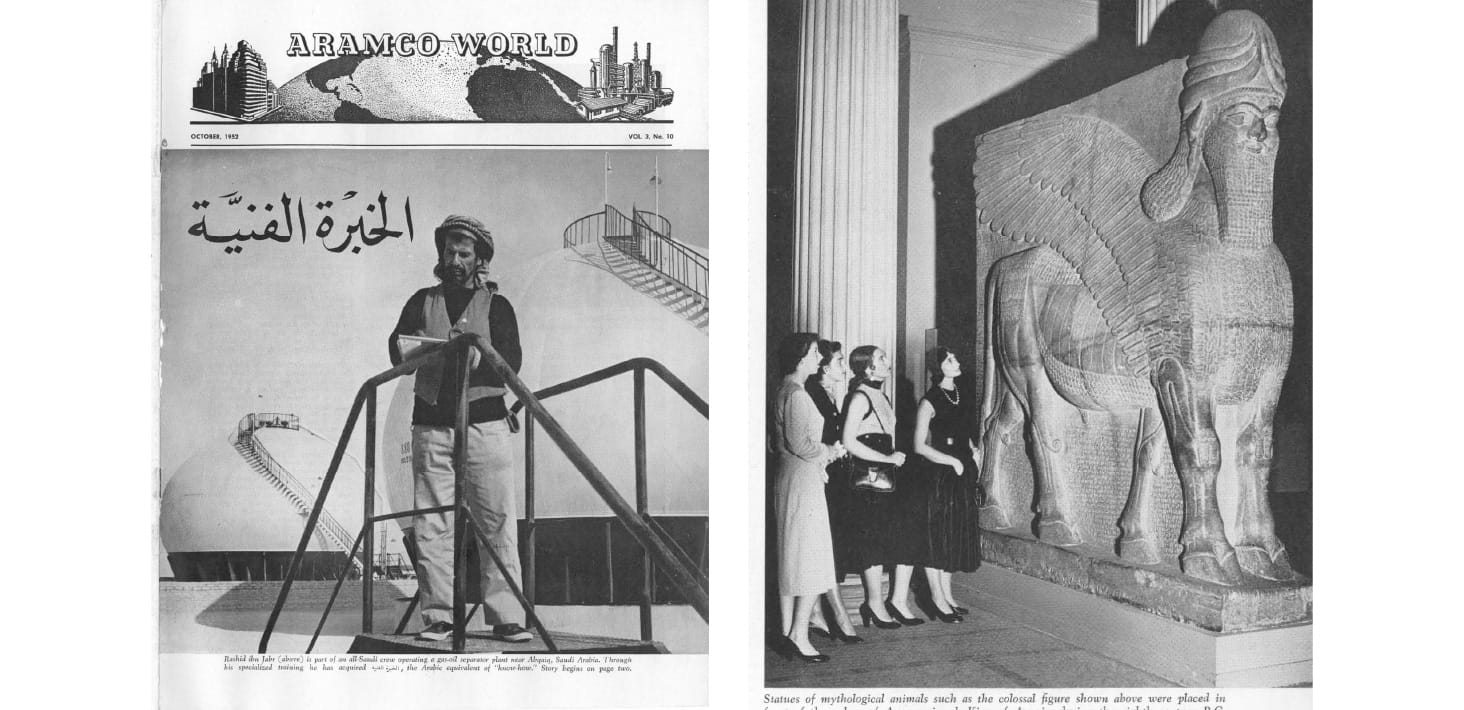
Left: The October 1952 cover “Know How” shows Rashid ibn Jabr taking notes as he managed a gas-oil separator, a trade he learned through an Aramco work training program. Right: From the same October 1952 issue, women from the New York Aramco office learn about the ancient Middle East on a visit to the Metropolitan Museum of Art. (Photo by Carl von Hoffman)
The first magazine with a cover resembling today’s publication—in January 1953—showed a Translation Department employee in Dhahran holding an Arabic-language newspaper. “To watch Maegie Scott reading an Arabic newspaper, her eyes gliding across the page from right to left, you’d never believe that two years ago she didn’t know a single word of this difficult language,” said the accompanying story.
“From the Field,” a column about work at Aramco by Joe Alex Morris Jr., began in the early ’50s. His boss, Thomas Gartland, was the first named editor of Aramco World. Morris appeared on the cover of the May/June 1968 issue, as Middle East Bureau chief of the Los Angeles Times, in a story about the reporters in the region.
The bulk of the covers in the 1950s and ’60s focused on the company. Single-subject issues such as “Tankers: A Special Issue” in 1966 became standard fare.
Up to the fall of 1963, Aramco World was a monthly publication; it went bimonthly partway through the year. Five of the nine issues published that year pictured company subjects on the cover. Over the decade, 28 covers focused on Aramco.
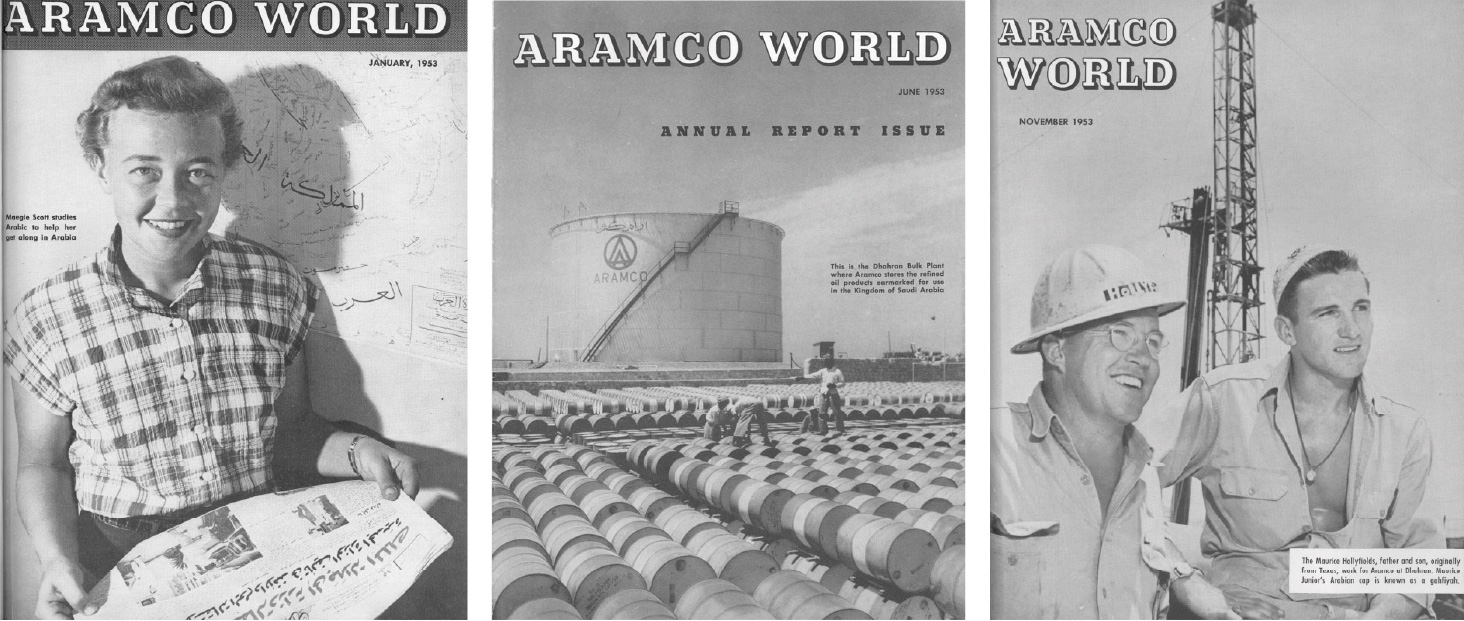
Left to right: January 1953, “Girl of the Desert” Maegie Scott of Santa Monica, California, learns Arabic to better communicate with her co-workers. (Photo by T. F. Walters) June 1953, “The 1952 Annual Report Issue” November 1953, “A Family Affair in Saudi Arabia” Father-and-son team Maurice and Maurice Jr. Hollyfield from Texas in a story about families on Aramco camp. (Photo by T. F. Walters)
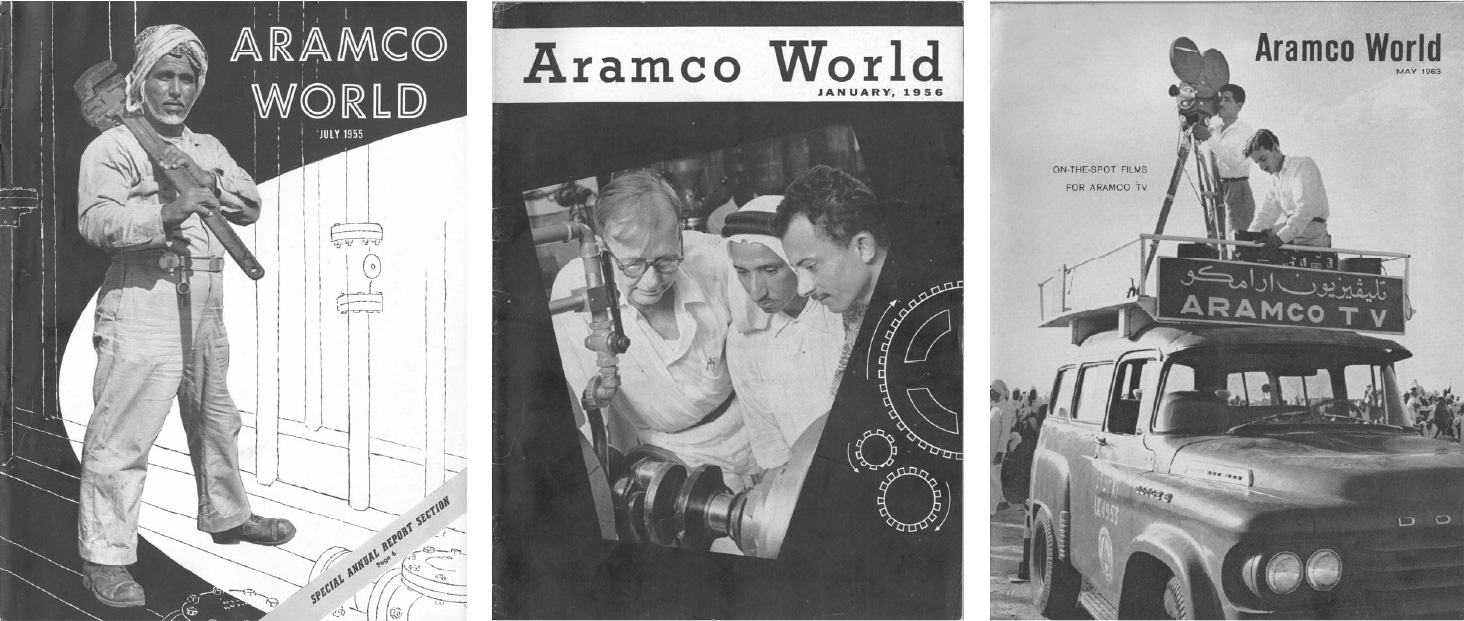
Left to right: July 1955, “People of Aramco” Standing proud on the cover is newly promoted gas-oil separator head supervisor Saad bin Agil in a story about Aramco employees. (Photo by T. F. Walters) January 1956, “A.I.D.D.” The collaborative cover highlighted the Arab Industrial Development Division training department. (Photo by E. E. Seal) May 1963, “Aramco TV On The Air” Shows the work of the on-location broadcast team with a mission to train the next generation of broadcasters.
The “How They Find the Oil” cover in the January/February 1966 issue was typical, showing a drilling rig against a stark, sepia-colored desert background. But the issue covered cultural topics too, with stories like “Music in the Middle East,” “City of the Palms,” about the caravan metropolis of Palmyra in Iraq, and “Ski Lebanon.”
This shift in reportorial focus reflected a new corporate outlook for the magazine and the imagination of its new editor, Paul Hoye, a Rhode Island newspaperman who came aboard in 1964 after studying Middle East affairs at Columbia University. It also highlighted the influence of the magazine’s new home in the cosmopolitan Arab capital of Beirut, where it relocated that year.
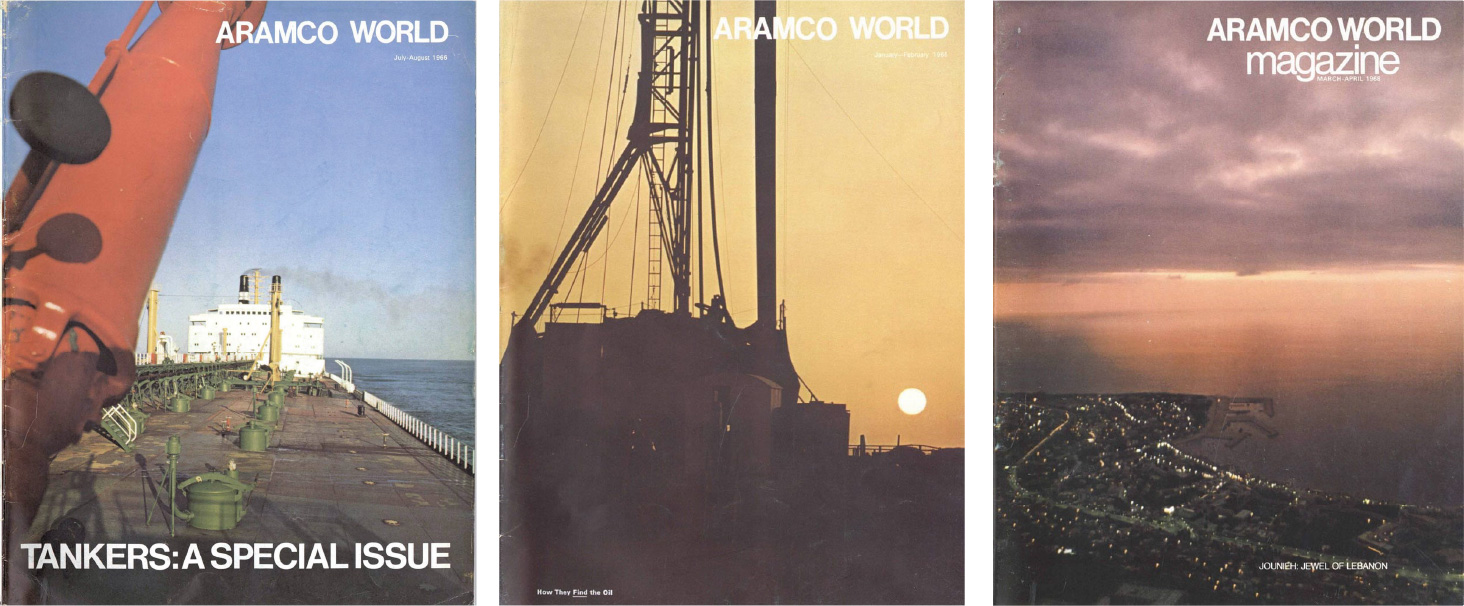
Left to right: July/August 1966, “Tankers: A Special Issue” (Photo by B. H. Moody) January/February 1966, “How They Find Oil” March/April 1968, “Jounieh: Jewel of Lebanon” (Photo by Tor Eigeland)
Aramco World was looking at the Arab world as a place where history and modernity mixed at every turn. [The Beirut headquarters] was much closer to Dhahran, where the magazine had moved in 1952.
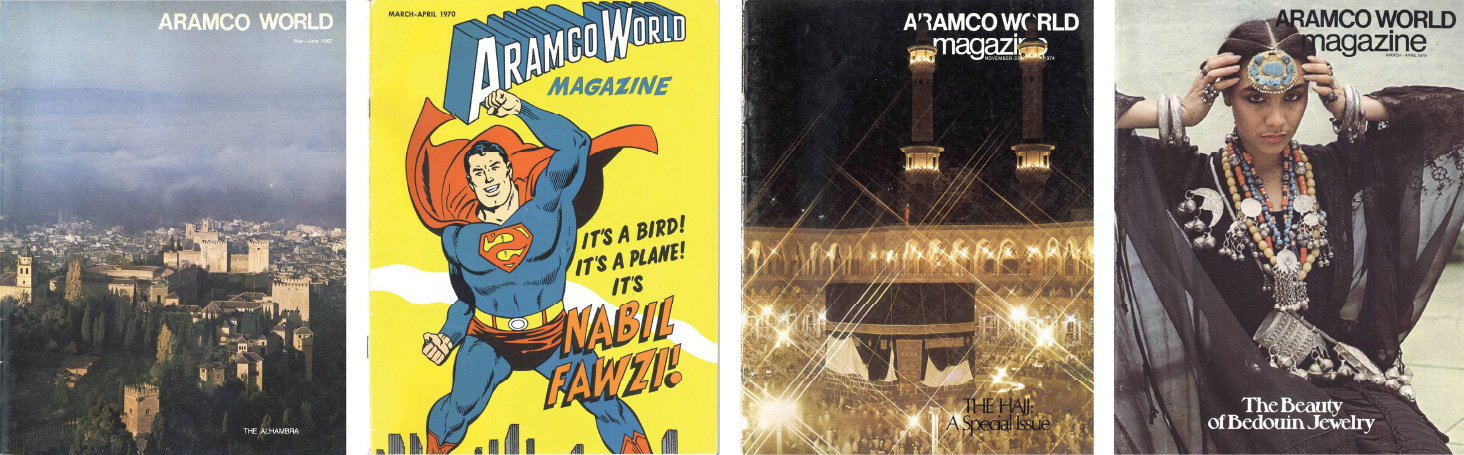
Left to right: May/June 1967, “The Alhambra” highlights the history and architecture of one of the most magnificent buildings in the whole world. (Photo by Tor Eigeland) March/April 1970, “It’s a Bird! It’s a Plane! It’s NABIL FAWZI!” tells of an editor’s quest to promote reading with Arabic translated comic books. November/December 1974, “The Hajj: A Special Issue,” an educational and historical look into the Muslim pilgrimage to Makkah. (Photo by S. M. Amin) March/April 1979, “The Beauty of Bedouin Jewelry” makes the cultural connection between Bedouins and Native Americans in the US and Mexico. (Photo by Ian Yeomans)
There, Aramco World was looking at the Arab world as a place where history and modernity mixed at every turn. It was also much closer to Dhahran, where the company had moved its headquarters in 1952.
The new environment for Aramco World fit well with a new company view on its role.
Tom Barger, a geologist who’d gone to Saudi Arabia in the 1930s, taught himself Arabic and became Aramco’s president in 1959 and CEO in 1961, and T. D. Durrance, vice president of Public Affairs, decided “that the magazine should be focused almost exclusively on the culture and history and customs of the Arab and Muslim world,” Hoye said in an interview published in Aramco’s weekly newspaper in Dhahran in August 1986, shortly before his death. “They wanted Aramco World to tell that story to the US—to the teachers, reporters, scholars, editors and others who helped shape US perceptions of the Middle East.”
Hoye’s take on that directive stood out on the cover of the March/April 1970 issue. It featured a Superman-like character behind the headline blast, “It’s a Bird, It’s a Plane, It’s NABIL FAWZI!” He “has had to learn Arabic because, we’re told, the 270,000 or so Arab boys and girls who so eagerly await his exploits each week refused to learn Kryptonese,” joked the cover caption.
A single-subject issue, “The Hajj,” appeared in 1974, a year before Aramco World relocated to The Hague in the Netherlands, headquarters of Aramco Overseas Company, in the wake of the civil war in Lebanon. Two stories in that issue came from Ismail Nawwab, a Makkah-born Islamic scholar who joined Aramco in 1970 and later played an important role in Aramco World’s development as manager of Public Relations and general manager of Public Affairs.
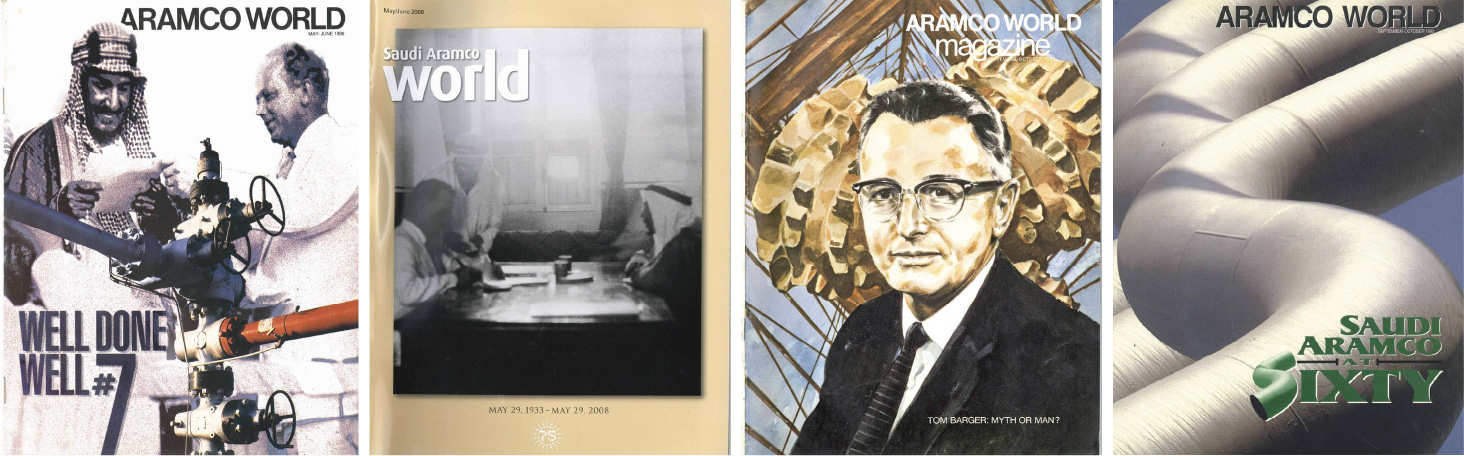
Left to right: May/June 1988, “Well Done Well #7” shares the story about the Prosperity Well and the discovery that changed a nation. May/June 2008, “75: May 29, 1933–May 29, 2008” celebrating the 75th anniversary of Aramco (Photo courtesy of Karl S. Twitchell/Aramco Archives) September/October 1969, “Tom Barger: Myth or Man?” (Illustration by Don Thompson) September/October 1993, “Saudi Aramco At 60” (Photo by S. M. Amin)
Hoye devoted the March/April 1975 issue to “Arabs in America.” Dr. Michael DeBakey, a Houston, Texas-based heart surgeon whose parents had emigrated from Lebanon, appeared at work on the cover.
Other cover stories in the ’70s, ’80s and early ’90s featured subjects such as “Muslims in the USSR,” reflecting the era of glasnost in the Soviet Union. That’s when reforms initiated by leader Mikhail Gorbachev in the mid-1980s allowed diverse communities to make themselves heard, en route to achieving independence, some seven decades after being swept into the country.
Aramco World did not quit writing about Aramco, but company stories took on an educational or commemorative nature.
“Aramco: A Celebration” in 1984 marked the 50th anniversary of the search for oil in the Kingdom by SOCAL; in 1988 the “Well Done, Well Seven” cover celebrated the anniversary of the Kingdom’s first commercial oil strike. That well, next door to Dhahran, is now known as the “Prosperity Well.” It was the seventh of a series drilled into a rock formation known as the Dammam Dome. Geologists had been exploring the region since the signing of the oil Concession Agreement with Saudi Arabia in 1933, but the search didn’t pay off until 1938, after nearly three long years of drilling.
From its earliest years, AramcoWorld has showcased the work of imaginative and talented illustrators.
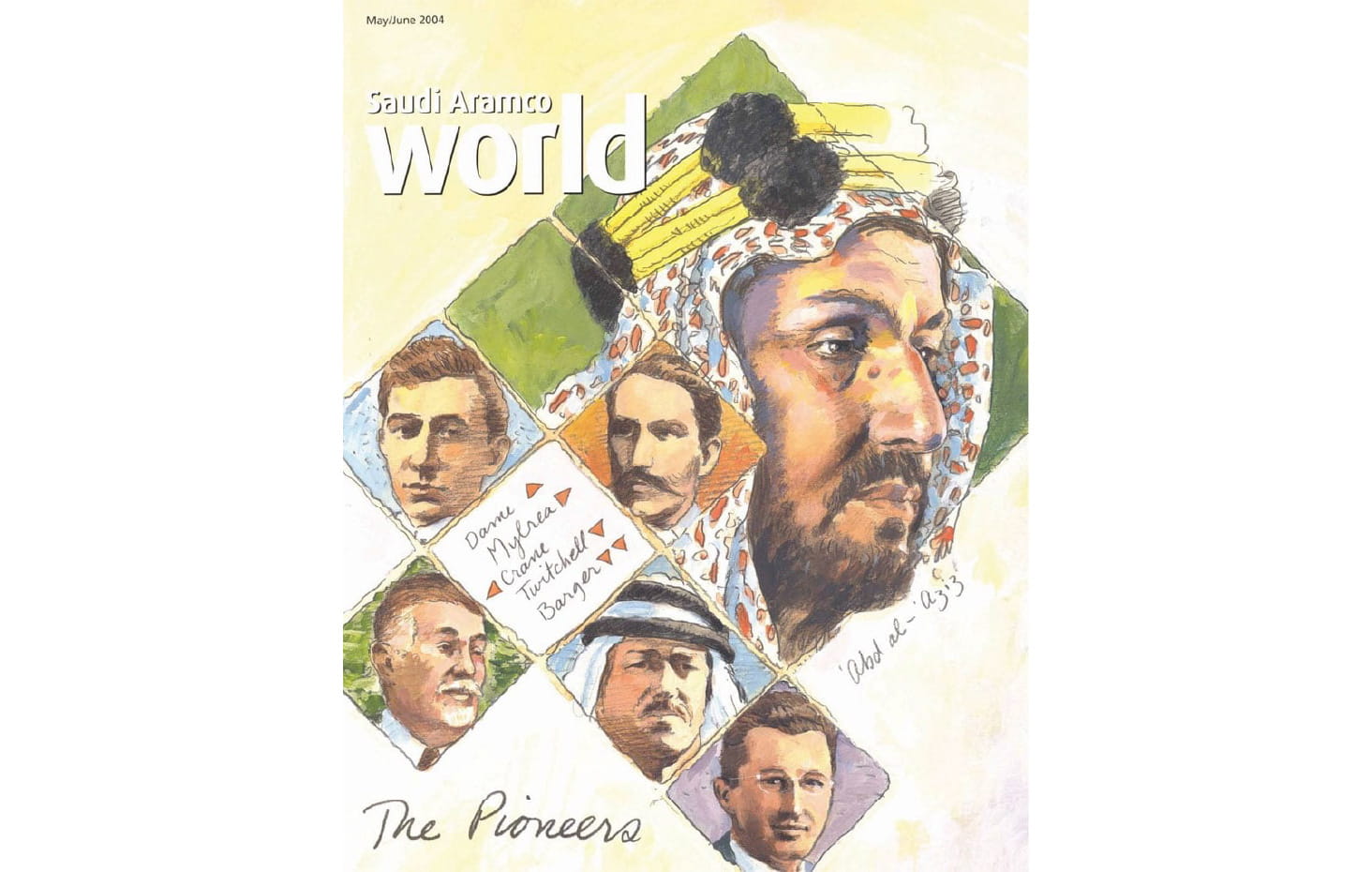
May/June 2004, “The Pioneers” recognizes the development of a company and a country and the pioneers who made it happen. (Illustration by Norman MacDonald)
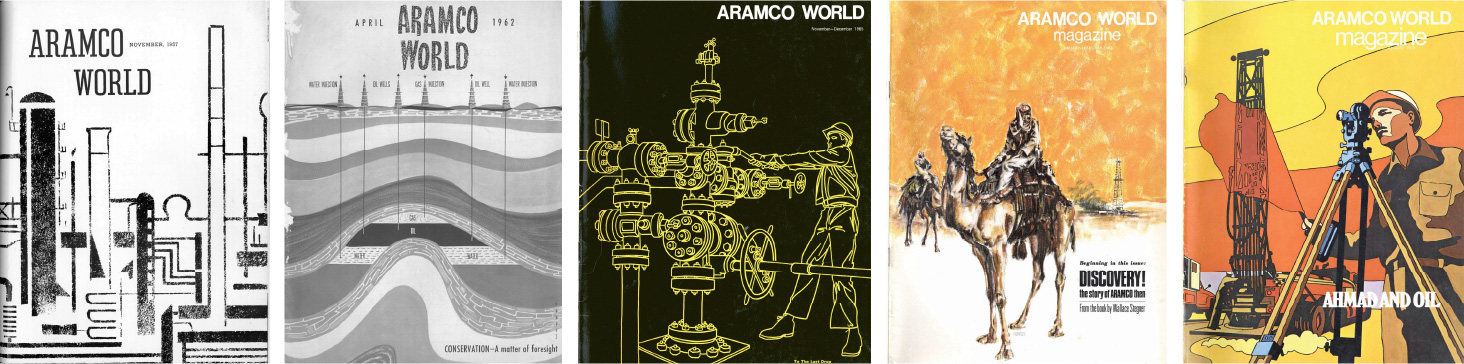
Left to right: November 1957, “Petroleum Magic,” an illustration of the Ras Tanura refinery in Saudi Arabia (Illustration by Walter Ferro) April 1962, “Conservation—A matter of Foresight” (Illustration by Harold D. Hoopes) November/December 1965, “To The Last Drop” (Illustration by B. H. Moody) January/February 1968, “Discovery! The Story of The Aramco Then” (Illustration by Don Thompson) July/August 1973, “Amad and Oil” (Illustration by Don Thompson)
Also in 1988, Saudi Arabia chartered the Saudi Arabian Oil Company (known as Saudi Aramco) to take over for Aramco. Earlier, in 1980, the Kingdom had completed the buyout of the company from its four American owners—including Chevron (formerly SOCAL). The magazine changed its title to Saudi Aramco World in 2000; in 2015, it reverted to a version of its original brand, as AramcoWorld.
From Dhahran, Nawwab supported Hoye and Rob Arndt, who succeeded Hoye as editor, in making the magazine a tool for educators. Hoye’s final magazine, in September/October 1986, was a US-based issue titled “The Arab Immigrants.” Arndt moved the magazine to Houston, headquarters of Aramco Services Company, or ASC (today’s Aramco Americas) in 1987.
There the magazine flourished with the backing of Shafiq Kombargi, head of ASC’s Public Affairs department. Kombargi had known the publication ever since he began working for Aramco in Beirut as a recruiter in 1949.
To enable the magazine to devote its resources to covering culture, particularly to further education, Nawwab engineered in the mid-1980s the creation in Dhahran of a magazine called Dimensions, later Dimensions International, to report on Aramco’s business activities—a role now played by a number of company news outlets and communications platforms.
Then, as today, the magazine’s message was that people are not all the same, but that their differences are of mutual interest; their societies and cultures are often historically interdependent in surprising ways.
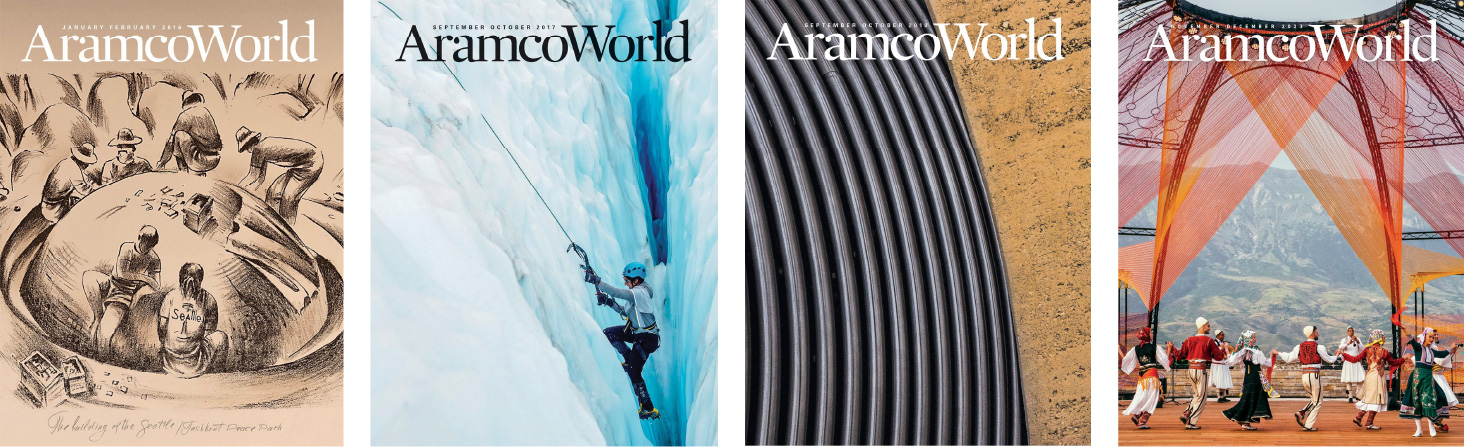
Left to right: January/February 2016, “The Unlikely Sisterhood of Seattle and Tashkent” (Lithograph by Marat Sadykov, courtesy of STSCA) September/October 2017, “The Seventh Summit” (Photo courtesy of Raha Moharrak) September/October 2019, “A House for the World” (Photo by Abdullah A. Alshammary) January/February 2024, “Meet Me at the Mudhif” (Photo by Nick de la Torre)
The company’s continued investment in Aramco World was consistent with the reason behind the publication’s establishment: bridging peoples, showing shared values to benefit both social intercourse and the economy at large.
“The Middle East and the Age of Discovery,” a single-subject issue in 1992 pegged to the quincentennial of Columbus’s voyages, was just one example of the magazine’s “teachable” bent.
Arndt “was very focused on education, and the magazine started to get used more and more in teacher-education workshops because US classes began adding courses and units in Middle East history—and that drove interest in AramcoWorld,” said Richard Doughty, who became assistant editor in 1994 and succeeded Arndt as editor in 2014 when he retired.
Company covers became rare, in favor of cultural topics, in the ’90s and into the new millennium. “A House for the World,” published in 2019, covered both sides of the coin: It portrayed the King Abdulaziz Center for World Culture—Aramco’s leading cultural and creative institution housed in a spectacularly modern building in Dhahran.
Over the years the magazine has expanded its offerings. It added cultural events listings in the 1990s and book reviews in 2000. It established its online presence in 2003 and the following year initiated a precursor to Classroom Guide, later renamed Learning Center, a resource geared toward educators and students. AramcoWorld added a video channel and activated its Instagram channel in 2015. For readers with a gustatory sense of adventure, the Flavors section came in 2018.
The new editorial team, under Johnny Hanson, that took over following Doughty’s retirement in 2023 continues to grow the magazine’s digital-first strategy. It is also expanding its online content and social-media presence, and amplifying its outreach to educators via digital-first stories—opening more windows into Arab and Muslim communities’ interconnectivity with the rest of the world.
Looking to the future, Hanson says, AramcoWorld “will remain global in its mission while focusing on our shared values, culture and history on multiple platforms.”
Today, even with the focus on digital growth, the first impression made by an AramcoWorld cover is paramount.
“Nothing complements our content better than the impact made by the cover of our magazine,” Hanson said. “It just invites you to pick it up and discover.”

You may also be interested in...
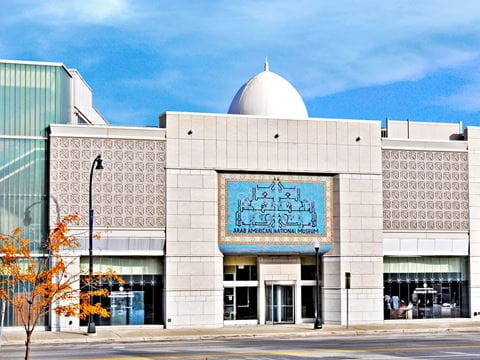
‘Home’: Arab American National Museum Celebrates 20th Anniversary
Arts
Arab American National Museum Director Diana Abouali says the facility—which is marking its 20th anniversary in 2025—in Dearborn, Michigan, has aimed to create a home for Arab Americans by preserving and presenting the history, culture and contributions of Arab immigrants as well as their native-born children and grandchildren.
Stratford to Jordan: Shakespeare’s Echoes of the Arab World
Arts
History
Shakespeare’s works are woven into the cultural fabric of the Arab world, but so, too, were his plays shaped in part by Islamic storytelling traditions and political realities of his day.
What It Takes to Feel Ramadan Again
Arts
Creative minds rebuild Ramadan traditions through deliberate acts of memory and care.