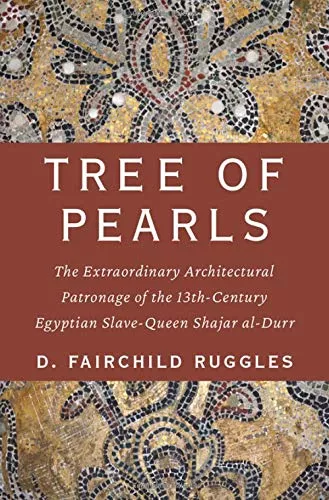
Tree of Pearls: The Extraordinary Architectural Patronage of the 13th Century Egyptian Slave-Queen Shajar al-Durr
Tom Verde
D. Fairchild Ruggles
2020, Oxford University Press, 978-0-19-087320-2, $35 hb.
The Islamic architectural practice of attaching a founder’s memorial to a madrasah (religious school) can be traced back to a single, exceptional woman. In 1250 CE Egypt’s Sultan Salih Najm al-Din Ayub passed away. His widow, Shajar al-Durr, took it upon herself not only to commission her late husband’s mausoleum, but also to assume the throne. As Egypt’s first (and last) queen since Cleopatra, Shajar al-Durr (whose name means “tree of pearls”) made history in many ways, not the least of which was to initiate what became, over centuries that followed, the transformation of Cairo’s skyline into a showplace of commemorative architecture. This art-historical biography balances Shajar al-Durr’s achievements as queen—stabilizing the government; fending off Crusaders; establishing the Mamluk dynasty, notably among them--with her determination to leave her mark on the capital city’s profile. Her husband’s tomb, as well as her own, with their domes “reaching toward the sky alongside mosque minarets” redefined Cairo’s urban space while changing “the course of architectural history in Egypt.”
You may also be interested in...
Architecture and Affect in the Middle Ages—Our Book Review
Author Paul Binski takes readers on a multisensory tour of medieval cathedrals across Europe.
Cookbook Food for Sharing by Ashia Ismail-Singer—Our Book Review
In her third cookbook, Food for Sharing, Ashia Ismail-Singer groups recipes by the social occasions they accompany—presenting food as a means of connecting with cultures around the table.