Nomadic Chieftain’s Biography Unveils Dynamics of Colonial Expansion
Reviewed by Aibarshyn Akhmetkali
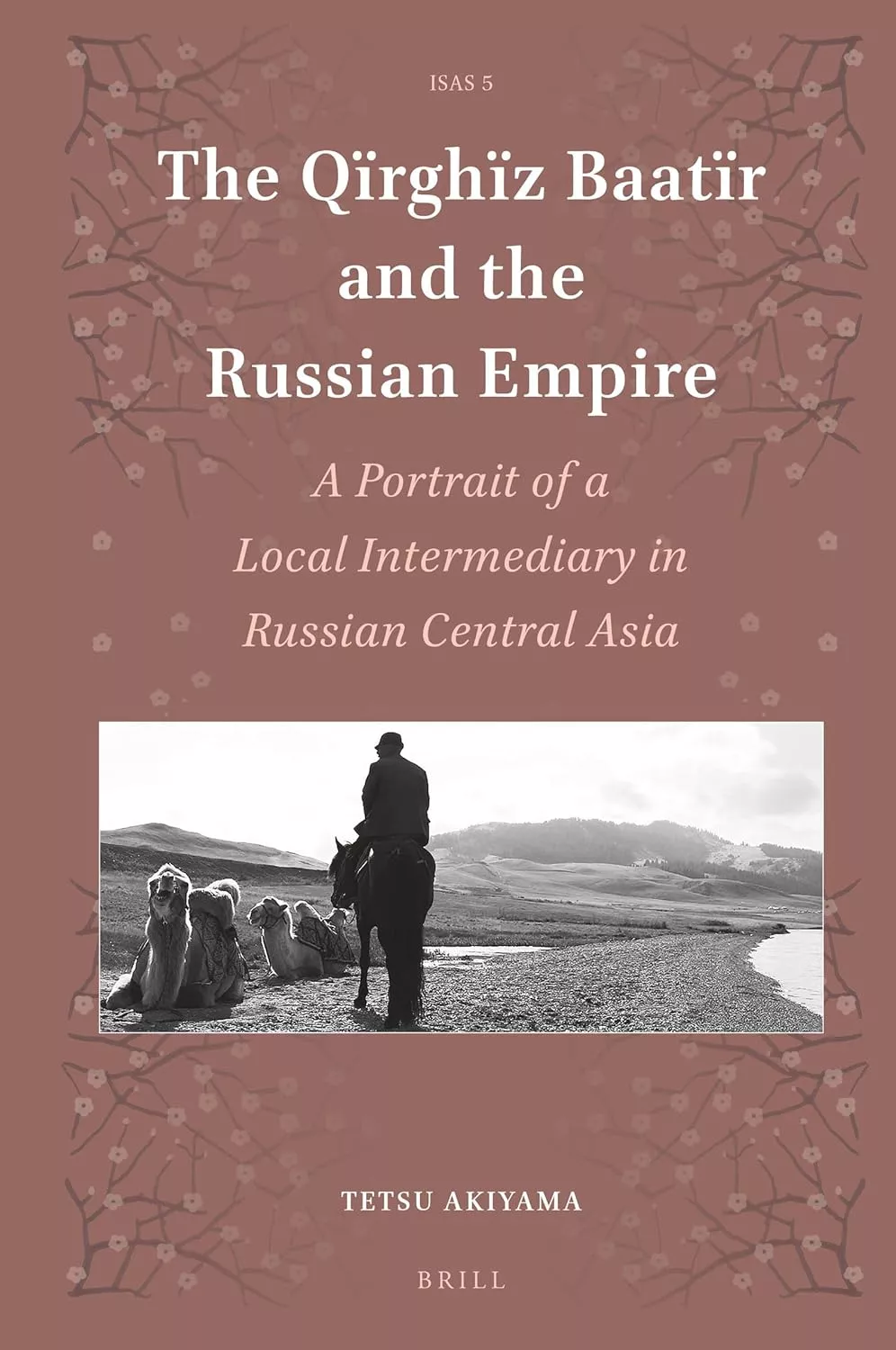
The Qїrghїz Baatïr and the Russian Empire: A Portrait of a Local Intermediary in Russian Central Asia
Tetsu Akiyama. Brill, 2021.
“In the imperial borderlands, at the interface of the Russian authorities and the indigenous society, there inevitably existed figures who played a mediatory role between them. Shabdan was certainly such an intermediary.
Historian Tetsu Akiyama’s book offers an in-depth study of Shabdan Jantay uulu, the pragmatic Kyrgyz chieftain who led his people during 19th-century Russian imperial expansion into Central Asia. Jantay uulu stands out for having balanced the interests of the colonizers and his own people amid shifting power dynamics in the region. Relying on primary native-language sources, the monograph enriches scholarship previously built off only colonial records. In the mid19th century, Central Asia constituted a vast territory occupied by related nomadic groups of Uzbeks, Kazakhs, Kyrgyz and Oirats (Kalmaks). Local elites, surrounded by the Kokand Khanate, the Russian Empire and the Qing Dynasty, consolidated authority through military prowess and by raiding neighboring tribes and clans. That’s when Jantay uulu’s military reputation earned him the honorific title of baatïr (hero/warrior). As Russian rule advanced deeper into Central Asia, his growing influence helped position him as an intermediary earning both the trust of local communities and the favor of Russian officials in their military quest against the Kokand Khanate. In showing Jantay uulu’s role as mediator, Akiyama challenges the narrative that the Kyrgyz were a “static and monotonous ‘traditional’ society’” destined to be subsumed by the Russian Empire. With its storytelling approach, the book will appeal to a wide readership looking to understand the dynamics shaping colonialism.
You may also be interested in...

A History of Mali’s National Drink Traces Green Tea—Book Review
By tracing ritual instead of commerce, anthropologist Ute Röschenthaler shows that the story of tea in West Africa involves multidirectional routes and local agency.
Cookbook Food for Sharing by Ashia Ismail-Singer—Our Book Review
In her third cookbook, Food for Sharing, Ashia Ismail-Singer groups recipes by the social occasions they accompany—presenting food as a means of connecting with cultures around the table.