Banjo on the Atlas: An Instrument’s Journey Across Continents
From its West African roots to its American reinvention, the banjo has traveled oceans and centuries to find its place in North African music.
On an outdoor stage at the Nuits D’Afrique music festival, the Montreal Chaâbi Orchestra took the stage in crisp white dress shirts and black trousers. Few members wore jackets, owing to the blazing heat. Still, an air of formality prevailed. The musicians cradled ouds, mondols, violins, a guitar and various Arabic percussion instruments—a tar and a darbouka. Then came the surprise: three banjos gleaming under the sun.
To the uninitiated, the banjo may seem like an odd presence among North Africa’s traditional instruments. Imagine a small guitarlike instrument, but in place of a wooden body sits an animal-skin-covered drumhead. The player plucks strings over that membrane to produce a bright, percussive sound that blends melody and rhythm.
“The banjo is basically a drum on a stick,” quips Laurent Dubois, a history professor at the University of Virginia, recalling a phrase he once heard at an American banjo camp. Reductionist though it may be, the phrase captures the instrument’s essence: simple yet striking in sound.
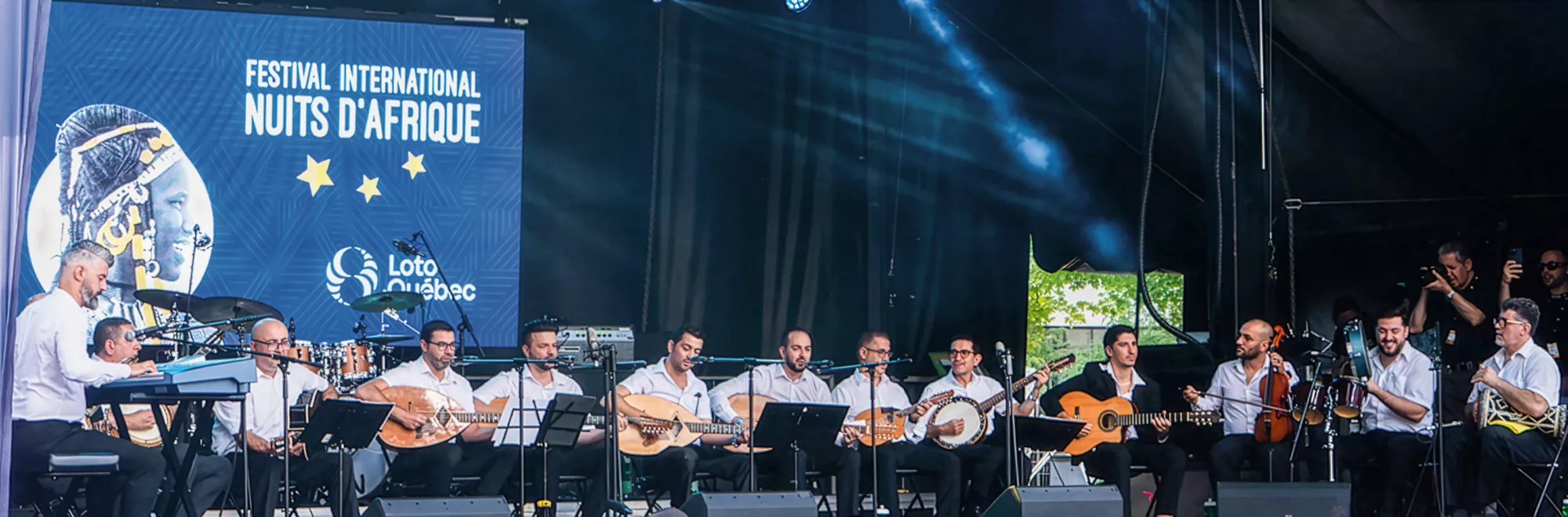
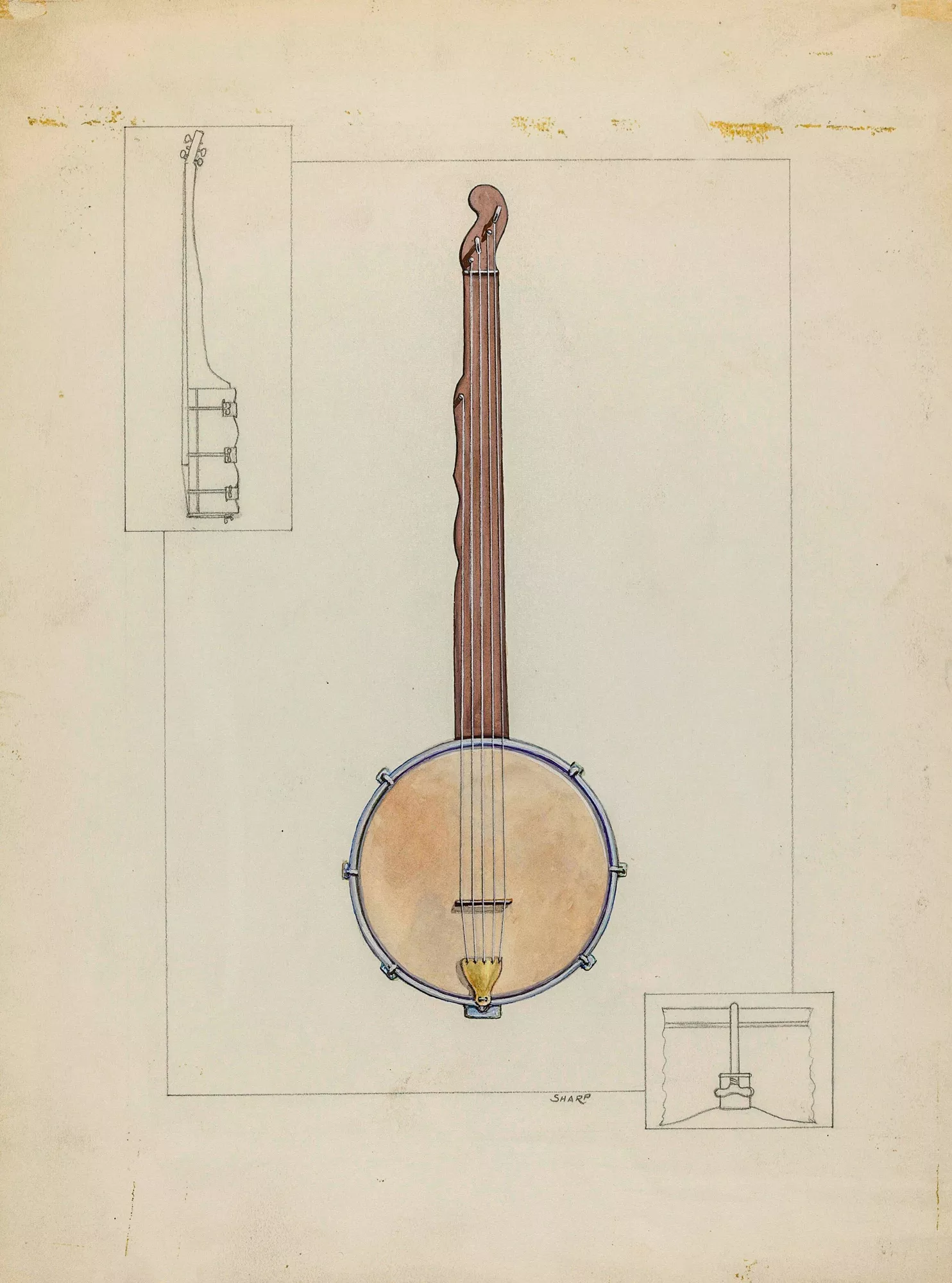
The Montreal Chaâbi Orchestra, including banjo players, performs at the Nuits d'Afrique music festival. Top "The Plantation Banjo," a circa 1937 illustration by Floyd R. Sharp, depicts the descendant of African stringed instruments that was played in the American South, especially on plantations. It is closely tied to African American musical heritage.
Banning Eyre Top: Courtesy of National Gallery of Art
In the United States today, small acoustic ensembles that play bluegrass, country and folk, including old-time, most often feature the banjo. Players usually use fingerpicks that produce a rapid, sparkling roll. In North Africa, by contrast, the banjo has been absorbed into ensemble traditions that emphasize single-line melodies and modal improvisation; players use a plectrum, a pick prized for its volume and percussive bite rather than chordal accompaniment.
Born from African memory and reimagined in the Americas, the banjo became a companion to work songs, dances and communal gatherings. The earliest examples of this date to the 17th century, when it was played almost exclusively by African Americans and their descendants, long before the instrument entered broader American culture. An instrument as resilient as those who played it, from plantation fields to minstrel performances, its African American roots formed an enduring thread through folk, blues and American jazz.
So, how did an instrument so entwined with American folk music appear in the lineup of an Algerian orchestra rooted in the music of old Al-Andalus?
It turns out two parallel narratives outline the banjo's return to Africa, one rooted in the Amazigh (Berber) culture of Morocco's Atlas Mountains and the other involving Algerian chaâbi music.
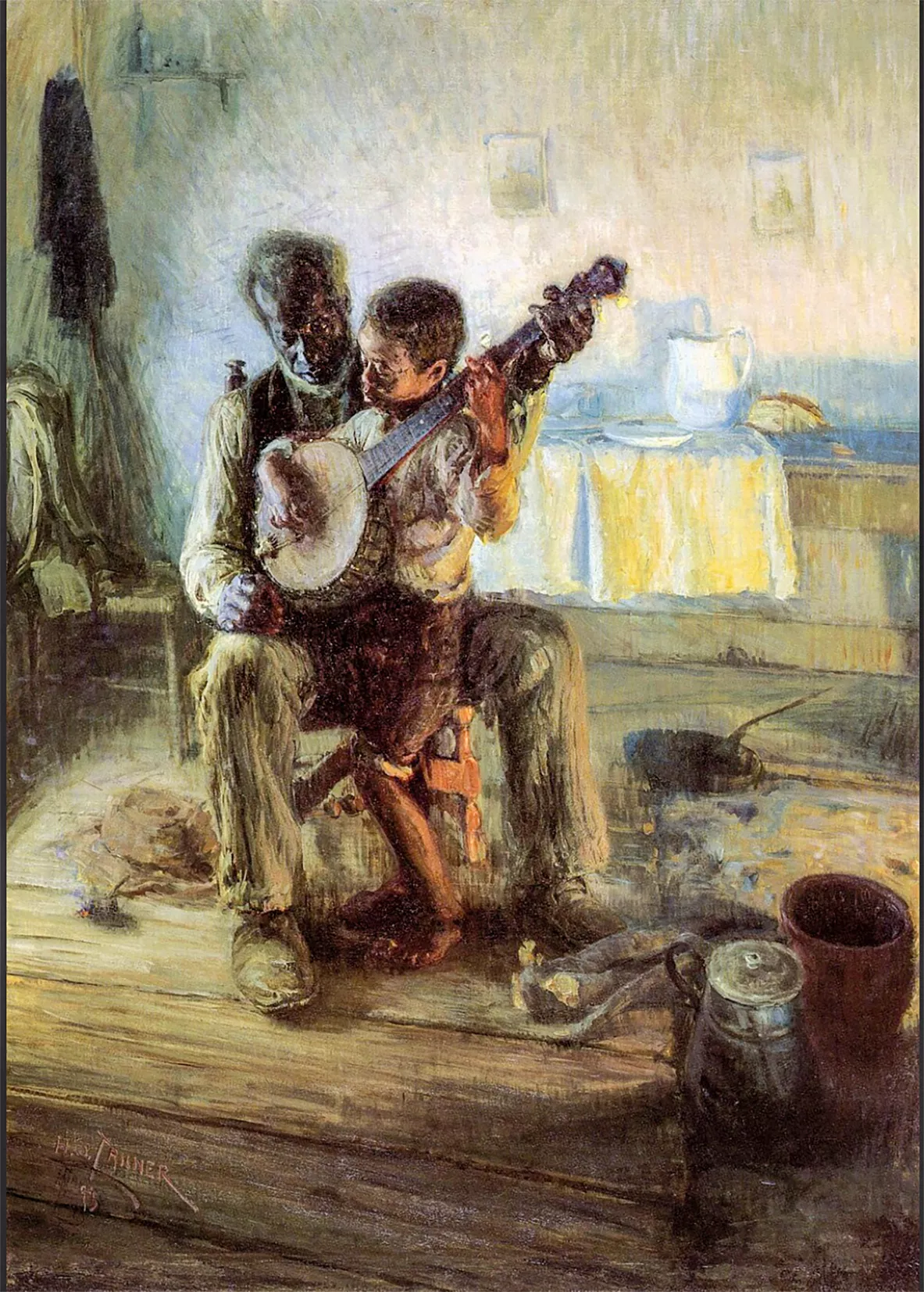
Above African American artist Henry Ossawa Tanner's 1893 oil painting "The Banjo Lesson" depicts a nurturing scene that refuted widely held racial stereotypes of the era. Right The banjo's earliest-known ancestors are a family of instruments known as the spike lutes of West Africa, including the Sora Ngoni (aka simbingo) of Mali.
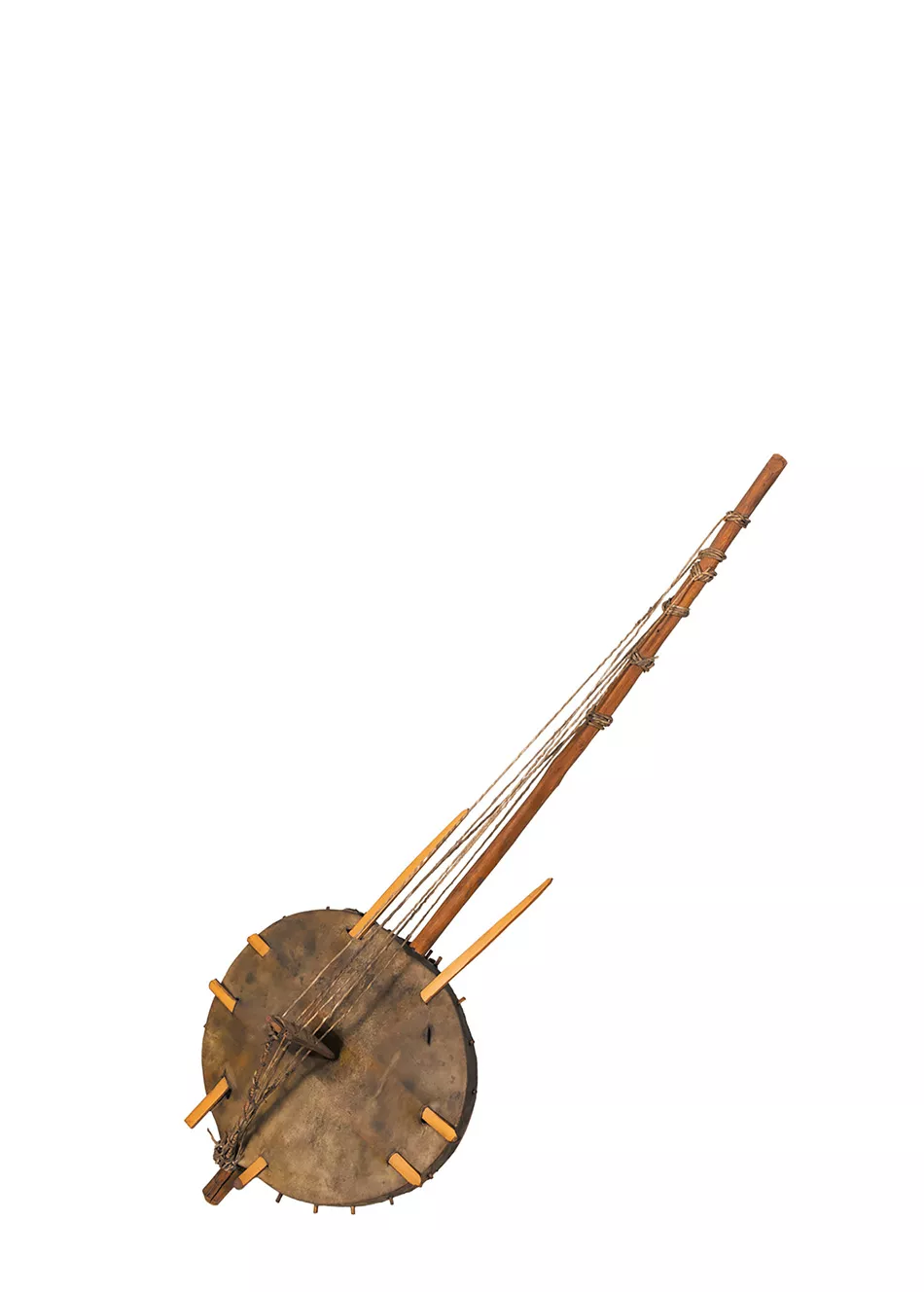
Crosby Brown Collection of Musical Instruments, 1899, courtesy of Metropolitan Museum of Art
The banjo's improbable backstory unfolds in Dubois's book The Banjo: America's African Instrument. His research shows that the banjo's earliest-known ancestors are a family of instruments known as the spike lutes of West Africa.
The banjo can't claim any single ancestor. The Gambian akonting, Senegalese xalam and Malian ngoni all fit the bill-fretless instruments whose sound chamber is a gourd or concave wooden body with animal skin stretched tightly over it and a bridge supporting between one and seven pluckable strings.
Dubois says the banjo resulted from the collision of African cultures in the American plantation South, where captive Africans fashioned gourd banjos using materials at hand. "If you're a musician on a plantation," says Dubois, "you have to successfully play to Ibos, Congos, maybe some Peul, all [ethnic groups who] have totally different musical traditions." In other words, one reason the banjo has traveled far and wide is its ability to traverse cultures. Today, the American banjo is a staple of music genres that descend, to varying degrees, from 19th-century minstrelsy, when the instrument was used to parody Black culture, leading the banjo to pass mostly to white hands.
"The banjo emerged in places of incredible cultural ferment, of migration and change," says Dubois. He adds, "when it gets back to Africa in the 20th century, a lot of Africans are experiencing similar things. It may not be quite right that instruments carry their history, but I would argue that the banjo was invented to deal with different ethnicities."
And that brings us to North Africa.
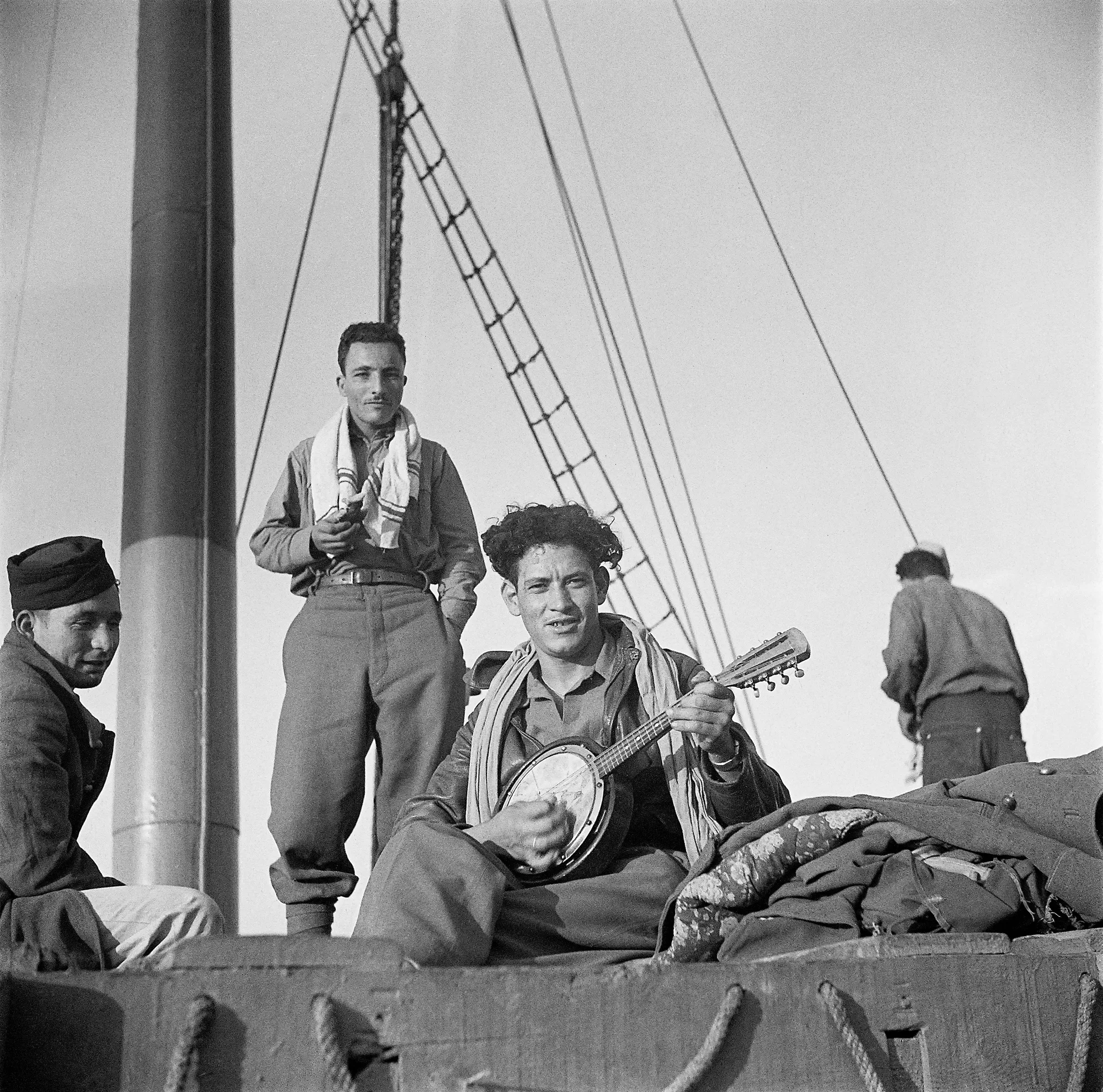
An Algerian soldier plays the banjo for his comrades in October 1945, at the end of World War II.
Getty Images
Amazigh strings and Moroccan squares
The banjo found its way into Morocco during the era of French colonialism. Already adapted in various European contexts, it arrived in North African cities, especially in the hands of African soldiers returning from serving in World War II.
Hassan Wargui, a Moroccan banjo player based in France, grew up immersed in Amazigh culture in Morocco. "In my culture, there is the lotar, an Amazigh instrument," he explains. "It has a voice like the banjo. There is a skin body and a neck; it's almost the same. That's why Moroccans are very accepting of the banjo." The lotar belongs to another branch of the African lute family tree that includes the likely ancestors of the banjo.
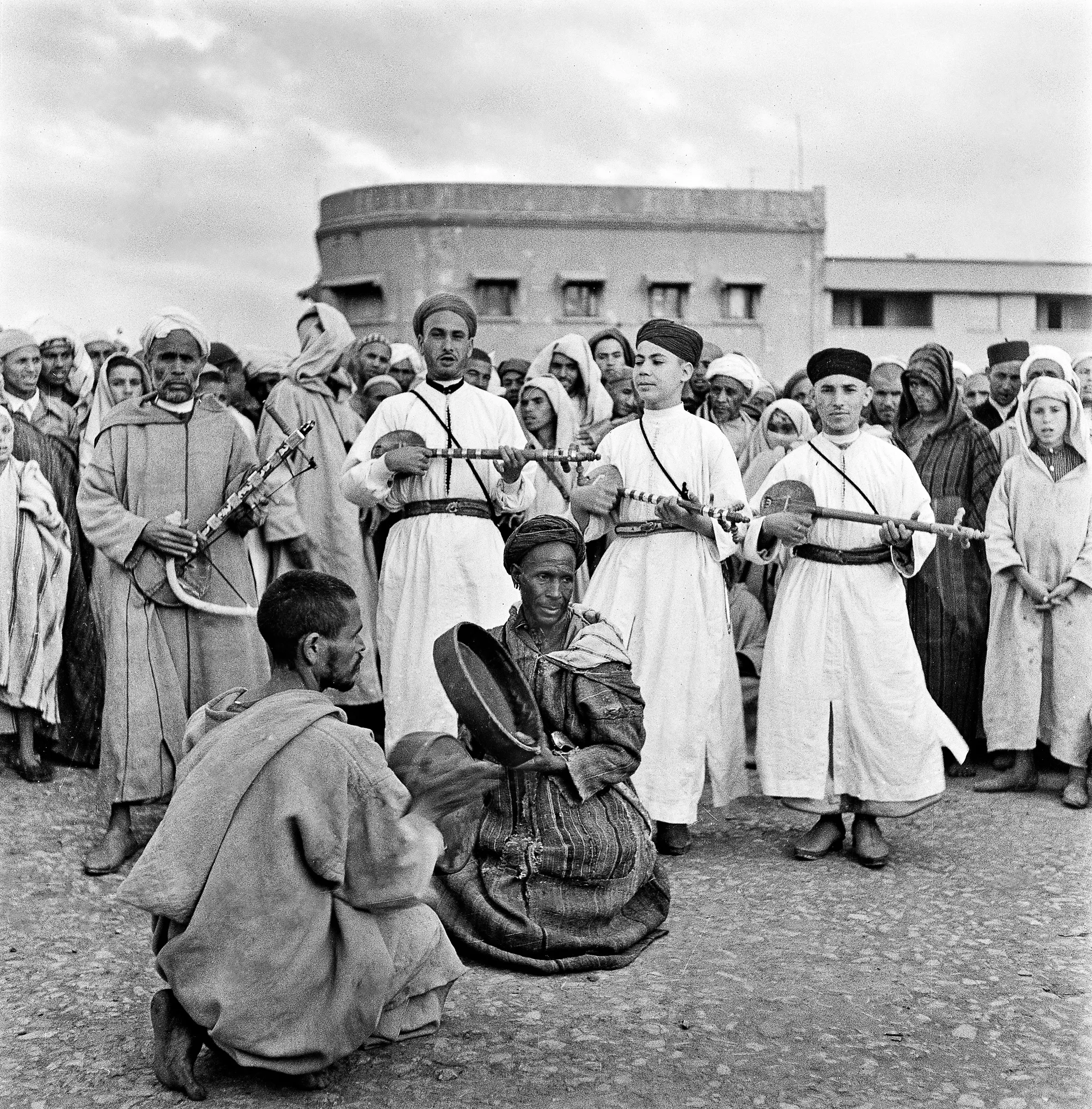
Troubadours of the Chleuh tribe of southern Morocco perform in Marrakech in 1946.
Russell Westwood/Popperfoto via Getty Images
By the 1960s Amazigh ensembles included banjos when performing rais folk music. "Going back to my childhood, the banjo was the instrument that you would see in the public square, like Jemaa el-Fnaa in Marrakech," recalls Said Graiouid, provost and dean of faculty at the School for International Training in Vermont, US, and Mohammed V University in Rabat, Morocco.
But the instrument's emergence in popular Moroccan culture came later, with the rise of the band Nass El Ghiwane, which American filmmaker Martin Scorsese once described as "the Rolling Stones of North Africa."
"I don't think we can write about the banjo in Moroccan culture outside the contribution of Nass El Ghiwane," Graiouid says. One of the band's original members, Allal Yaâla, with his Amazigh background, introduced the banjo early on, and it became a signature of the band's sound.
"The banjo emerged in places of incredible cultural ferment, of migration and change."
Echoing Dubois's notion of cultural ferment, Graiouid notes that Nass El Ghiwane performed as Morocco was experiencing rapid social and cultural change. Its music offered a fresh, distinctive voice that resonated widely, and in time, the band's innovative style-which Graiouid calls Ghiwanism-became a defining influence on Moroccan popular music.
The same cannot be said for the banjo. Though it remains a constant in Amazigh folk music, more mainstream groups rarely include it. Graiouid says that Nass El Ghiwane today is strongly associated with al-zaman al-jamil, basically "the good old days"-mainstream ensembles would not want to be compared to this legendary group nor accused of imitating it.
Chaâbi and the Algerian banjo
The story in Algeria is quite different. Guitarist and banjo player Ali Syroco, a founder of the Montreal Chaâbi Orchestra, explains: "We grew up with the banjo in Algeria. I listened to chaâbi music when I was little. And the two signatures of chaâbi are the banjo and the mondol." The Algerian mondol (sometimes mandol, mondole or mondola) is a steel-string, fretted instrument rather like an oversized mandolin.
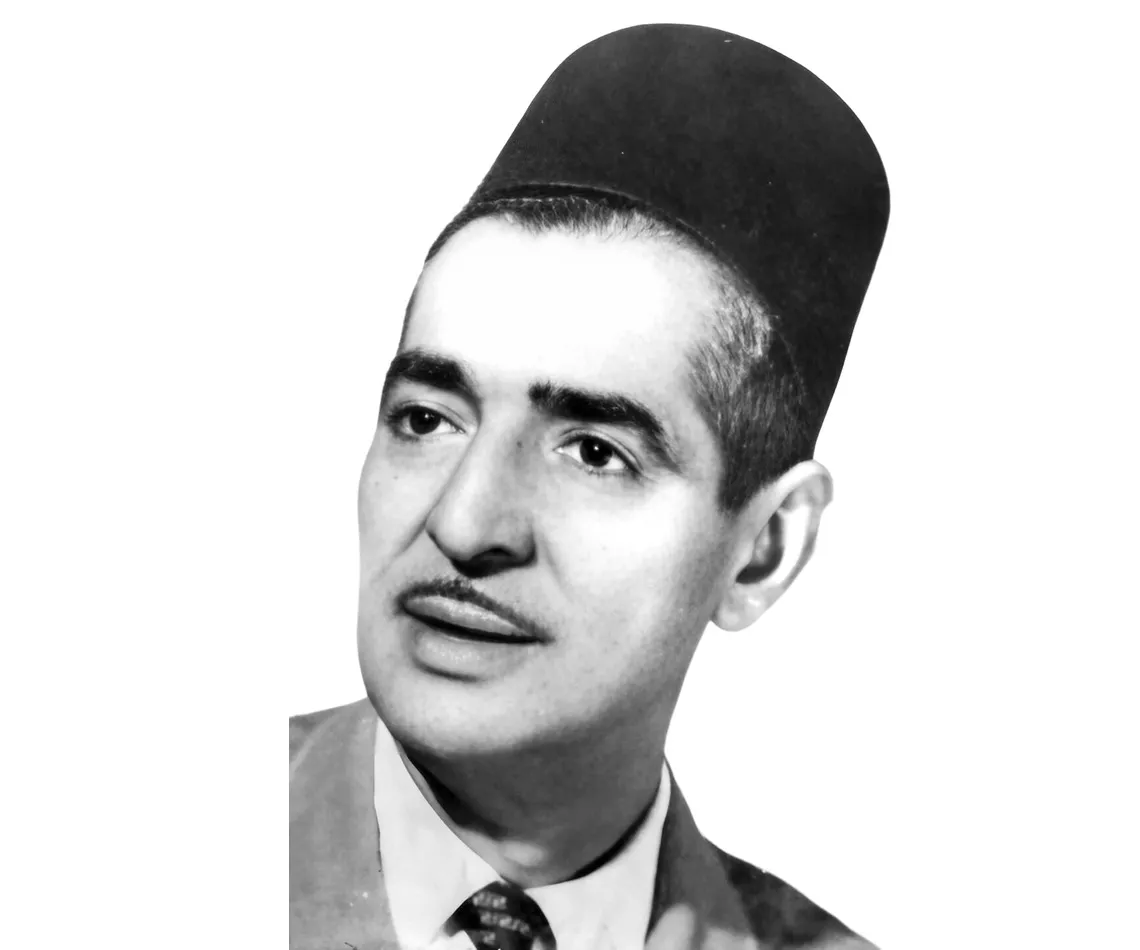
Hajd M'Hamed El Anka is known as the "grand master" and founder of Algerian chaâbi music.
Hadj M'Hamed El Anka, the "grand master" and founder of Algerian chaâbi music, began innovating in the 1930s, enlarging the classic mondol with the help of an Italian luthier to make it louder for ensemble settings.
During and after World War II, as the banjo found its way into Algerian cities, El Anka immediately appreciated its ability to project volume and its percussive quality. "The mix between the mondol and the banjo was a really fresh new sound," Syroco says. "The metallic banjo sound with the round sound of the mondol was perfect."
Add a darbouka drum and a singer, and you have the basis of Algerian chaâbi, which coalesced in the 1940s. Sporting events began featuring the musical style as sport was becoming a symbol of identity, once again a milieu of cultural ferment and change. In the early '40s, El Anka composed "L'Union L'USMA," a praise song in honor of the USM Alger football club that many consider the first patriotic sports song in Algerian history.
After World War II, El Anka became the music director for Algerian radio, giving him a powerful vehicle for popularizing this young genre. In 1955, he began teaching chaâbi as a professor at the Municipal Academy of Algiers. His first pupils all became renowned musicians, including Amar El Achab, Hassen Said and Rachid Souki.
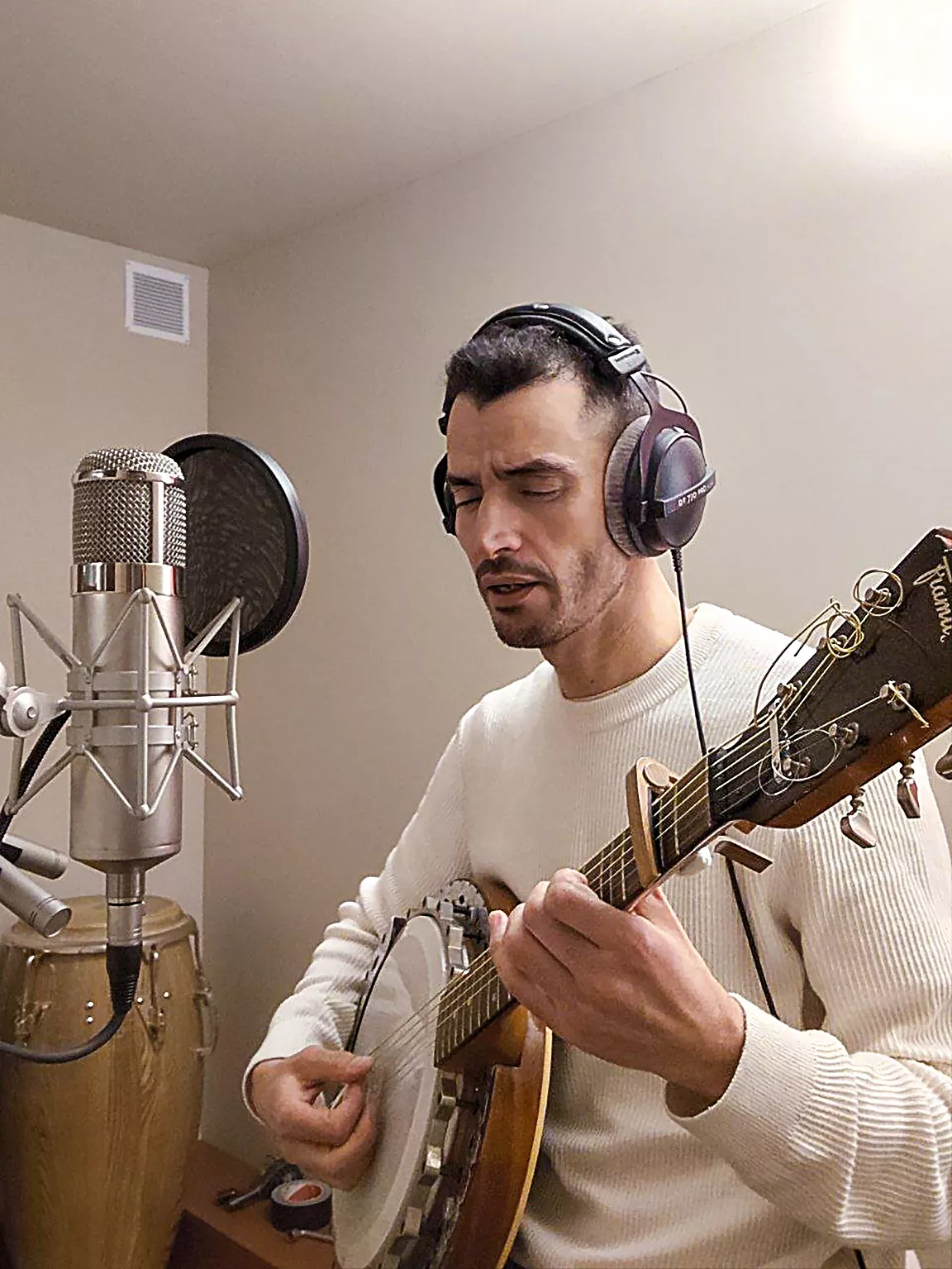
Hassan Wargui, a Moroccan musician based in France, grew up in the Amazigh culture that he says embraced the banjo for its similarity to a lute known as the lotar.
Courtesy of Hassan Wargui
"[The lotar] has a voice like a banjo. ... They're almost the same. That's why Moroccans are very accepting of the banjo."
Syroco says a modern chaâbi ensemble generally includes two banjos, a "guitar banjo" playing on the low strings and a tenor banjo taking the high melodies. These two are sometimes called the "wings" of the chaâbi sound. The mondol plays a main melody while the banjos embellish with what Syroco calls "spice."
The Algerian banjo, like its Moroccan cousin, carries a distinctive voice-bright, percussive and endlessly adaptable. "We play always by pick, never by finger," says Syroco, adding that the instrument plays single-line melodies, not chords. "You always have to respect the melody because in chaâbi, it's always about melody."
Wargui says that the Moroccan banjo has six strings that are generally, though not always, tuned like a lotar. Since the instrument remains mostly in folk circles, there are no established fabricators. This stands in contrast to Algeria, where the luthier Farid Taleb's mondols, guitars and banjos bring renown. Sometimes Moroccan players remove the frets to play quarter-tone melodies. This harks back to the earliest days of manufactured banjos in America, which came with an optional plate that could be placed over the frets to create the same effect.
Wargui adds that Moroccans consider the banjo a traditional instrument. As for its deeper history in West Africa, "I don't think most people know about it." There's another echo: For years, American banjo players were unaware of the instrument's African origins, until more recent scholarship removed all doubt.
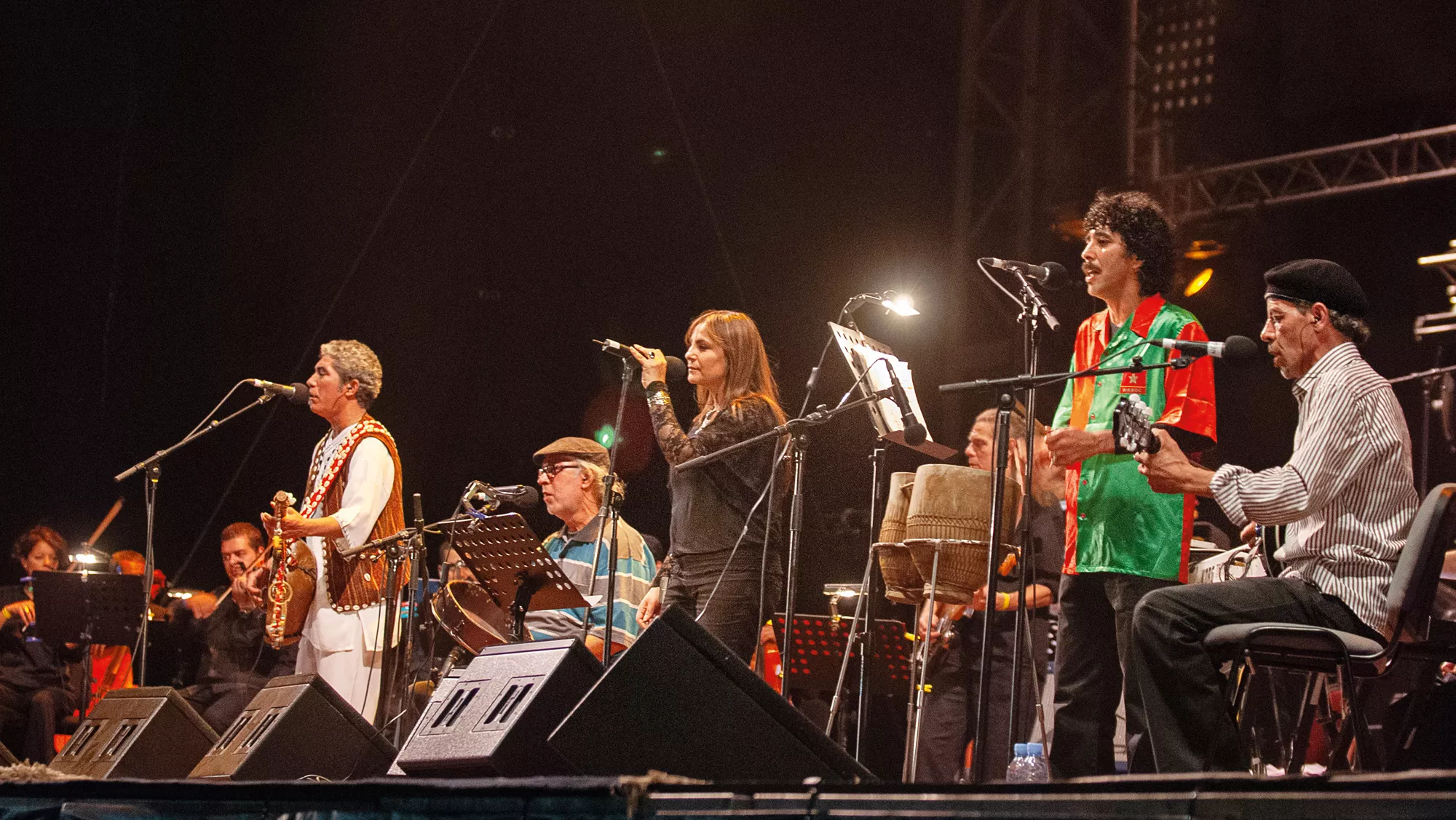
The musicians of Moroccan folk band Nass El Ghiwane play a variety of traditional drums and lutes. The banjo forms a large part of the ensemble's signature sound.
Banning Eyre
And so, on the Montreal stage, the banjo continues its centurieslong journey-from African roots to American reinvention, back to North African ensembles-carrying with it a history of resilience, adaptation and the enduring power of music to connect cultures.
As Dubois notes, a sense of ownership lies at the heart of the banjo's almost universal appeal. "I think the key is," he says, "nobody thinks of it as foreign."

You may also be interested in...

Spotlight on Photography: Finding Frozen Fun in Kyrgyzstan
Arts
Culture
In the winter of 2020, Lake Ara-Köl in Kyrgyzstan was becoming more and more popular.
Spotlight on Photography: Beneath the Cherry Blossoms in Japan
Arts
Japanese culture reveres the springtime blooms as a symbol of renewal.
A Conversation With Author Tim Bascom on Why Football Endures
Arts
Culture
As the 2026 World Cup nears, Tim Bascom asks: Why do people keep playing soccer when the world is ready to break apart?