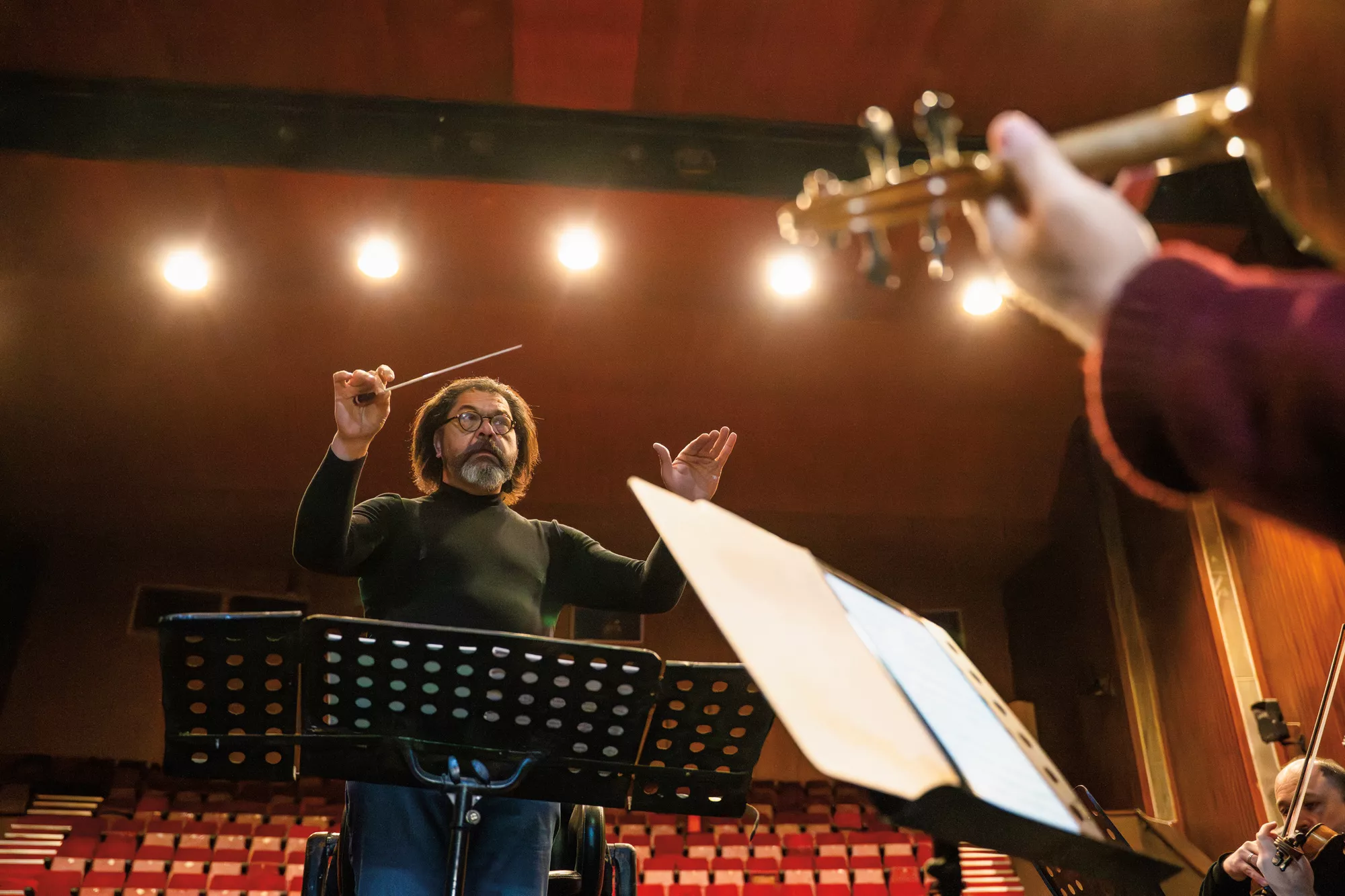
Conversation With Karim Wasfi, Chief Conductor of Iraqi Orchestra
Through his leadership of the Iraqi National Symphony Orchestra, cellist-turned-conductor Karim Wasfi has broadened the range of musical compositions that audiences hear.
“Music communicates beyond words. It transcends cultural, linguistic and social barriers. This was a belief that I wanted to translate into action and to share with all audiences and musicians.”
There is a moment, says Karim Wasfi, standing center stage in a concert hall with hands raised, when he can feel the intention and meaning of the orchestral performers around him hovering in the air. He knows that as soon as he makes his next move, like a magician with a wand, something that wasn’t there before will be conjured into reality. What Wasfi creates is classical music, and it has been the great passion of his life.
A musical prodigy during his childhood in Baghdad, Wasfi spent years studying in the United States where he learned from virtuoso performers and conductors like Yehudi Menuhin and János Starker. And yet, in his own words, he always had the idea to return to Iraq “and to re-establish the symphony orchestra.”
Wasfi, born in 1972 to an Egyptian mother and Iraqi father, is driven by a conviction that culture, arts and civility together form the path forward for Iraq, and that this is especially important as a response to the conflicts he has witnessed during his lifetime. This led him to establish the Peace Through Arts Foundation, which promotes social cohesion and community healing through music and the arts.
In 2007 he became chief conductor of the Iraqi National Symphony Orchestra, one of the Middle East’s oldest classical ensembles. Today it boasts 85 members, ranging from those in their mid-20s to septuagenarians. Under Wasfi’s leadership, the orchestra has integrated elements of traditional Arabic music and created opportunities for local composers to hear their work performed in public.
Although the orchestra is in its eighth decade, Wasfi believes its most exciting years still lie ahead. AramcoWorld spoke with him about these ambitions and his life and career in music.
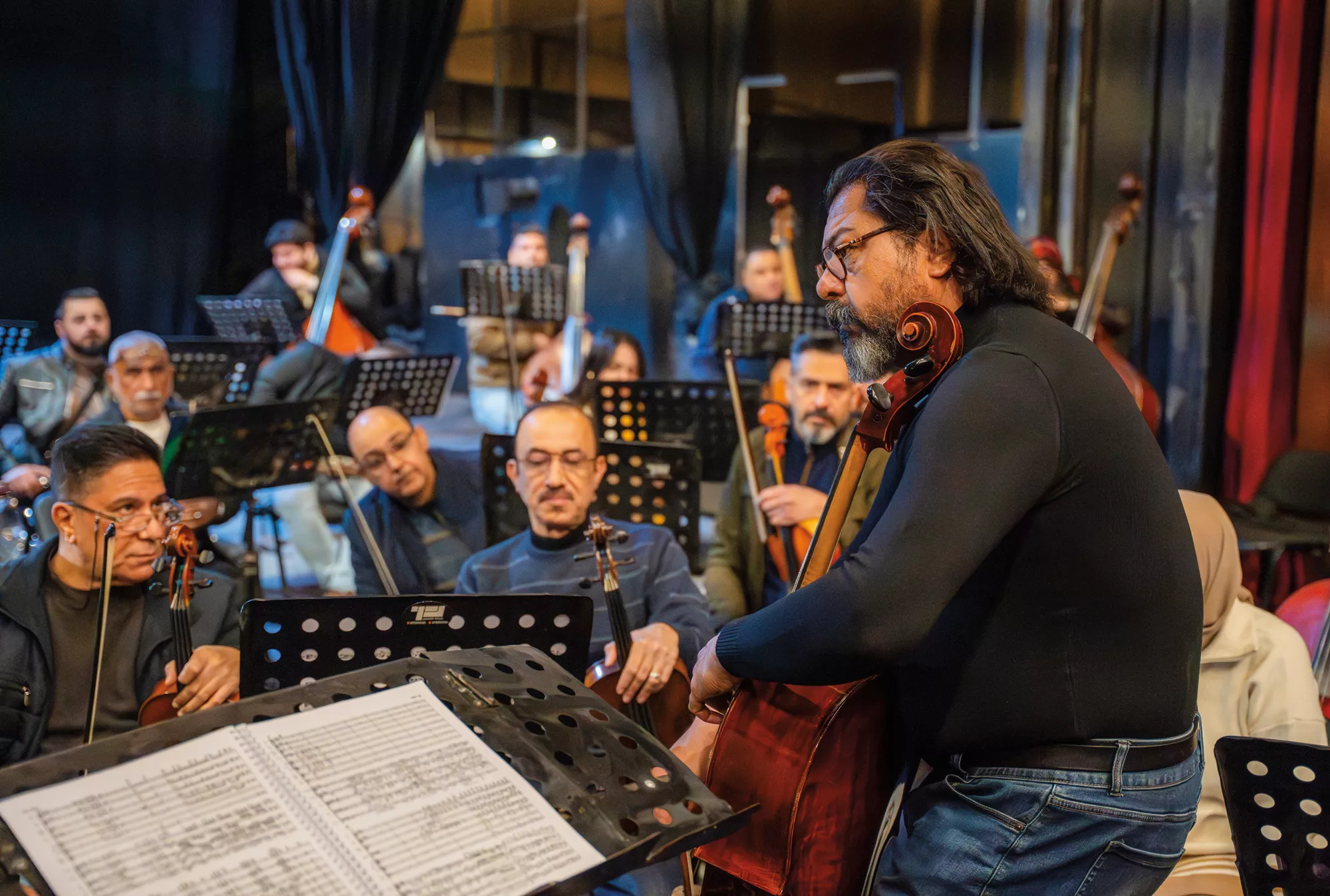
Karim Wasfi first trained as a cellist. Top Kareem Wasfi has helmed the Iraqi National Symphony Orchestra since 2007.
When did you begin to learn the cello, and what was the appeal of classical music?
At the extremely young age of 4, I started to consciously recognize sound and music and that they were part of our day-to-day life. My late mother was a pianist and researcher from Egypt. My late father was a well-known artist and movie star, and music was one of the major foundations for his work. So, it actually started with home. Sometimes I say it was perhaps before I was even born because music was always there, and specifically classical music.
Later I joined the Music and Ballet School of Baghdad, which was, and still is, the major [arts] institution in Iraq. I grew up with teachers and faculty from what was back then the Soviet Union. That became another element of my educational background. At the age of 6, the cello was chosen for me at school, and it went from there.
When was it clear that music would be your career, and what was your first involvement with the Iraqi National Symphony Orchestra?
At the end of every semester at the music and ballet school, we would have a performance. By 1986 [at age 14] and after a few solo performances, the conductor of the national symphony requested that I join them for the experience and exposure, and also to shape my capabilities with others.
I was always more of a soloist, but there was also the need to be able to sit with others and perform. It was sort of annoying in some cases because I felt so free performing as a soloist. But I learned in no time it was important to understand that this was about engaging with others through music.
When you later became chief conductor of the orchestra, what music were you interested in playing?
I became the chief conductor in late 2007 while I was still playing cello and performing. I wanted to turn it into a philharmonic, a full orchestra. I wanted to challenge musicians and the audience.
Some musicians were only used to playing classical music and some Iraqi genres of a smaller size of orchestra: Haydn, Mozart, a couple of Beethoven symphonies. I introduced Richard Strauss and Nikolay Rimsky-Korsakov. These were bigger pieces with more instruments.
I managed to attract more musicians, which allowed me to enlarge the repertoire. So, it became everything. It was classical European, as well as promoting Iraqi composers. Then I started the beehive of compositions, as I call it. From Iraq, whoever composed whatever was allowed to perform back then. That was my idea for exposure for composers, that they would get a chance to perform it through the orchestra.
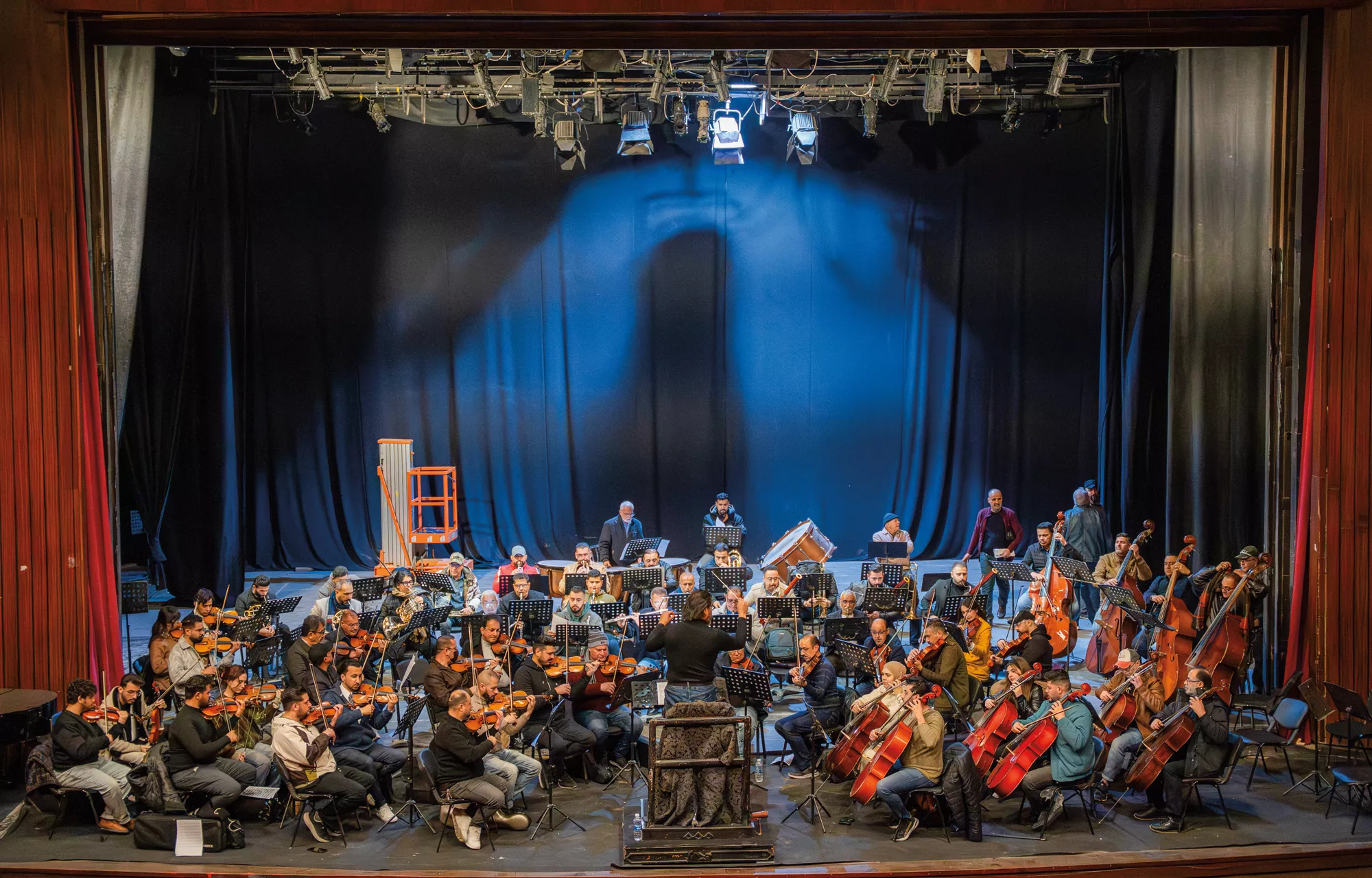
Cellist and chief conductor Karim Wasfi leads the Iraqi National Symphony Orchestra through a rehearsal at the Alrasheed Theater in Baghdad.
How do you see the relationship between traditional music from Iraq and classical music?
Iraq’s relationship with classical music ranges from its early days, with an audience of the expatriate community and westernized Iraqis back in the late 1940s, to the creation of a standardized path of education in the professional music schools, to recent years where audiences once again include expats but also Iraqi graduates from western universities and young people who have discovered the form.
Classical Arabic music as a genre has certain instruments and its own identity. I chose to integrate both [classical music and traditional music from Iraq] within the repertoire for many reasons. I didn’t mind [orchestrating or turning] some of these compositions into symphonic or orchestral pieces so that, as a repertoire, they can get exposure both abroad and locally as a manifestation of cultural identity.
In some cases we would also integrate that with language. So instead of an opera, we had lots of instances of citation and narration with a composition. In some cases it was Shakespeare poetry translated into Arabic alongside a certain composition. I have always encouraged local composers to create this different vision for the Iraqi music, as both orchestral and symphonic.
Is there one moment that you’re particularly proud of from your time leading the orchestra?
There are so many. In a couple of performances, the power went off, and to my pride—and to the pride of the orchestra—we kept playing and I kept conducting, and we didn’t stop until the power was back. I even have a video of one of these performances. Some people thought it was staged. It was actually simply that the orchestra had reached a level, after so much rehearsing, to be able to continue playing with no mistakes.
What is next for you?
I welcome composers from around the world, and I would love to perform work from more contemporary American composers. I would definitely welcome more soloists from abroad, and this is something I’m working on. We are also looking to include more chamber music. I look at the orchestra as a success story that is still continuing, despite the sad fact that there’s no opera house yet. There was recently a government reconsideration for the project to build one, and I hope there will be an allocation for it. We’re lacking some players of certain instruments, like a harp. We had a harp 6,000 years ago in Sumeria, but we don’t have a harp yet today.
For myself I’m excited about the intersection of music and language, and am working on this with the inspiring linguist, intellectual and poet Sina’a Al Taii. These are not just tools of communication but lived experiences that shape how individuals perceive themselves, others and the world.
About the Author
Leon McCarron
Leon McCarron is an author, broadcaster and hiking-trail designer based in Beirut. He is the author of three books, including Wounded Tigris: A River Journey Through the Cradle of Civilization, as well as the forthcoming Last Train From Damascus: A Journey Along the Hejaz Railway.
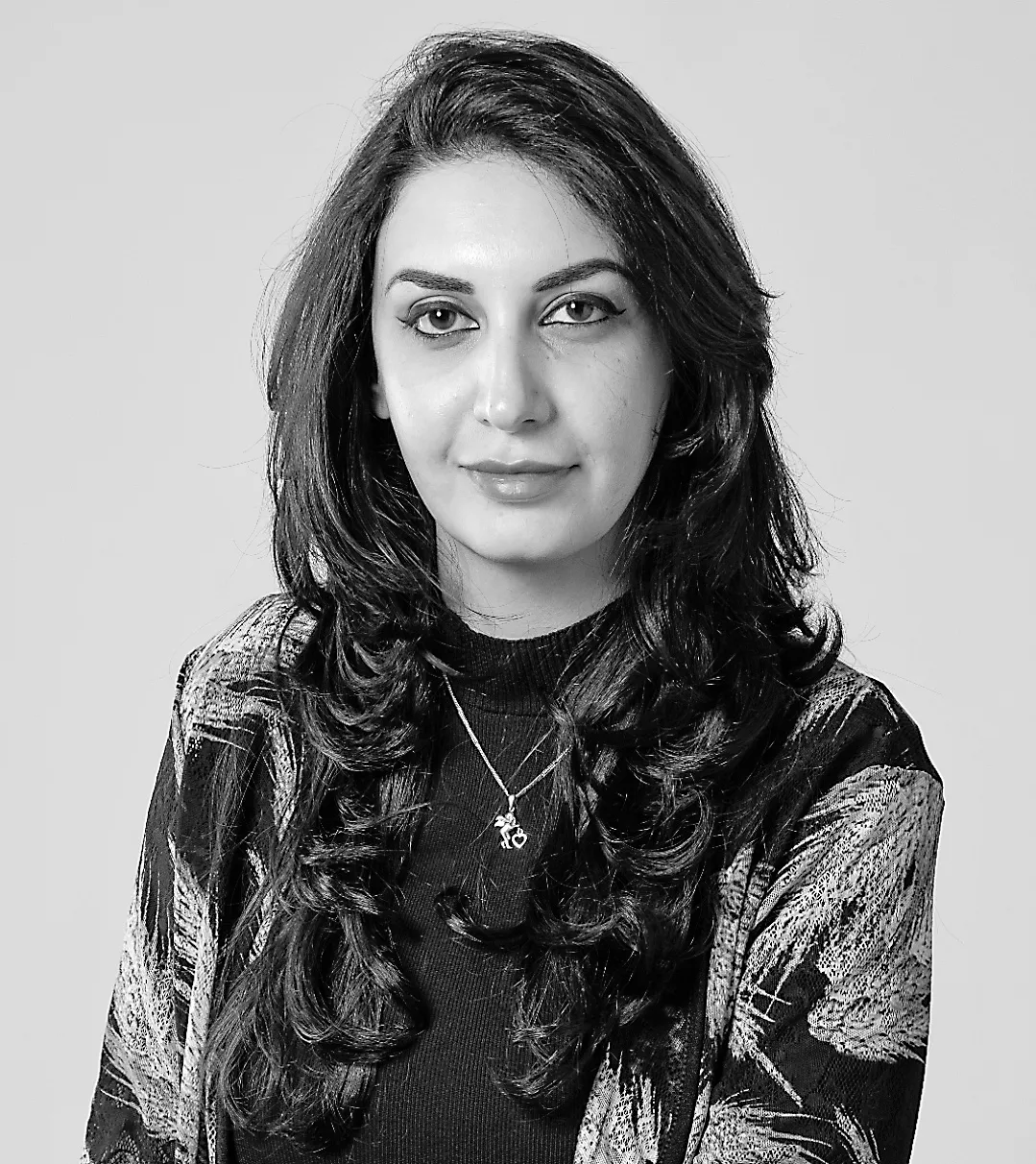
Saba Kareem
Saba Kareem works as a photojournalist and visual storyteller, collaborating with Reuters since 2019 as well as various international organizations and magazines. Her work focuses on women's topics, social changes and more.
You may also be interested in...
Stratford to Jordan: Shakespeare’s Echoes of the Arab World
Arts
History
Shakespeare’s works are woven into the cultural fabric of the Arab world, but so, too, were his plays shaped in part by Islamic storytelling traditions and political realities of his day.
Spotlight on Photography: Long Exposure Grabs AlUla's Starry Night
Arts
Photographer Waleed Dashash gets away from urban light pollution, adjusts his aperture and shutter speed—and catches the majesty of AlUla at night.
How Pantomime Lets New Voices Take the Stage
Arts
A UK production, "Snow Brown and Her Seven Chachay," shows how the form of theater continues to absorb diverse influences without losing its familiar sense of play.