.webp?cx=0.36&cy=0.38)
From Shimla to Chittagong: How a Fish Dish Helped Me Remember
A writer prepares cookbook author-restaurateur Asma Khan’s recipe for Shimla Mirch Machli in her London kitchen—and is transported to the places of her grandparents’ birth.
The fish is already marinating—turmeric, chili powder, salt pressed gently into flesh. It rests on the counter while the kitchen waits.
Nothing is happening yet, but the pause feels deliberate.
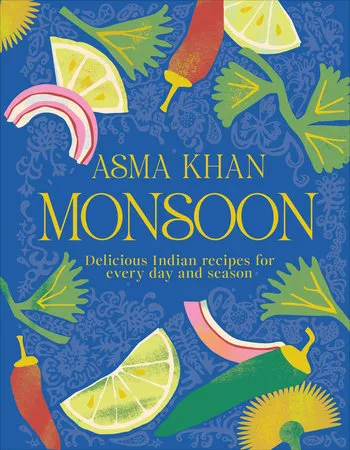
A cookbook, Monsoon, by India-born British restaurateur Asma Khan, lies open nearby. Only then does the name appear: Shimla Mirch Machli.
Shimla. The word lingers longer than it should.
I’ve never been to Shimla. It arrived instead through the stories of my Naano—“grandmother” in Urdu—a large family home perched on a hill in northern India, high ceilings carrying the echoes of her 13 siblings, monkeys slipping through kitchen windows to steal roti.
.webp?cx=0.5&cy=0.5)
The name sounds precise yet flexible. Shimla mirch—bell pepper—is an everyday ingredient valued for sweetness and bulk. Dishes named for ingredients tend to travel easily, adapting across kitchens and regions. This one belonged everywhere and nowhere in particular.
The name keeps going. Machli, “fish” in Urdu.
Shimla came to me through my grandmother. Fish through my Nana Abbu.
My grandfather grew up in Chittagong, a coastal city along the Bay of Bengal in what is now Bangladesh, where fish anchored daily life. After moving to Lahore, Pakistan, far from the coast but rich in markets, he made sure fish stayed part of family suppers. Freshwater rohu and saltwater pomfret appeared on the table with regularity. I loved the taste, though I dreaded the careful deboning that always followed.
My grandmother seemed to know the exact moment the local fishmonger would turn into her street. “Machli!” she ’d call from the backyard, and he would stop, offering her the day ’s catch at a price she considered fair. The exchange repeated often enough that it grew into a routine.
By the time I knew her, we were living in Lahore—hot, inland, far from any hill. In the thick of summer, she would sometimes pause over the stove and say, almost wistfully, “I wish I were still in Shimla. My body can’t tolerate this stifling heat. I feel like a fish out of water here.”
Only then did I begin to understand what she had left behind.
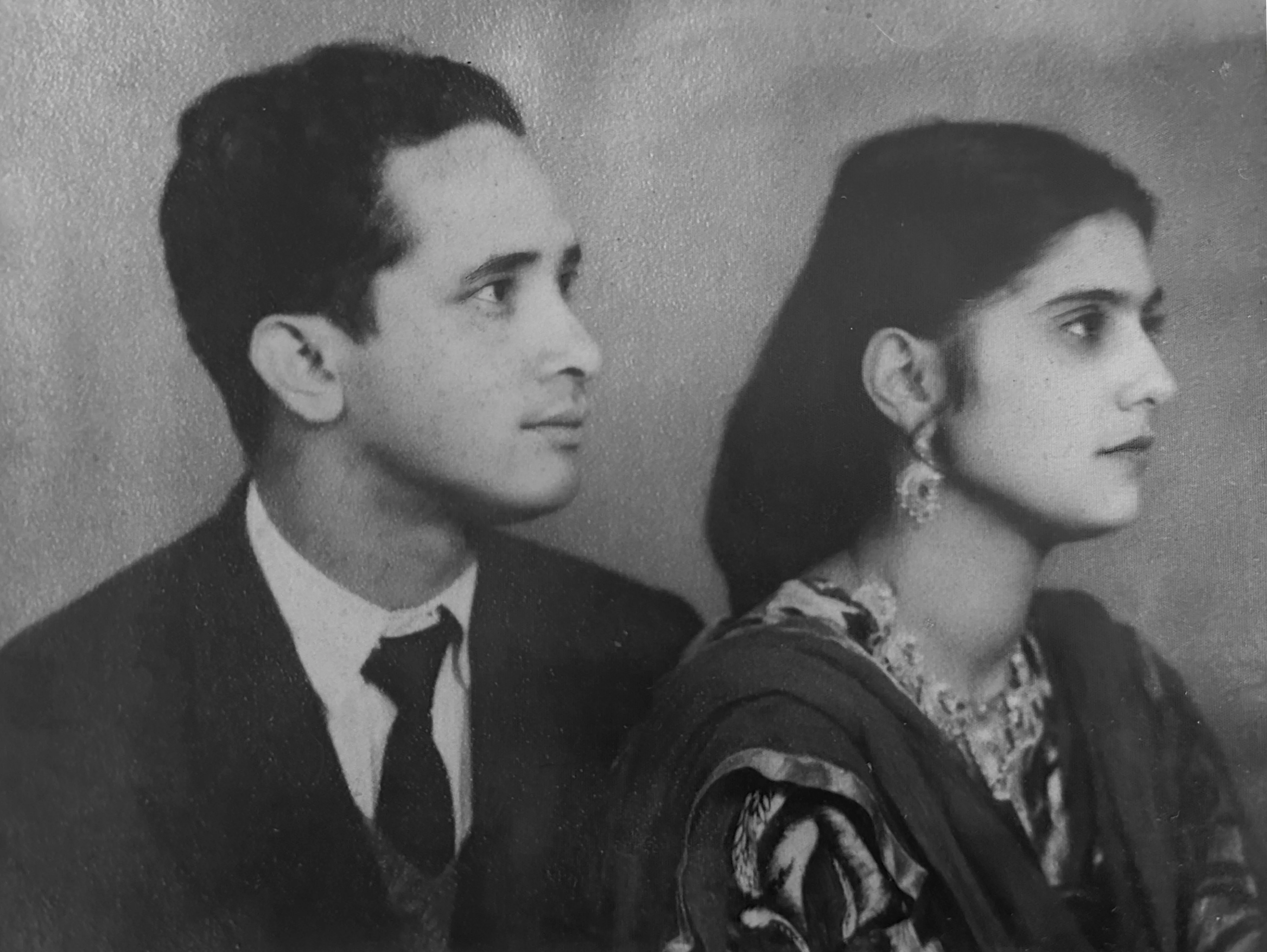
Author's grandparents, days after they married in 1955, Lahore, Pakistan.
Sunniya Ahmad Pirzada
An old hill station in near the Himalayas, Shimla sits in cooler weather that favors vegetables and slow, homestyle cooking. It was a place I learned secondhand—one for which my grandmother mourned the distance. The thought follows me back to the stove.
Fish, once eaten regularly in my grandparents’ home, survives mostly as a memory for me. The repetition that made it ordinary and dependable has thinned over time. Memory alone hasn’t been enough to carry it forward. There’s nothing left to think through.
Chopping, stirring, waiting. The motions offer a cadence I didn’t realize I’d been missing.
Mustard seeds begin to pop in hot oil. Dried red chilies release their sharpness into the room. Capsicum falls into neat cubes on the cutting board. The kitchen fills with scent and sound, and then something shifts. The process itself opens a door: to seize the opportunity to remember what had been buried under years of silence and distance.
Fish once structured my grandparents’ days in Lahore. Now, in this quaint London kitchen, it had to be reconstructed intentionally, step by step.
The onions soften and turn golden. Garlic and ginger follow. The peppers begin to sear.
I stir, adjust the heat and wait again.
The fish browns quickly in the pan, its surface turning firm before yielding. It rests briefly on a tray while the capsicum-onion mixture blends smooth and returns to the heat. Spices go in. Tomatoes soften. The sauce thickens until oil separates at the edges.
The fish returns to the pan. Coconut milk follows. I lower the heat, and the dish settles into a slow simmer. Steam rises steadily, filling the kitchen.
For the first time in years, memory moves with the motions of the stove.
I stay there while it cooks.
By the time the remaining coconut milk goes in, along with a squeeze of lemon and a scatter of coriander, the room feels held by the dish itself.
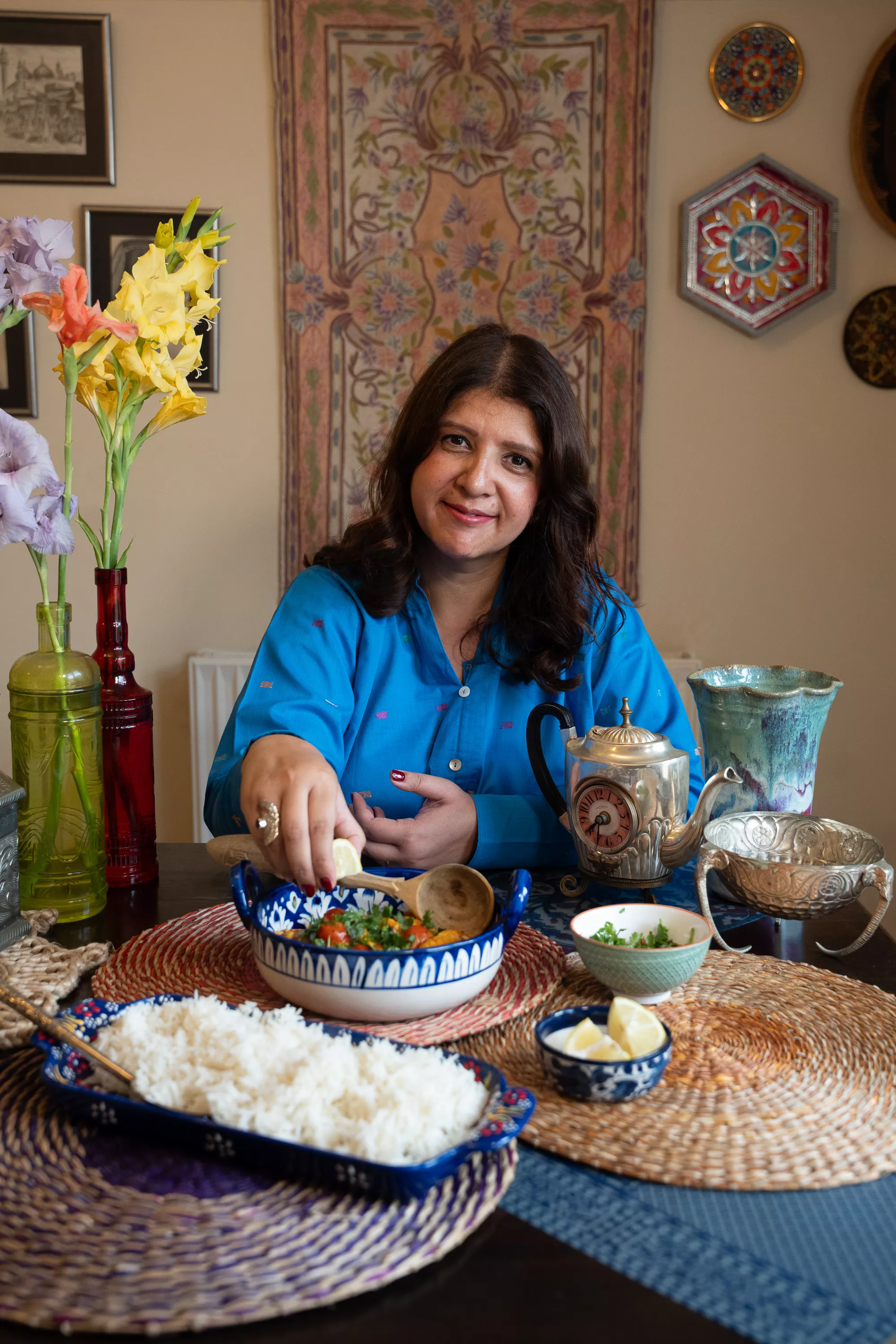
Recipe
Shimla Mirch Machli (Adapted from Asma Khan’s Monsoon)
Makes 4 to 5 servings
- 500 grams haddock fillets (skinned)
- ½ teaspoon ground turmeric
- 1 teaspoon chili powder
- 1 teaspoon salt (or to taste)
- 2 red capsicums (bell peppers), cubed
- 2 medium brown onions, sliced into half-moons
- A handful of sliced ginger
- 6 garlic cloves, chopped
- ¼ cup avocado oil
- 1 teaspoon mustard seeds
- 2 bay leaves
- 2 dried red chilies
- A pinch of brown sugar
- 8 cherry tomatoes
- 1 can (400 milliliters) coconut milk
- Fresh coriander, chopped
- ¼ lemon
Marinating
I pat the haddock dry, cut them into 10-centimeter pieces before rubbing them gently with turmeric, chili powder and salt and setting them aside for half an hour.
Preparing the vegetables
I cube the red capsicums, slice the onions and ginger, and chop the garlic, imagining the motions of my grandmother in her own kitchen.
Aromatic base
I take half of the avocado oil and heat it in a pan over medium heat. I add mustard seeds—they start popping like firecrackers within seconds. I follow them with the bay leaves and the dried red chilies. Soon this blend fragrances the air.
I stir in the onions until they soften and turn golden and then add in the garlic, ginger and capsicums, which start to sear after a few minutes.
Frying the fish
I wipe the pan clean, heat the remaining oil and lay in the fish without overcrowding it. It browns quickly on the outside. I’m careful turning it so it doesn’t break. When cooked on both sides, I transfer the fish to a tray.
Bringing it together
After removing the bay leaves, I blend the capsicum-onion mixture smooth, then return it to the fish pan, stirring until the oil separates. I then add the remaining turmeric, chili powder and salt, along with a pinch of sugar and cherry tomatoes.
After five minutes, I return the fish to the pan and pour two-thirds of the coconut milk. I allow it to simmer gently for about 15 minutes. I finish it with the remaining coconut milk, a sprinkle of coriander and a squeeze of lemon.
I serve it with plain basmati rice.
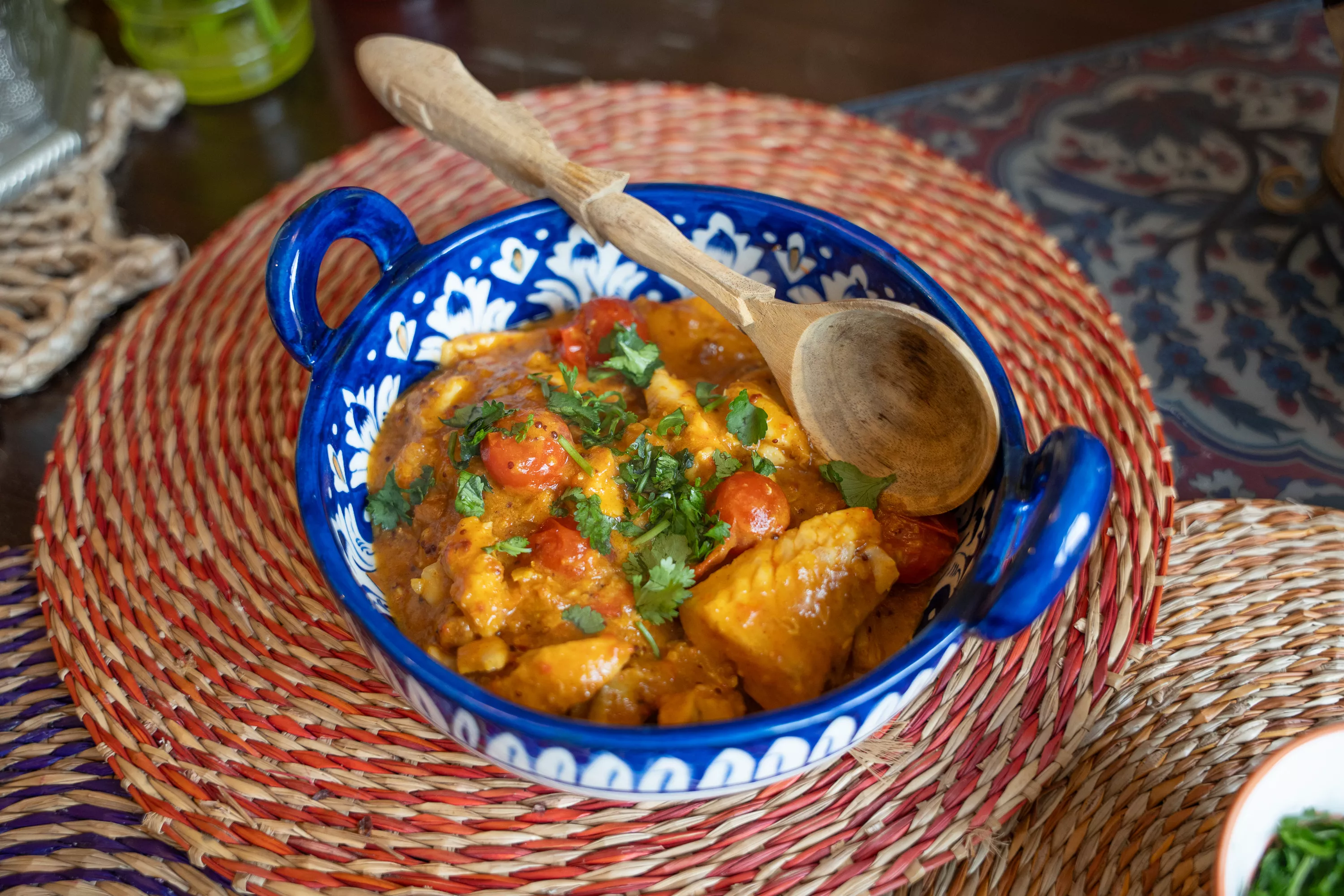
I may never visit Shimla, and Chittagong now exists only as a memory from a visit in 2002. Yet through this dish, both my grandparents feel present again. The table becomes a place to honor their love and their absence.
Shimla Mirch Machli may be just one dish, but for me it has become a map, tracing their paths from Shimla and Chittagong to Lahore, and my own from Lahore to London. Each journey marked by movement and adaptation, finally meeting at the same table.
More From AramcoWorld
Asma Khan's Cookbook Reclaims Taste of Home: A Review
About the Author

Sunniya Ahmad Pirzada
Sunniya Ahmad Pirzada is a Peabody Award-winning journalist whose work focuses on the intersection of race, class and gender and how it impacts people and societies around the world.
Talie Rose Eigeland
Talie is a photographer and videographer who creates striking, intimate portraits. Her captures are bold and three dimensional—while stylized, they remain warm and authentic. Norwegian-born and raised in France, Talie’s career took off in London, where her unique eye and candid approach have led her to work with several top publications and personalities over a career spanning more than 10 years.
You may also be interested in...
Biting Into the Past: Re-creating Gary Nabhan’s Albóndigas Meatball Recipe
Food
What do lamb, pomegranate and a Silk Road secret share? A meatball with a hidden past.
Recipe: How a Spanish Tortilla Got Me Over My Distaste for Eggs
Food
A lifelong egg aversion softens through a recipe by Jeff Koehler for a simple Spanish tortilla and the quiet resourcefulness it shares with Pakistani kitchens.
America at 250: The Eastern Foods the Nation Has Always Loved
Food
History
As the United States marks the 250th anniversary of its independence from Great Britain on July 4, the foods that filled the tables of the Founding Fathers—the late-18th-century statesmen who were most influential in the new country’s creation—are a reminder that elite households relied on ingredients carried through trade routes connecting the Mediterranean, Africa, Asia and regions now known as the Middle East.