How Pantomime Lets New Voices Take the Stage
A UK production, "Snow Brown and Her Seven Chachay," shows how the form of theater continues to absorb diverse influences without losing its familiar sense of play.
The Evil Queen does not glide onstage. She stomps.
Her boots thud against the floorboards as she sweeps across the stage in a black cape that flashes purple when she turns. Curved horns rise from her head, but beneath the theatrics, she wears an embroidered Pakistani kameez, a tuniclike garment, glittered with thread that catches the light.
She plants herself center stage, fixes the audience with a glare and bellows the question everyone knows is coming.
"Mirror, mirror on the wall …"
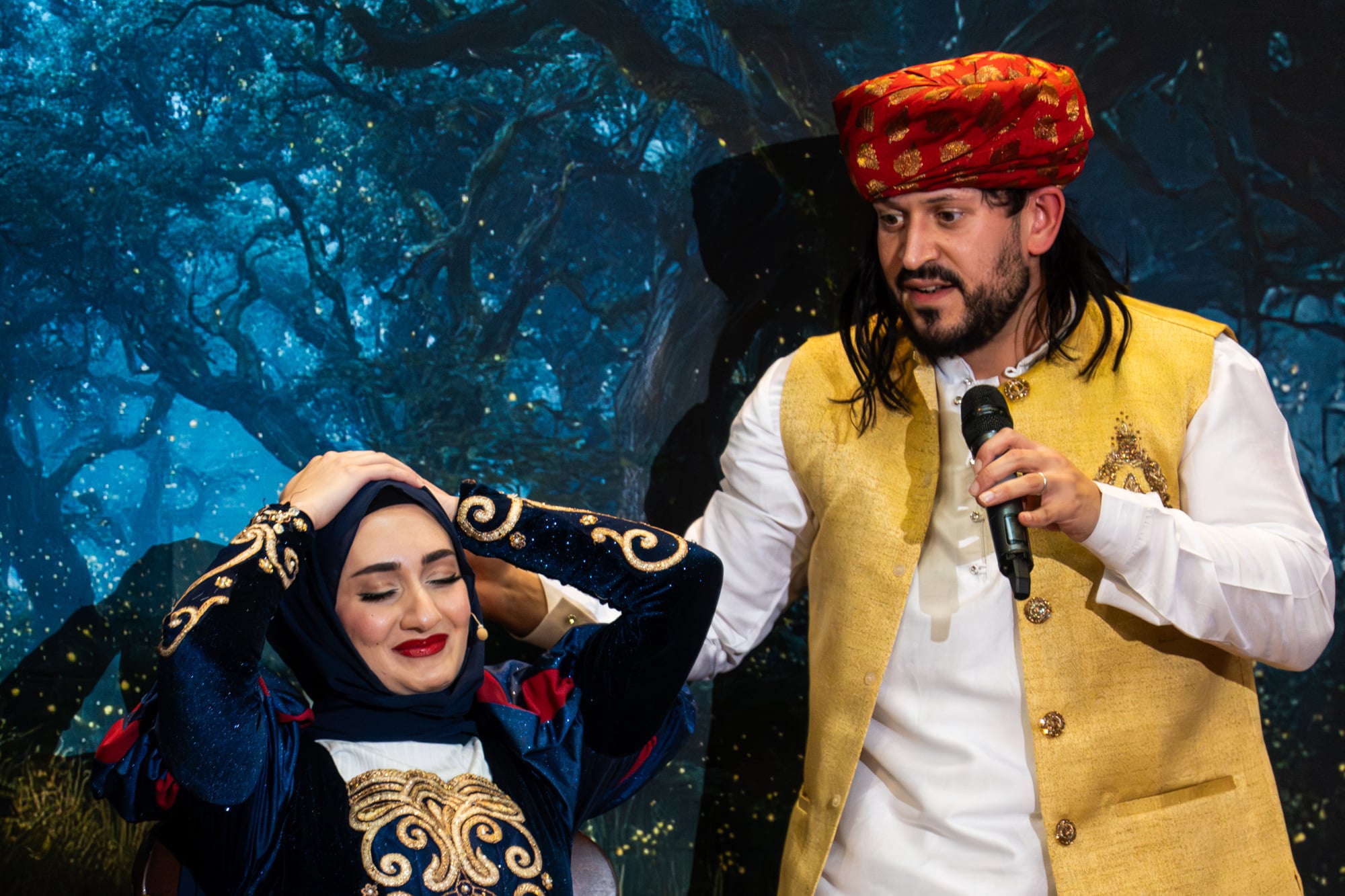
Lubna Saleh plays Snow Brown alongside show creator Abdullah Afzal. Top The cast of “Snow Brown and Her Seven Chachay” performs a contemporary pantomime that draws on multiple cultural traditions while retaining its familiar form.
Before she can finish, something clatters in from the wings. Mahmood the Mirror—walking, talking and apologetically late—stumbles into view.
Played by British Pakistani comedian Abdullah Afzal, Mahmood appears as a large silver frame strapped to his shoulders, his head poking through a sheet of reflective fabric.
"Sorry," he says. "I was doing my wudhu."
The London audience erupts. Children whoop with laughter. Adults snort in recognition of the familiar delay of ablutions before prayer. The spell is broken, and the rules are clear: This isn't Snow White as the German Brothers Grimm imagined in 1812 when they first published Sneewittchen.
This is "Snow Brown and Her Seven Chachay," chachay being the Urdu word for paternal uncles.
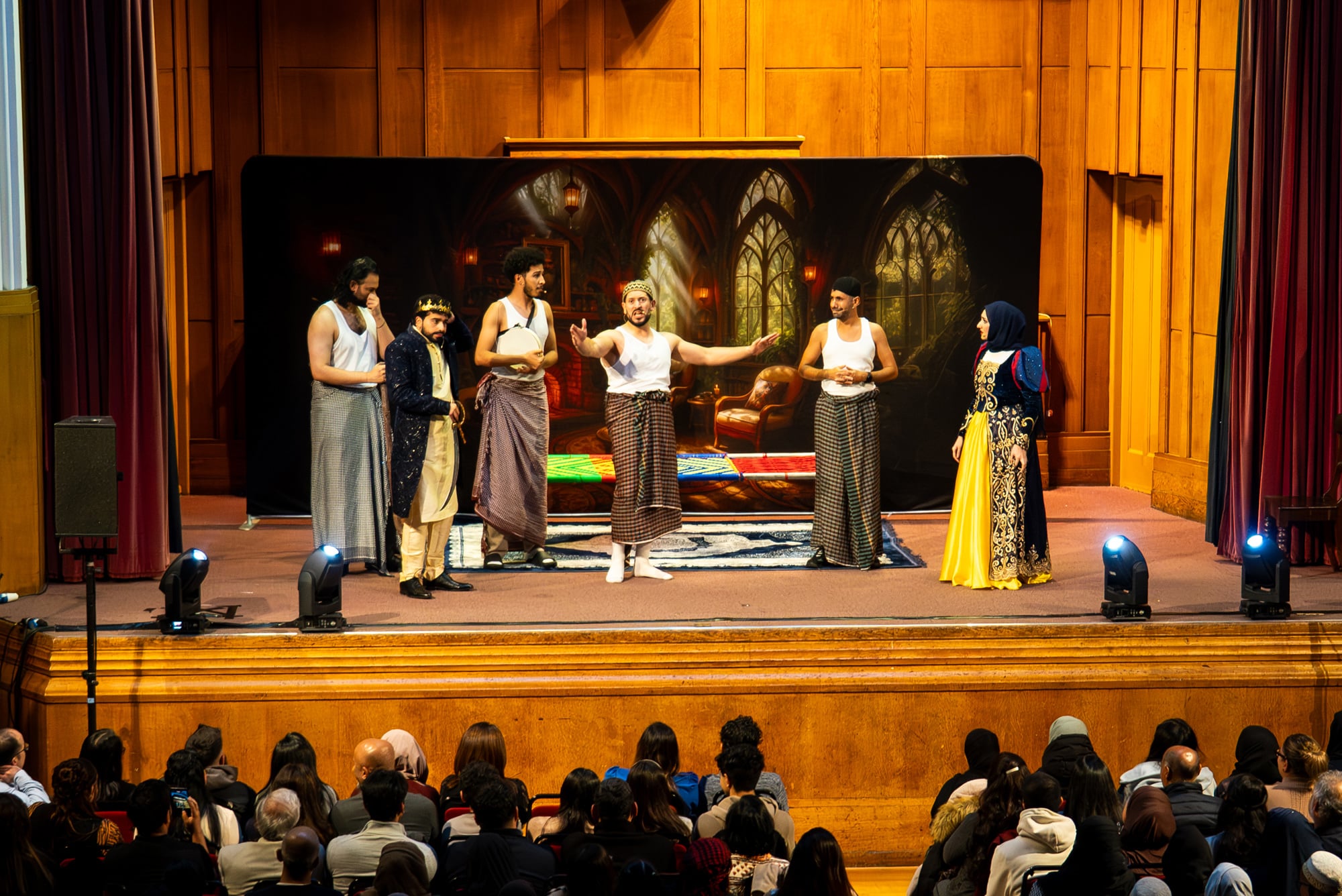
The story is instantly recognizable as a pantomime, a staged musical comedy based on a well-known fairy- or folktale: a virtuous heroine, an evil queen, a handsome prince and a chorus of comic guardians. In this version, however, there are four chachay rather than seven dwarves—loud, overbearing, affectionate, meddlesome figures, drawn from the everyday theater of extended family life.
An art form now closely associated with Great Britain, pantomime is in fact one of theater's most versatile iterations. From its origins as Italian street theater to Victorian spectacle and contemporary reinterpretation, pantomime has always thrived on adaptation. Built on familiar stories, exaggerated archetypes and audience participation, pantomime has long taken in new influences without losing its shape or familiar sense of play.
"Snow Brown," then, is not so much a reinvention of pantomime as it is a vivid example of how it functions: When actors are influenced by who is in the room, the production allows different cultural references to sit side by side and trusts audiences to recognize both the familiar and the new.
Afzal also plays Chacha Gusa, the perpetually angry uncle, stalking the stage in a white vest and checked sarong—a casual uniform familiar across many South Asian and Arab households.
Best known for his television work in the United Kingdom, Afzal describes the production as a "Muslim pantomime." It is not his first foray into the genre. In 2021, he created "Cinder'aliyah," a reworking of Cinderella that follows a young Pakistani girl trapped by her wicked stepmother and jealous stepsisters, Bushra and Shagufta. Like "Snow Brown," the production uses a familiar framework to tell a story that feels recognizable to its audience without claiming universality.
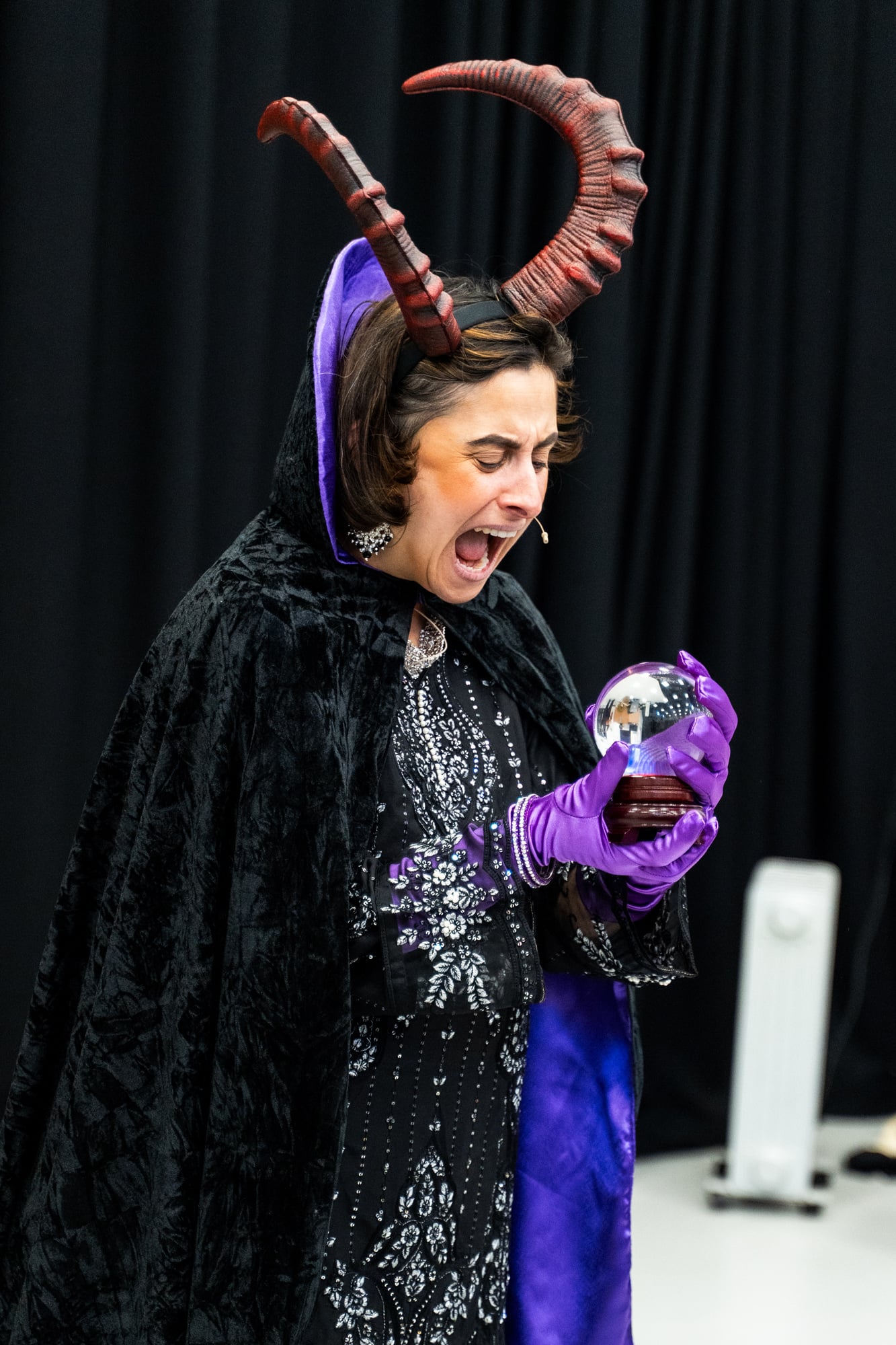
Zoe Iqbal brings theatrical flair and comic menace to the stage as the Evil Queen.
And Afzal is already thinking ahead: Next year's production, he says, will be "The Lion Sheikh"—a pantomimic riff on "The Lion King."
Across all of these productions, which he stages independently in cities throughout the UK, the aim is consistent. Afzal wants audiences to feel welcome, to know what kind of space they are entering. That reassurance matters.
But Afzal is equally clear about what his work is not. It does not claim to represent a single "British Muslim culture"—because, for him, no such thing exists.
The cast itself makes that obvious. Performers come from Pakistani, Moroccan, Kenyan-Indian, white British and North African backgrounds, each bringing different rhythms of speech, gesture and humor. The jokes lean heavily toward South Asian family life, not as a statement of dominance but as a reflection of audience reality. According to the 2021 England and Wales Census, two-thirds of Britain's 3.9 million Muslims identify as Asian, with Pakistani heritage forming the largest group.
"Originally, I wrote it quite South Asian," Afzal acknowledges. "That's who I knew would be coming. But as we brought more creatives in, the show opened up.
"We've got someone from Morocco, someone with Yemeni heritage, someone who … is white English, someone Indian Kenyan."
What then emerges onstage is not a neat portrait of identity but something closer to lived experience: overlapping references, shared laughter, moments of recognition that do not require explanation.
A form built to move
Pantomime's openness is not accidental. Its ancestry runs through commedia dell'arte, the improvised street theater that emerged in Italy in the mid-16th century. Traveling performers relied on stock characters, physical comedy and loose story frameworks to connect with audiences wherever they landed. The details shifted from town to town, but the structure endured.
As these traditions spread across Europe in the 17th and 18th centuries, they absorbed local dialects, gestures and jokes. By the time pantomime took root in Britain, it had become defined by borrowing. Folktales blended with spectacle; later, the music hall added songs, topical humor and direct address to the crowd.
By the Victorian era, pantomime had become exuberant, unruly and defiantly interactive. Booing villains, shouting warnings and laughing at exaggerated authority figures—these conventions were functional. Audience participation kept performances lively.
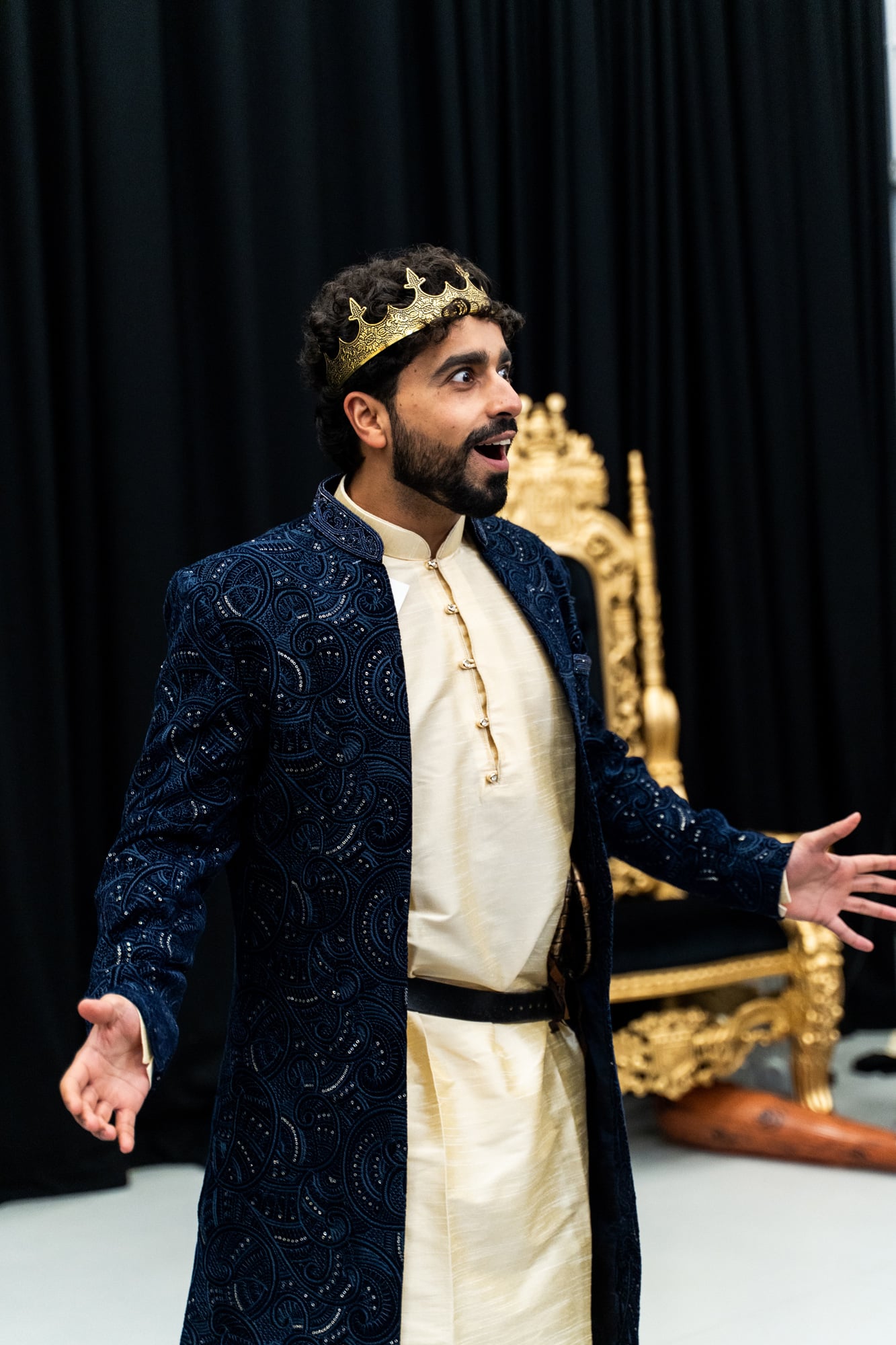
Nezar al-Ahdal is Prince Khalid in “Snow Brown and Her Seven Chachay,” where even a name becomes part of the joke.
The stories themselves were equally mobile. Many came from fairy tales that had already traveled widely.
As literary scholar Jack Zipes notes, what we now call fairy tales began as oral stories exchanged to amuse, instruct and confront urgent social realities.
"The essence of fairy tales, oral or literary," explains the author and professor emeritus at the United States' University of Minnesota, "can be found in the manner in which they speak truth to power."
Those tales survived, he argues, because they changed—absorbing new values, anxieties and voices while also retaining recognizable cores. Their progression, he suggests, "marks and measures the evolution of civilization."
Pantomime extends that tradition on stage. The narrative remains intact even as the surface shifts.
Finding familiarity in difference
The "Snow Brown" character of Prince Khalid, played by British Yemeni actor Nezar Al-Ahdal, shows how this works in practice. Introduced as Snow Brown's childhood friend and eventual suitor, Khalid arrives with swagger, sincerity and a running joke about pronunciation.
"Prince Kalid!" a character shouts.
"It's Khalid," Al-Ahdal fires back, exaggerating the guttural kh. "Kh, kh, kh."
The joke lands because the difference is real and needs no explanation.
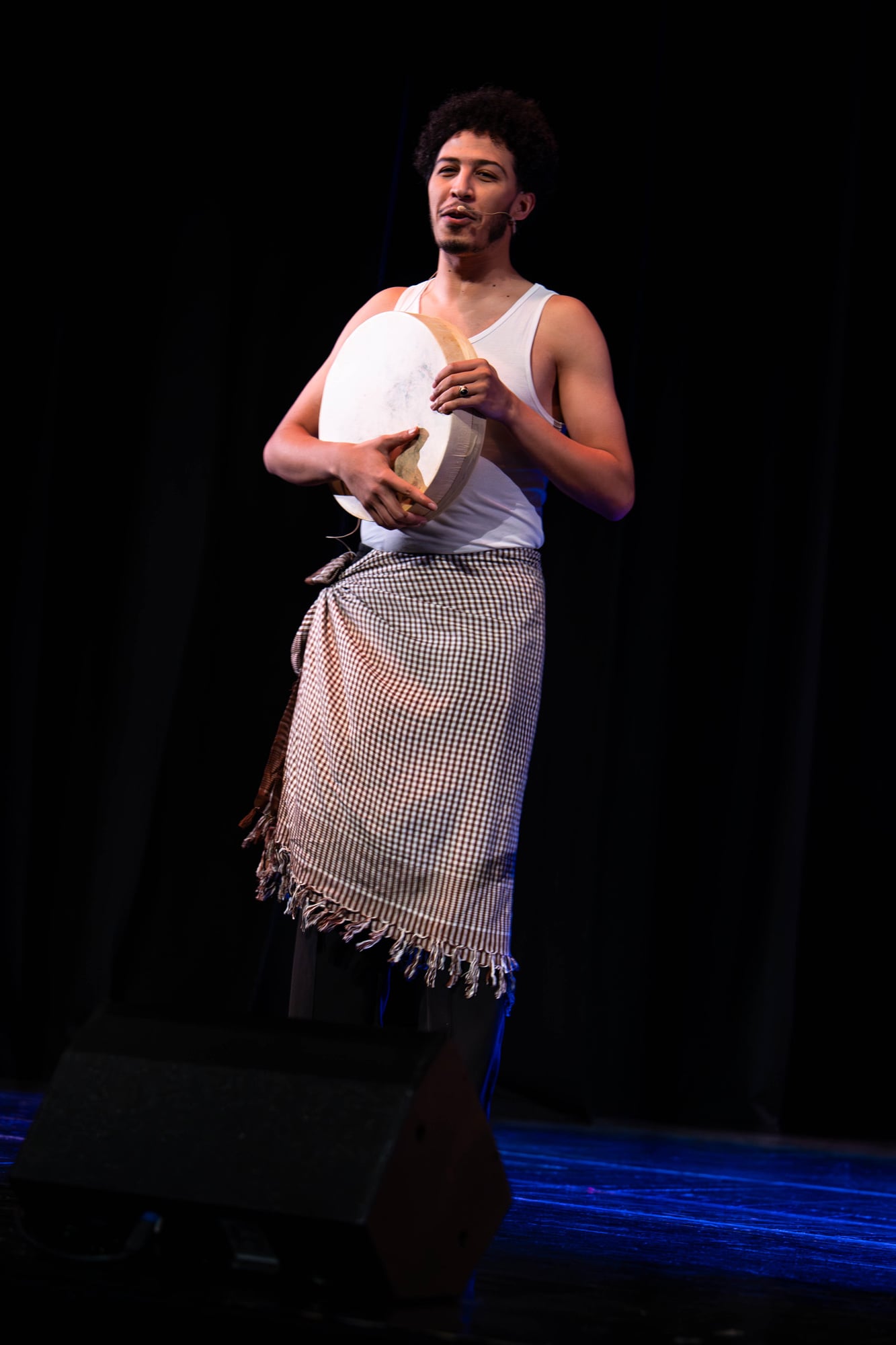
Moroccan Amazigh performer Hamza Bouzhar brings music and storytelling to the stage as Chacha Naat.
Born in Jeddah, Saudi Arabia, and raised in the north of England, Al-Ahdal grew up moving between languages and communities.
"Switching between languages in the script felt natural," he says. "I grew up around Pakistanis, so I understood the rhythms straight away."
Cultural overlap, he insists, is part of everyday life in Britain.
"We're all different, but we're also similar," he says. "Sometimes it's language that unites people more than religion."
For Moroccan Amazigh singer and actor Hamza Bouzhar, pantomime triggered a different kind of recognition. As Chacha Naat, the singing uncle, he steps onstage with a duf, a type of drum, in hand and breaks into soulful Arabic nasheeds, coaxing the audience into a sing-along.
"The show actually made me feel like I was back in my childhood," he says.
Amazigh storytelling traditions tend to be dramatic, rooted in land and history, while pantomime is louder, messier, more playful, he explains. But the physicality felt familiar.
"There's a feeling of spontaneous storytelling," Bouzhar explains. "There is trust. It feels like performing with family."
That ease carries onto the stage. "If we're enjoying ourselves, the audience feels it immediately," he adds.
Performance scholar Aqeel Abdulla argues that this sense of shared ownership explains pantomime's enduring pull. Theater already unfolds as a lived experience, he notes—audiences cannot pause or step outside the moment. Pantomime deepens that immersion by inviting audiences to act.
"They feel that they have a stake in the performance," says Abdulla, a lecturer in culture, media and creative industries at King's College London. "They can assist in making it a success."
Even small acts—like shouting "Look behind you!" or repeating a line of dialogue—matter.
"These contributions might sound minimal," he says, "but their emotional impact on the audience is great."
Participation, Abdulla continues, also allows pantomime to hold multiple cultural voices without reducing them to a single identity.
"The only real obstacle is prior judgment and attitude," he explains.
He points to "Aladdin," one of pantomime's most enduring staples, drawn from a Persian folktale set in an imagined Middle Eastern world.
"If this is accepted as a traditional pantomime," he asks, "why wouldn't any other cultural practice or identity be?"
Back onstage, the Evil Queen, played by Zoe Iqbal, returns. The audience boos and hisses on cue. The scene veers wildly off course, with even some of the actors struggling to suppress their laughter, before Afzal steps in to steer it back.
Improvisation is not an accident here; it is the method. Afzal rewrites constantly.
"The show you see today wasn't the show two weeks ago," he says. "The only boss I have is the audience."
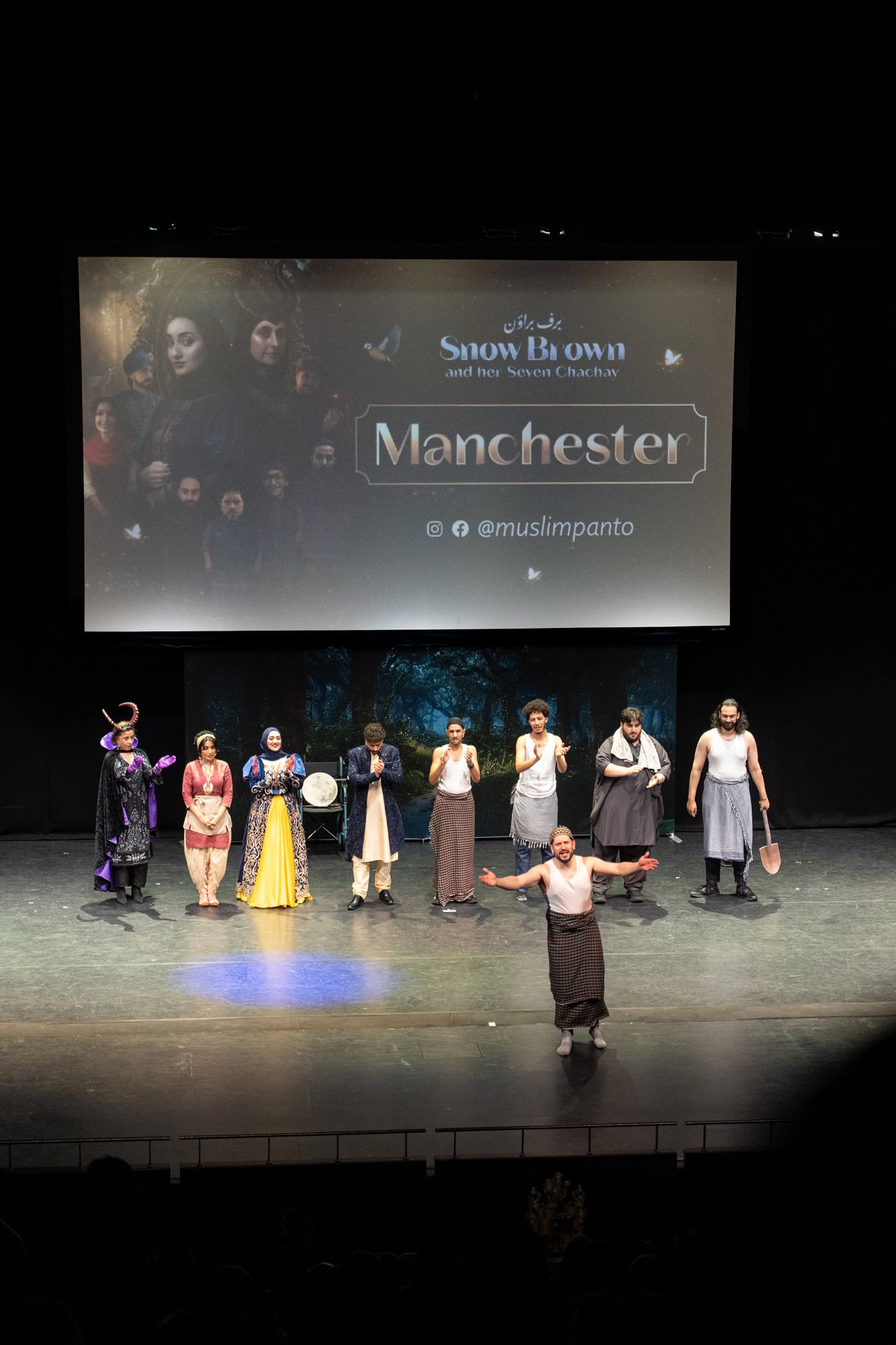
The cast of “Snow Brown and Her Seven Chachay” answers the curtain call.
This responsiveness, this willingness to listen as much as perform, is what has carried pantomime from Italian marketplaces to Victorian theaters to a London stage where a talking mirror named Mahmood apologizes for being late because he was washing for prayer.
Pantomime has never survived by standing still. It survives by adapting—again and again—always a step ahead yet always, somehow, still anchored in the past.

You may also be interested in...
Stratford to Jordan: Shakespeare’s Echoes of the Arab World
Arts
History
Shakespeare’s works are woven into the cultural fabric of the Arab world, but so, too, were his plays shaped in part by Islamic storytelling traditions and political realities of his day.
Nasreen ki Haveli: Pakistani Textile Museum Fulfills a Dream
Arts
Collector Nasreen Askari and her husband, Hasan, have turned their home into Pakistan’s first textile museum.
‘Home’: Arab American National Museum Celebrates 20th Anniversary
Arts
Arab American National Museum Director Diana Abouali says the facility—which is marking its 20th anniversary in 2025—in Dearborn, Michigan, has aimed to create a home for Arab Americans by preserving and presenting the history, culture and contributions of Arab immigrants as well as their native-born children and grandchildren.