The Hill Rice Connection: Trace Its African Roots and Examine How Communities Sustain Its Heritage
History
Geography
Anthropology
West Africa
Americas
Follow hill rice from its African roots and see how growers in North America preserve its history, identity and traditions.
The following activities and abridged text build off “Trace Moruga Hill Rice’s Cultural Path to Trinidad,” written by Ramin Ganeshram and photographed by Jean Paul Vellotti.
WARM UP
Scan the article’s photos and captions to predict its main idea.
IF YOU ONLY HAVE 15 MINUTES ...
Identify the cultural origins of Moruga Hill Rice and discuss how farmers blend traditional practices with modern techniques in its cultivation.
IF YOU ONLY HAVE 30 MINUTES ...
Explore the connections between rice and African American agricultural history and analyze how hill rice connects to African American agricultural history and examine the Gullah Geechee community’s efforts to preserve this heritage through cultivation and storytelling.
VISUAL ANALYSIS
Create a visual timeline that highlights major dates linking the history of enslavement to the spread, adaptation and cultivation of hill rice across the diaspora.
Directions: As you read, watch for highlighted vocabulary words. Use context clues to guess their meanings, then hover on each word to check if you’re right. After reading, answer the questions at the bottom of the page.
Trace Moruga Hill Rice’s Cultural Path to Trinidad
Rising every day before dawn, Trinidadian farmer Mark Forgenie prepares himself to go into the “hole,” a forested area in the town of Moruga where he grows a unique variety of West African rice. Red upland rice, “hill rice,” as it’s also known, came to the island two centuries ago with Forgenie’s ancestors, formerly enslaved people from the Carolinas in the American South. Today, Trinidad counts as one of the only places where the crop grows.
Forgenie grew up watching his grandmother cultivate hill rice on three or four small plots behind her house. She milled the gran herself and, along with tending five acres of other crops and hunting bushmeat, supported a family of 14. Studies he later commissioned found that same rice contains high amounts of fiber, protein and vitamin C—an unusual nutritional profile for any rice variety. “I remember being told that the hill rice alone was the most nutritious thing you could eat,” he says.

Mark Forgenie, a descendant of those men, has been growing the rice in the Moruga Hill region of Trinidad since he was a child. Today, he sells it internationally under the name Moruga Hill Rice. (Courtesy Mark Forgenie)
Forgenie recalls eating the rice his family grew and milled. Local lore holds that the grain carried curative properties. That belief pushed him to resume farming it and sell it internationally under the name Moruga Hill Rice in 2016. The crop reached mass produced once before, during World War II, when the British government used it to feed its troops.

Hill rice used to grow in the fields adjacent to the Cape Fear River, seen in the distance, in the Brunswick Town/Fort Anderson State Historic Site in Winnabow, North Carolina.
Beyond nutrition, hill rice offers another, less quantifiable value: It endures as a powerful piece of cultural heritage, linking today’s growers and eaters to the customs, foods, language and religion—including Islam—of their forebears.
British naval records state that Forgenie’s ancestors reached Trinidad in the high heat of August 1816, along with 700 British Colonial Marines. The climate and wetland landscape mirrored their former homes in the American South. Enslaved African people lived there as well. Although the slave trade to British colonies had been outlawed in 1807, slavery itself remained legal throughout the British Empire and persisted until emancipation in 1834.

In an albumen silver print mounted to a stereographic card, photographer O. Pierre Havens shows upland rice being grown and harvested in the 1880s in Savannah, Georgia. (The J. Paul Getty Museum)
According to the US National Park Service, Forgenie’s ancestors came from the Chesapeake in the Mid-Atlantic region down to the Carolinas and Georgia and the small barrier islands hugging the shoreline of America’s rice country. The largest among them, Cumberland Island, now serves as a designated national seashore inhabited only by wild horses, alligators and deer. Descendants enslaved Africans from this region continue to be called Gullah Geechee, a group whose dialects and culture have largely endured.
The Gullah men fought with the British during the War of 1812 between Great Britain and the US. In exchange, they received promises of freedom and land in Trinidad, then a British colony. They eventually settled in the village of Moruga in south Trinidad, carrying few belongings—among them tiny seeds of a unique red rice suited to dry land.

A historical map of rice planting in Savannah, Georgia, shows former rice fields along the Savannah River.
In Trinidad, people called the newcomers Merikins—pidgin for “Americans.” Like their forebears, captured and enslaved West Africans in the American South, they knew how to cultivate rice with uncommon skill. The variety they brought—”red bearded upland rice,” or “hill rice,”—helped sustain them, aided by the indigenous Warao people who showed them where to hunt and fish.
Upland Rice Growing Unchanged
Forgenie plants hill rice among trees on high ground, relying only on rainfall, much like upland farmers in parts of West Africa today.
The manner of growing upland rice differs dramatically from the old Carolina rice paddies, the vestiges of which still scar the low-country landscape. Satellite images on Google Earth reveal the hard angles of irrigation ditches cut by enslaved people.
Historian Jim McKee notes the first Carolina rice originated as a West African white variety that grew as far north as Brunswick Town, North Carolina. Over time, those original grains adapted to local soil and eventually developed into Carolina Gold, a prized variety that built vast fortunes for planters whose operations proved particularly lethal.
“Working in rice fields was deadly business,” McKee says. “There were alligators, malaria and yellow fever, but those dangers also kept white planters away. And that led to preservation of culture.”
Rice and the Slave Trade
Like all stories shaped by the Transatlantic Slave Trade, the story of rice in the Americas unfolds with complexity. A variety of West African rice (Oryza glaberrima) was first planted in South Carolina in 1685 on dry land. Later, greater yields were produced using a system of floodgates and canals built with African know-how.
Historical evidence shows that Portuguese slave traders observed rice growing prolifically in West Africa and purchased the grain to feed their ”human cargo.” In 1594, trader and writer André Álvares d’Almada described the inundated rice fields along the Guinea Coast, where farmers started the crop before moving to drier land. Inland, or “up land,” variants of wild rice (Oryza barthii) grew in forested regions—the same areas where Forgenie plants Moruga hill rice today. By 1678, enslaved people in Jamaica cultivated rice in their provision plots.
According to the International African American Museum in Charleston, people from Africa’s Rice Coast—modern-day Senegal, Gambia, Sierra Leone and Guinea—were forcibly transported to develop what would become the American Rice Coast from North Carolina to Florida in the 17th century.
Because rice plantation owners avoided the harsh environmental conditions, enslaved rice farmers often worked with little direct oversight. That distance aspects of West African culture and language to endure, as noted in Gullah Geechee Muslims in America, by Muhammad Fraser-Rahim. Their local dialect still echoes English vernaculars in the Caribbean, where African-descended people far outnumber European planters.
Enslavers encouraged enslaved people to grow rice in their subsistence gardens because rice offered a calorically dense staple, though they likely withheld valuable paddy land for themselves. The West African dryland variety met these constraints perfectly.
The story of Moruga hill rice even connects to Thomas Jefferson. He wrote that swamp rice, “sows life and death with almost equal hand,” prompting him to look for alternatives to West African dryland rice. In 1790, while serving as secretary of state in Philadelphia, Jefferson received a 30-gallon cask labeled “red rice.” He distributed the seeds to planter friends, including James Madison and, very likely, George Washington.
Even with Jefferson’s support, red upland rice never caught on commercially with Carolina planters. In 1808, Jefferson wrote that it had been “carried into the upper hilly parts of Georgia, it succeeded there perfectly, has spread over the country, and is now commonly cultivated: still however, for family use chiefly.”
In 1830, Anne Newport Royall, widely considered the first female American journalist, saw it growing in Alabama: “Upland rice grows here with success. It looks like oats, is sown in drills, and plowed and hoed like corn. It is of a reddish color when cooked. Every planter rears enough for his own use.” Within six years of the Merikin arrival in Trinidad, hill rice appeared there as well, alongside other distinctly African–South Carolinian foods.
Moruga Rice Today
In modern Gullah Geechee communities, direct ties to dryland rice may have faded, but the intertwined history of rice and slavery remains unmistakable. Across the Caribbean and North America, red upland rice offers a bridge among people who now live as strangers yet share a legacy woven deeply into their DNA. Some in the Gullah community of the Carolinas and Georgia also recognize the Merikins’ connection to both Africa and their own traditions, with red bearded upland rice threading seamlessly into the present.

Left: Gullah Geechee chieftess Queen Quet Marquetta L. Goodwine traveled to Trinidad to view the rice fields planted by Merikins—whose ancestors were captured from West Africa's Rice Coast and brought to the American South before being freed and arriving in Trinidad. Right: Roosevelt Brownlee, a Gullah Geechee descendant and soul-food chef from Savannah, Georgia, is a local advocate of hill rice dishes.
Chaz Brown, a chef with both Southern and Merikin roots, now prioritizes efforts to re-evangelize Moruga hill rice in America and preserve its African diasporic heritage.
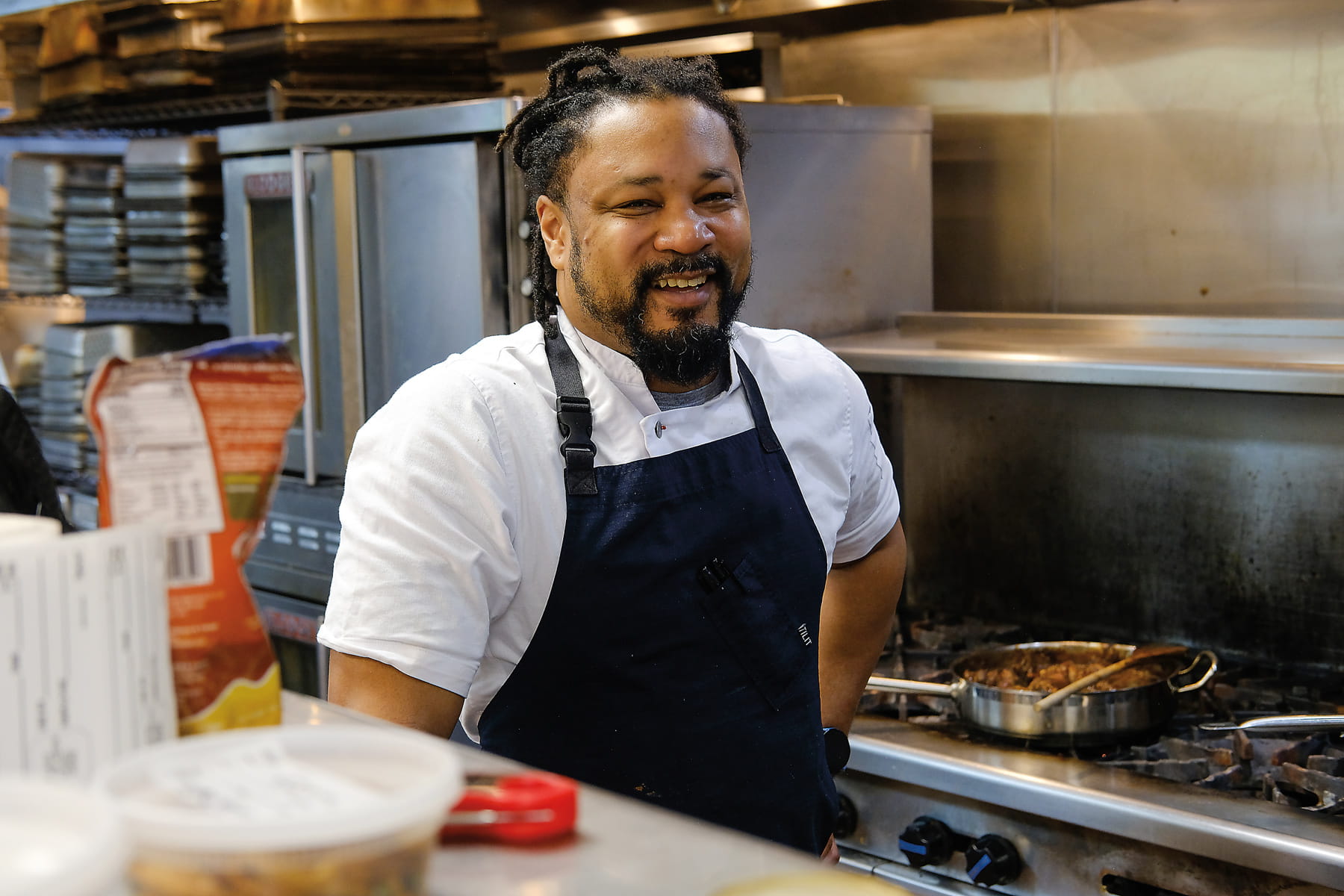
American chef Chaz Brown of Philadelphia shares the story of hill rice through his Afro Caribbean cuisine, including in his preparation with beef oxtails.
Back in Trinidad, hill rice continues to gain popularity—even beyond the Merikin community. But for those linked directly to the original Gullah Geechee men, the impulse to grow and eat these precious grains runs deeper. Hill rice offers a connection to the African diaspora and serves as a cultural signifier with meaning that endures across generations.
Other lessons
Cairo Across America: Interpreting Geography, History and the Meaning of a Name
Geography
History
Uncover how towns named Cairo turned ancient inspiration into uniquely American stories of aspiration, identity, and change.
Tracing the History and Geography of Portuguese Tilemaking
Geography
Architecture
Europe
Analyze how culture and technology have changed the ways tiles have been made in Portugal for over 500 years.
Teaching the Heritage of Place Through Storytelling
History
Geography
Southeast Asia
George Town’s restoration shows how storytelling can do more than just preserve historic buildings—it keeps memory, identity and environmental awareness alive.